SAEDNEWS: Stephen Hawking, the world-renowned genius physicist, passed away after years of battling ALS. In this article, we explore the cause of his death, his biography and the reason behind his paralysis.
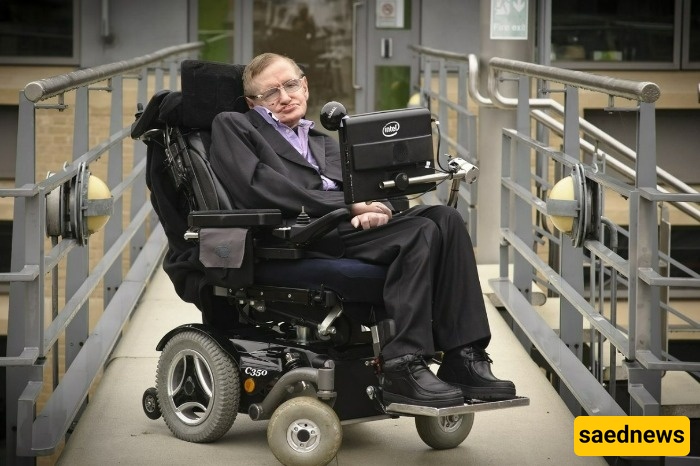
According to SAEDNEWS, On March 14, 2018, the scientific world witnessed the passing of Stephen Hawking, the renowned theoretical physicist who, despite severe physical limitations, transformed our understanding of cosmology and pushed the boundaries of human knowledge. This section examines the final years of his life, the cause of Stephen Hawking’s death, and the scientific community’s farewell to this extraordinary genius.
Stephen Hawking died on March 14, 2018 at his home in Cambridge at the age of 76.
His family announced the sad news in a heartfelt statement, saying:
“With deep sadness, we announce that our beloved father passed away today. He was a great researcher and an extraordinary man whose legacy will live on for many years to come.”
Although the official cause of death was reported as old age, ALS played a significant role in the gradual weakening of his body. The disease causes the loss of muscle control and can eventually affect the function of vital organs.
Despite his challenging physical condition, Hawking remained actively involved in research, writing, and public lectures until the final years of his life.
Stephen William Hawking was a British theoretical physicist, cosmologist, and author who was born on January 8, 1942, in Oxford, England, and died on March 14, 2018, in Cambridge. He served as the director of research at the Centre for Theoretical Cosmology at the University of Cambridge and held the prestigious Lucasian Chair of Mathematics from 1979 to 2009, a position once held by Isaac Newton.
Stephen Hawking was one of the most influential scientific figures of the 20th century. Despite his severe physical disability, his groundbreaking research on cosmology and black holes expanded the boundaries of human understanding of the universe.

The rare neurological disease known as amyotrophic lateral sclerosis (ALS) was the main cause of Stephen Hawking’s paralysis. He first noticed symptoms while he was a student at Oxford University, when he was only 21 years old. After experiencing muscle weakness and frequent falls, he visited a doctor.
Medical tests revealed that he had ALS, a disease that gradually destroys motor nerve cells in the brain and spinal cord, eventually leading to complete paralysis.
At the time, doctors predicted that Hawking would not live for more than two years. However, against all expectations, he survived with the disease for more than five decades and became one of the most influential scientists of his era.
Due to paralysis of his muscles and the loss of his ability to speak, Hawking could no longer communicate through natural speech. He used a computerized speech-generating device to express himself. His distinctive robotic voice later became an important part of his cultural identity, and it was recognized as the iconic “voice of Stephen Hawking” in films, documentaries, and even popular television series.