SAEDNEWS: Stainless steel wire mesh, also known as stainless steel mesh, is a strong and durable network of stainless steel wires. Thanks to its excellent strength, long service life, and high resistance to corrosion, it is widely used in industrial applications, construction, filtration systems, protection, and architectural projects.

According to Saednews, Stainless steel mesh, also known as stainless steel wire mesh or stainless mesh, is one of the most widely used and strategically important metal products in modern industries. It is manufactured by weaving or interconnecting wires made from stainless steel alloys. Thanks to its unique combination of strength, durability, and exceptional corrosion resistance, stainless steel mesh has become an important material in industrial, construction, and architectural applications.
Its open structure allows air, liquids, or light to pass through, making it an ideal choice for filtration systems, protective barriers, screening applications, and decorative elements.
Stainless steel mesh is essentially a network of stainless steel wires joined together using different weaving methods to create a strong surface with uniform openings, commonly referred to as mesh openings or apertures.
The primary reason for its excellent resistance to rust and corrosion is the presence of chromium in stainless steel. Chromium forms a thin, invisible layer of chromium oxide on the surface of the metal, protecting it from corrosive elements and helping the material maintain its durability over time.
Stainless steel mesh is manufactured in a wide range of designs and grades, with each type intended for specific applications. Choosing the appropriate mesh depends mainly on its weaving pattern and alloy grade.

Plain weave is the most common and simplest type of stainless steel mesh. In this pattern, each warp wire passes alternately over and under the weft wires. The result is a symmetrical and strong mesh with a high number of openings per unit area.
In a twill weave, each warp wire passes over two weft wires and then under the next two. This repeating pattern creates diagonal lines across the mesh and provides greater flexibility and strength compared with plain weave.
Dutch weave uses thinner weft wires arranged at a higher density to create a highly compact mesh with very small openings. This structure makes it particularly suitable for precision filtration. Common variations include plain Dutch weave and twill Dutch weave.
Grade 304, also commonly known as non-magnetic stainless steel mesh, is one of the most widely used and cost-effective types of stainless steel mesh. With approximately 18% chromium and 8% nickel, it offers very good corrosion resistance and is suitable for general-purpose applications, filtration, food processing, and construction.
Grade 316 contains molybdenum, in addition to chromium and nickel, giving it greater resistance to corrosion, particularly in acidic, chloride-rich, and marine environments.
Often referred to as acid-resistant stainless steel mesh, 316 mesh is an excellent choice for demanding applications in the chemical, marine, pharmaceutical, and food industries.
Heat-resistant stainless steel meshes are manufactured from specialized grades such as 309, 310, 314, and others. They are designed to withstand extremely high temperatures, in some applications exceeding 1,000°C.
These meshes are commonly used in ceramic manufacturing, industrial furnaces, kilns, and high-temperature equipment.
This type of mesh is manufactured using high-carbon grades to provide increased resistance to wear and friction. It is commonly used in mining operations, screening equipment, and crushers where the mesh is exposed to demanding mechanical conditions.
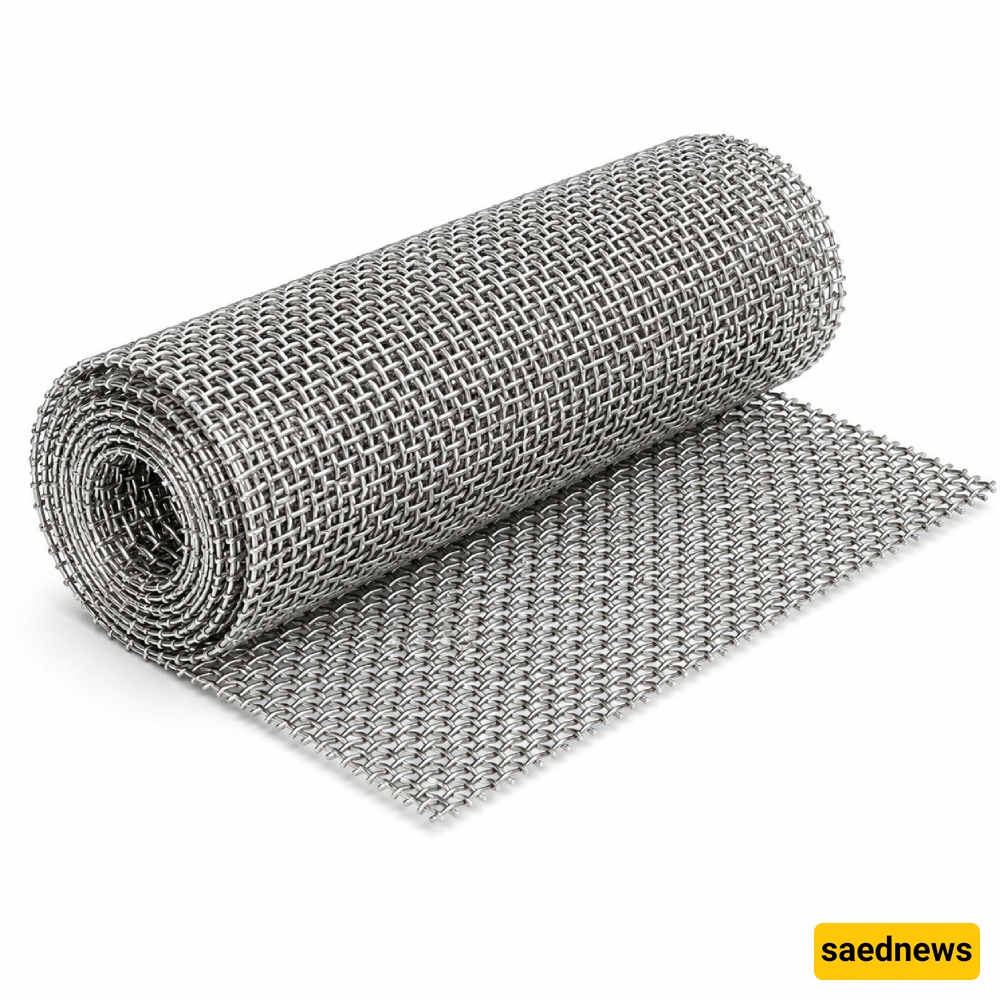
Stainless steel wire mesh with a plain weave and uniform openings
Because of its combination of strength, corrosion resistance, durability, and versatility, stainless steel mesh is used across a wide range of industries.
Common applications include:
Industrial and precision filtration
Food processing and food-production equipment
Chemical and pharmaceutical industries
Mining and mineral processing
Screening and separation systems
Construction and building projects
Protective guards and safety barriers
Furnace and high-temperature equipment
Marine applications
Architectural and interior design
Decorative screens and partitions
Air and liquid filtration systems
Selecting the right stainless steel mesh starts with identifying the technical requirements of the application. Several factors should be considered, including alloy grade, dimensions, wire diameter, mesh count, weave pattern, and roll size.
Choosing the correct alloy is one of the most important steps.
For general environments and food-related applications, 304 stainless steel mesh is usually a practical and economical option.
For highly corrosive environments, exposure to seawater, or contact with aggressive chemicals, 316 stainless steel mesh is generally more appropriate.

For applications involving extremely high temperatures, a suitable heat-resistant stainless steel grade should be selected.
Two important specifications are the mesh count and wire diameter.
Mesh count indicates the number of openings within a given length, while wire diameter determines the thickness and contributes to the overall strength of the mesh.
Together, these specifications determine the size of the openings, filtration performance, and mechanical strength of the finished product. A mesh-to-millimeter or mesh-to-micron conversion chart can be particularly useful when selecting the required opening size.
The weave pattern should be selected according to the intended application. Options include plain weave, twill weave, Dutch weave, and other specialized patterns.
It is also important to consider the width and length of the roll. Common roll widths include 1 meter, 1.2 meters, and 1.5 meters, while 30-meter roll lengths are also widely available.
Corrosion- and heat-resistant stainless steel mesh roll
The quality and authenticity of stainless steel mesh can have a significant impact on its performance and service life.
A reliable supplier should be able to provide stainless steel mesh sourced from established international manufacturers and offer supporting documentation such as material test certificates, chemical composition analysis, and product warranties where applicable.
A professional supplier with technical expertise can help determine the most suitable grade, mesh count, wire diameter, and weave based on the specific operating conditions of a project.
Experienced suppliers and importers often maintain a broad inventory of stainless steel mesh products, allowing them to handle both standard requirements and specialized orders.
Purchasing directly through an established importer or supplier can reduce unnecessary intermediaries and may result in more competitive final pricing, particularly for larger or recurring orders.
Stainless steel mesh is a versatile material that combines corrosion resistance, mechanical strength, durability, and flexibility in a wide range of industrial and architectural applications. Understanding the differences between weave patterns and stainless steel grades such as 304, 316, and heat-resistant alloys makes it easier to select a mesh that matches the operating environment.
Before purchasing, it is important to evaluate the required opening size, wire diameter, mesh count, weave pattern, alloy grade, roll dimensions, and required certifications. Choosing the right specifications from the beginning can improve performance, extend service life, and prevent unnecessary replacement costs.