SAEDNEWS: Jupiter’s icy moon Europa contains a vast ocean beneath its frozen crust, making it one of the most intriguing places in the search for extraterrestrial life. But a new study suggests that water from that deep ocean may have enormous difficulty reaching shallow reservoirs near the surface.
According to SaedNews: Jupiter’s moon Europa has long been one of the most tantalizing destinations in the search for life beyond Earth. Beneath its frozen exterior lies a planet-sized mystery: a global ocean containing more than twice as much water as all of Earth’s oceans combined.
That sounds like an ideal place to look for biological activity. But a new study suggests that one of the most tempting shortcuts for investigating that hidden ocean may not work as scientists once expected.
NASA’s Europa Clipper mission is currently on a 1.8-billion-mile journey toward Jupiter. Its central goal is to investigate whether Europa has conditions capable of supporting life. During 49 planned close flybys of the icy moon, the spacecraft will examine its surface and surrounding environment in search of evidence that could reveal what is happening beneath the ice.
Scientists already know about Europa’s subsurface ocean thanks to information gathered by earlier missions, including Voyager and Galileo. The challenge is that this enormous body of water is buried beneath a thick ice shell, making direct investigation extraordinarily difficult.
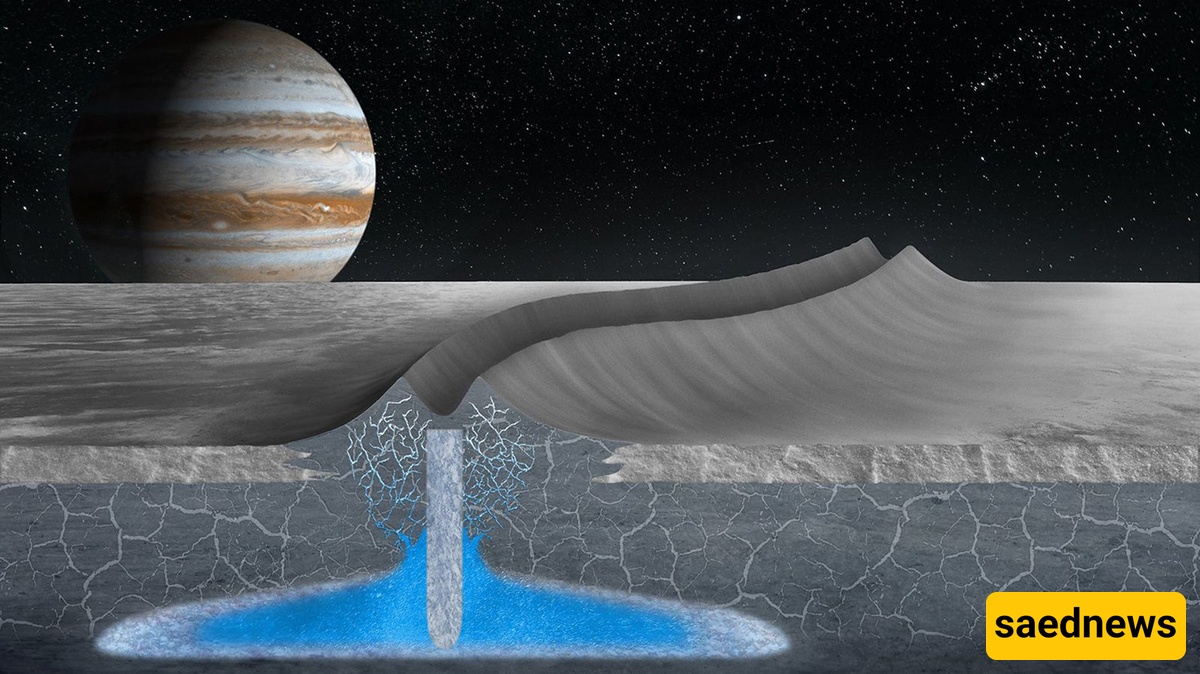
One possibility has attracted particular interest: water from the underground ocean could potentially rise through fractures in the ice and collect in shallower reservoirs closer to the surface. If such reservoirs were directly connected to the ocean below, spacecraft passing Europa could have a much easier opportunity to study material associated with that hidden water.
The new research, led by planetary scientist Lujendra Ojha of Rutgers University, questions whether that process can actually happen as easily as some earlier models suggested.
The researchers used computer simulations to model the physics of water moving through cracks in Europa’s ice. Their results indicate that water rising from the deep ocean would not necessarily travel upward in a smooth, steady stream.
Instead, the movement could become highly turbulent.
As liquid water rises through fractures, it would repeatedly collide with the cold walls of the ice. That interaction could cause the water to lose heat rapidly. According to the study, the water could become supercooled—remaining liquid below its standard freezing point—before eventually producing tiny ice crystals.
Those crystals could accumulate rapidly inside the fractures, effectively choking off the pathways that the water would need to continue moving toward the surface.
Ojha described the central problem as the difficulty of explaining how water could travel from Europa’s deep ocean through the ice shell without freezing along the way. The new simulations, according to the researchers, challenge the idea that a simple upward flow could provide a direct connection between the ocean and shallow areas.
The study does not mean that water cannot exist closer to Europa’s surface. Instead, it raises an important question about where that water comes from.
Previous models had treated fractures as potential routes through which ocean water could move upward relatively smoothly. The new simulations suggest that real-world fluid dynamics may make such a journey much more chaotic and far less efficient.
The researchers found that wider fractures could theoretically carry greater amounts of water. However, preventing the liquid from freezing completely would require channels to be unusually long or extremely numerous.
That distinction could become especially important once spacecraft begin returning detailed observations.
Europa Clipper is expected to reach Jupiter in April 2030. The European Space Agency’s JUICE mission is scheduled to arrive in July 2031 to study Jupiter and three of its ocean-bearing moons: Europa, Ganymede and Callisto.
If either mission detects shallow liquid reservoirs or similar features on Europa, scientists may need to be cautious about interpreting them as direct samples or extensions of the deep ocean.
The new research suggests that such shallow features could instead be produced by localized melting within Europa’s ice shell itself. In other words, finding liquid water near the surface would be fascinating, but it would not automatically demonstrate that material had traveled directly upward from the buried ocean.
That could change how scientists interpret one of the most important pieces of evidence returned by future missions.
The implications go beyond simply finding water. If researchers are trying to identify environments that might preserve chemical clues associated with life, knowing how water moves through the ice is crucial. A shallow reservoir created locally inside the ice could have a very different history from material originating in Europa’s deep ocean.
For the scientists planning and analyzing these missions, that distinction could help determine where the most promising evidence should be sought.
Europa remains an extraordinary target precisely because so much of its story is hidden beneath ice. Its enormous subsurface ocean makes it one of the Solar System’s most compelling places for investigating potentially habitable environments, but the new study suggests that reaching that ocean indirectly may be more difficult than expected.
The mystery, therefore, is not simply whether Europa has water—it clearly does. The bigger question is how that water moves, where it can reach, and whether material from the hidden ocean can leave a detectable trace near the surface.
As Europa Clipper and JUICE prepare to investigate Jupiter’s icy worlds, scientists may have to look at every apparent clue with greater care. A patch of liquid water on Europa could be a tantalizing discovery, but understanding its origin may be just as important as finding it.
The study, published in Nature Astronomy, offers a reminder that the search for life on another world may depend not only on discovering the right ingredients, but also on understanding the complicated journey those ingredients take through an alien environment.