SAEDNEWS: In his latest interview, Netanyahu rejected J.D. Vance's claim that "Trump is Israel's only ally," while highlighting his international ties. The interview also included a surprising claim that some Lebanese had sought annexation to Israel.
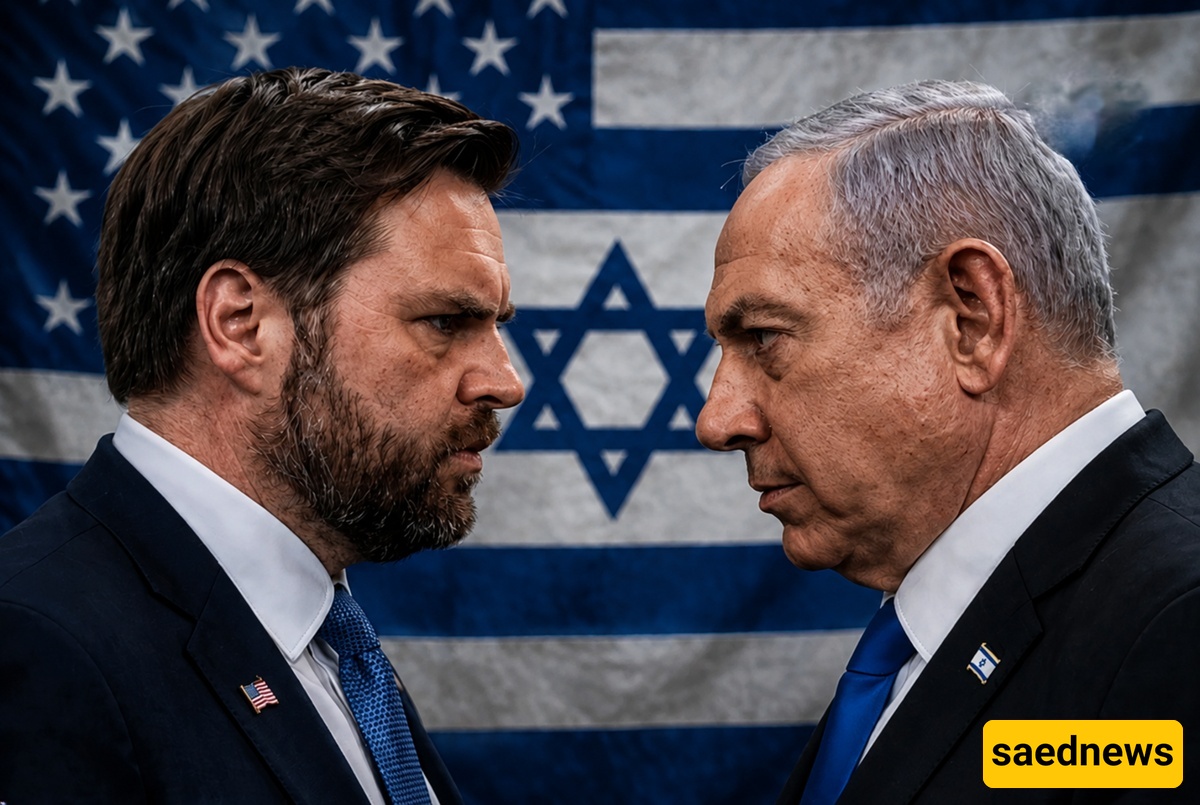
According to Saednews political reports, Israeli Prime Minister Benjamin Netanyahu, while emphasizing the uniquely close relationship between Israel and the United States, questioned the claim that U.S. President Donald Trump is the only world leader who continues to support Israel.
Last month, U.S. Vice President J.D. Vance criticized Netanyahu over his response to a U.S.-Iran memorandum aimed at ending the recent conflict. Vance stated that Donald Trump was "the only head of government in the world who currently sympathizes with Israel," adding that if he were part of Israel's government, he would not attack the country's only remaining powerful ally.
In response, Netanyahu acknowledged that Trump is "the greatest friend Israel has ever had in the White House," but insisted that he is far from Israel's only friend.
Pointing to Israel's international relationships, Netanyahu noted that India, with a population of 1.4 billion people, strongly supports Israel. He added that many other countries also maintain friendly ties with Israel. Highlighting Israel's technological capabilities, he said the country ranks among the world's leaders in cybersecurity and innovation, arguing that Israel enjoys broader international support than critics suggest.
During the interview, Netanyahu stated that he and President Trump share the same strategic objectives regarding Iran.
He said both leaders want Iran to abandon its nuclear weapons program, eliminate its stockpile of enriched nuclear material, and dismantle its uranium enrichment facilities. According to Netanyahu, these goals remain central regardless of the diplomatic path chosen.
He explained that Trump believes negotiations, combined with sustained pressure following recent military exchanges, could achieve these objectives. Netanyahu expressed hope that diplomatic efforts would succeed but declared that, whether through an agreement or otherwise, Iran would not obtain nuclear weapons while he remains Israel's prime minister.
The interview also addressed public disagreements between Washington and Jerusalem over the recent U.S.-Iran memorandum intended to end the latest conflict.
Israel was not a party to the agreement and did not participate in the negotiations concerning Iran's nuclear program. Nevertheless, Israel was asked to halt its military operations against Iran. Israeli officials have publicly expressed dissatisfaction with several aspects of the arrangement, and Netanyahu recently announced plans to send a delegation to Washington for further discussions.
Despite these differences, Netanyahu maintained that he and Trump remain aligned on the broader strategic approach toward Iran.
Following several public remarks by President Trump criticizing Netanyahu over issues related to Iran and Hezbollah, Netanyahu dismissed suggestions of a serious rift between the two leaders.
Speaking to Fox News, he downplayed the significance of those comments and emphasized that the United States has no greater ally than Israel, just as Israel has no greater ally than the United States.
Netanyahu acknowledged concerns about declining support for Israel among younger Americans, particularly within Republican circles.
He argued that misinformation circulating on social media has contributed to changing public attitudes. According to Netanyahu, coordinated online campaigns by certain countries use automated networks to spread anti-American and anti-Israel content aimed primarily at younger audiences.
Despite these concerns, he expressed confidence that the long-term U.S.-Israel relationship would remain strong because it is based on both shared interests and shared democratic values.
Netanyahu also claimed that Christian communities in Lebanon have sought Israel's protection and that some Christian villages have even requested annexation by Israel. He further asserted that Israel protects Christian communities across the Middle East from Hezbollah.
He later extended this claim, stating that members of Lebanon's Druze community, Sunni Muslims, and a number of Shiite Muslims had also sought Israeli protection.
However, Netanyahu did not provide evidence to support these assertions.
Critics have pointed to Israel's military operations in Lebanon, including reports of damage to churches and Christian religious sites, as conflicting with Netanyahu's characterization of Israel as a protector of Lebanese Christians.
They also note that Netanyahu made these remarks shortly after Israeli National Security Minister Itamar Ben Gvir posted on social media following the deaths of four Israeli soldiers in southern Lebanon, saying that "all of Lebanon should burn."
In addition, Netanyahu—who faces arrest warrants from the International Criminal Court over alleged war crimes and crimes against humanity related to the conflict in Gaza—did not present evidence that Lebanese Christian villages had requested annexation or that Hezbollah had specifically targeted Christian communities in the manner he described.
The interview has renewed debate over Israel's diplomatic position, its relationship with the United States, and the implications of recent U.S.-Iran diplomatic efforts for regional politics.