SAEDNEWS: The History of Lithographic Printing and Its Beginnings in Iran
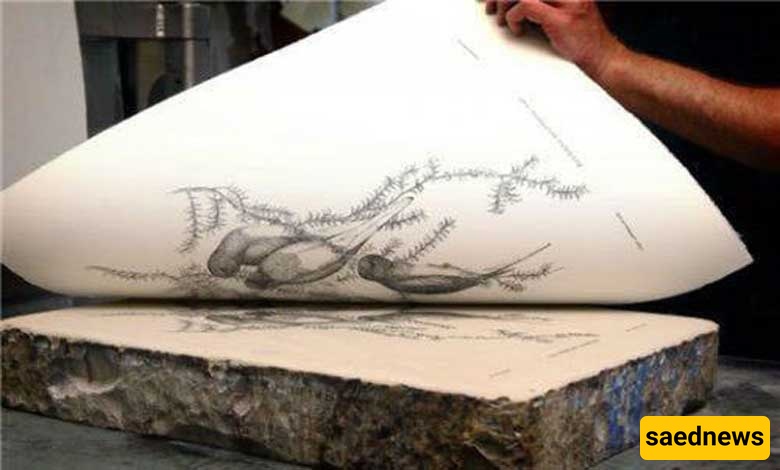
According to Saednews, To better understand lithographic printing and its significance, it is useful to begin with a brief history of the printing industry.
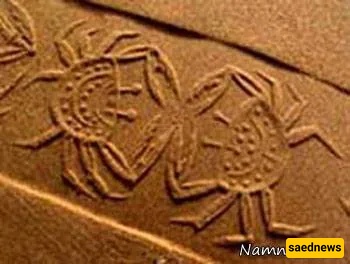
The invention of printing actually dates back centuries before Gutenberg, whose name is traditionally recorded in history as the inventor of printing. Several thousand years before Christ, the Mesopotamians stamped symbols onto clay tablets. The use of movable type also began in China between 1051 and 1058. The inventor of this type was a man named Bi Sheng, and the characters were made from clay. Later, wooden and metal movable type were also developed, although wooden type became more widely used.
In 1440, Gutenberg apparently invented movable type independently, without knowledge of the Chinese experiments. He used a separate piece of type for each letter of the alphabet. Although the Chinese had invented movable type, Gutenberg, who was a goldsmith by profession, developed a suitable alloy of lead and antimony for casting the letters. He carefully adjusted the proportions of the two metals so that the type would be neither too hard nor too soft. He also developed a suitable printing-ink formula and, by overcoming various technical difficulties, made the printing process practical and workable.
Lithographic printing was invented before the end of the eighteenth century by Alois Senefelder. It was later introduced into Iran from Russia and became widespread in major Iranian cities from around 1824 (1240 AH). Approximately 20 years after Gutenberg's initial efforts in printing, the use of raised surfaces for printing had become established on a limited scale in cities such as Venice, Florence, Paris, and Lyon. However, Gutenberg's printing press was extremely expensive and therefore accessible mainly to wealthy people, so it did not receive widespread acceptance for a long time. About 300 years after Gutenberg's invention, the German playwright Alois Senefelder invented lithography in 1796.
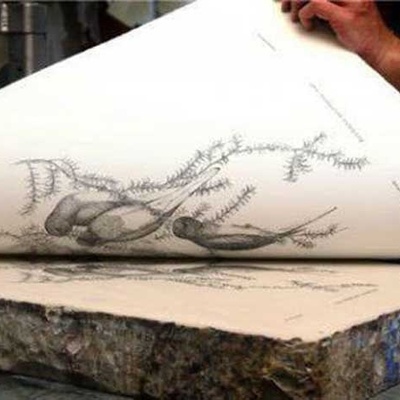
A stone on which text or an image had been produced using this method could generally provide satisfactory printing for approximately 750 copies. After that, the image on the stone could no longer be used effectively for printing.
Although there are several accounts concerning the introduction of lithographic printing to Iran, it appears that lithography was first established in Tabriz by Mirza Saleh Shirazi. Mirza Saleh had traveled to Europe on behalf of the Iranian government to learn modern arts and technologies. Upon his return, he brought a lithographic printing press to Tabriz and put it into operation in 1825 (1250 AH).
The first modern printing house using movable metal type was established in Tabriz during the reign of Abbas Mirza. The first book printed there was Risala-ye Jihadiya, written by Isa ibn Hossein Qa'em-Maqam Farahani. It was first printed in 1817 (1233 AH) and a second edition appeared in 1818 (1234 AH). Letterpress printing remained in use in Iran until 1852 (1269 AH), after which it was largely replaced by lithography for nearly a century.
Lithographic printing had been invented by Alois Senefelder before the end of the eighteenth century and was introduced into Iran from Russia. From around 1824 (1240 AH), it became widespread in the major cities of Iran.
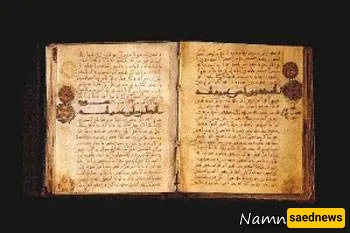
The first lithographically printed book in Iran was a Qur'an printed at the Dar al-Taba'a Dar al-Saltaneh printing house in Tabriz in 1832–1833 (1248–1249 AH). Two important factors led to lithography replacing letterpress printing in Iran.
First, lithography required simpler and less expensive equipment than letterpress printing, and the equipment was also easier and safer to maintain. Second, the style of writing and the appearance of texts in lithographically printed books were much more compatible with the cultural and social characteristics of Iranian society than the standardized metal type used in letterpress printing.
Lithographic printing houses were established in Tehran within a short period, followed by Isfahan and then other Iranian cities. For more than 50 years, lithography was the principal method of printing in Iran. Until the late Qajar period, most materials printed in Iran were produced using lithographic techniques.
Letterpress printing had actually been introduced about eight years before lithography reached Iran. However, because of its high cost and the labor required, it was largely abandoned after the arrival of lithography. Toward the end of the Qajar period, metal type and letterpress printing once again became widely used.
One of the distinctive features of lithography that elevated its artistic importance was the possibility of reproducing Nastaliq calligraphy and illustrations. The technique was used extensively for newspapers and books. Master Mirza Mohammad Reza Kalhor was one of the prominent calligraphers associated with lithographically printed newspapers during the Qajar period. Among the notable illustrators were Abu Torab Ghaffari, Abol-Hassan Ghaffari, known as Sani al-Mulk, and Musa Momayez.
1. To print Persian letters and words, which are written from right to left, the text and illustrations were first written on special transfer paper. The paper was then placed on the stone so that the letters and words were transferred onto the stone in reverse, from left to right. During printing, they would consequently appear in their correct orientation.
2. A thin layer of nitric acid was applied over the entire surface of the stone.
3. The stone was treated with acid, gum, and water until, when ink was applied, only the areas containing the greasy drawing or writing would accept the ink. The remaining areas would repel the ink and leave no mark.
4. A sheet of paper was placed over the printing stone and pressed against it, transferring the inked design onto the paper.
The first lithographically printed book containing illustrations was Layli o Majnun by Maktabi Shirazi, printed in Tabriz in 1843 (1259 AH). For two years after its publication, no other illustrated book was published. From around 1846 (1263 AH), however, the printing of illustrated books became increasingly common.
The first Iranian artist to illustrate lithographically printed books was Mirza Ali-Qoli Khoei. He produced illustrations for Ferdowsi's Shahnameh.
The letterpress printing process was relatively simple. Paper was pressed against a surface composed of raised metal letters coated with ink. Under pressure, the letters left their impressions on the paper.
Typesetting for newspapers was initially done by hand. Later, it was carried out using machines, the most common of which was the Linotype.
The Linotype automatic typesetting machine was developed in 1886. As a result, printing speed gradually increased. Advances in technology eventually caused metal typesetting equipment to become obsolete and replaced it with electronic typesetting systems.