SAEDNEWS: Types of Lenses and Their Uses: Key Features of Concave Lenses and a Practical Comparison of Converging and Diverging Lenses
According to Saednews, A lens is a transparent optical object, usually made of glass or plastic, that changes the direction of light rays through refraction. Lenses are divided into two main types: convex (converging) and concave (diverging) lenses. They are commonly used in devices such as eyeglasses, magnifying glasses, cameras, and microscopes.
Lenses play an important role in many everyday devices and scientific instruments, from eyeglasses and magnifying glasses to cameras and microscopes. But do you know which types of lenses are used in these devices and how convex and concave lenses differ? In this article, we will explore the different types of lenses and their most important applications.
Based on their shape and the way they affect the direction of light, lenses are divided into two main categories:
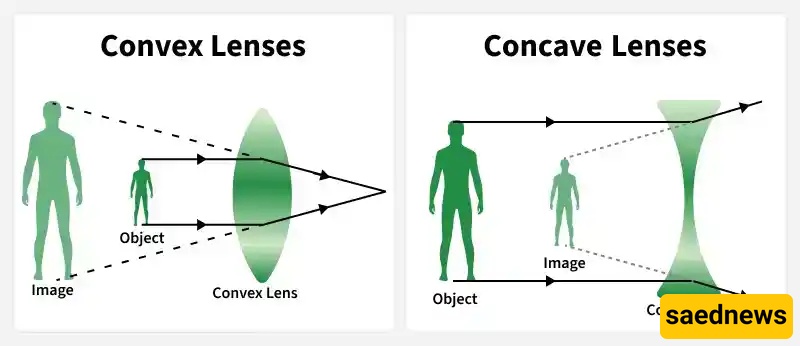
A convex lens is thicker in the middle and thinner at the edges. It brings parallel light rays closer together after they pass through the lens, causing them to meet at a point called the focal point. For this reason, it is known as a converging lens.
Characteristics and Applications of Convex Lenses
A concave lens is thinner in the middle and thicker at the edges. It causes parallel light rays to spread apart after passing through it. Therefore, it is known as a diverging lens.
Characteristics of Concave Lenses:
Thinner in the middle than at the edges.
Causes light rays to diverge.
Has a negative focal length.
For a real object, it generally produces a virtual, upright, and smaller image.
Applications of Concave Lenses:
Used in eyeglasses for people with nearsightedness.
Used in certain optical instruments.
Combined with other lenses to correct optical aberrations.
The following comparison highlights the main differences between the two types of lenses: converging and diverging lenses.
Lenses play an essential role in many scientific instruments and everyday devices. Their most important applications include:
Different types of lenses are used in eyeglasses to correct vision problems. For example:
Nearsightedness (Myopia): Concave or diverging lenses are used to help focus images of distant objects onto the retina.
Farsightedness (Hyperopia): Convex or converging lenses are generally used to make it easier to see nearby objects.
Astigmatism: Special lenses, such as cylindrical lenses, are used to correct blurred or distorted vision.
Microscopes use lenses to magnify extremely small objects. In a conventional optical microscope, there are two main lens systems:
Objective Lens: Located close to the specimen, it produces a magnified image.
Eyepiece Lens: Further magnifies the image so that the details of the specimen can be observed.
With these lenses, scientists can examine cells and microscopic organisms that cannot be seen with the naked eye.
A magnifying glass consists of a convex lens. When an object is placed closer to the lens than its focal length, the lens produces a virtual, upright, and enlarged image.
For this reason, magnifying glasses are used to examine small objects and read fine print.
A camera uses a combination of lenses to direct light and produce a sharp image on its image sensor. By moving or adjusting these lenses, the camera can focus clearly on both nearby and distant objects.