Saed News: American researchers have succeeded in developing a smart skin patch that can analyze health data in real time and diagnose certain diseases without the need for the internet, a smartphone, or cloud servers.
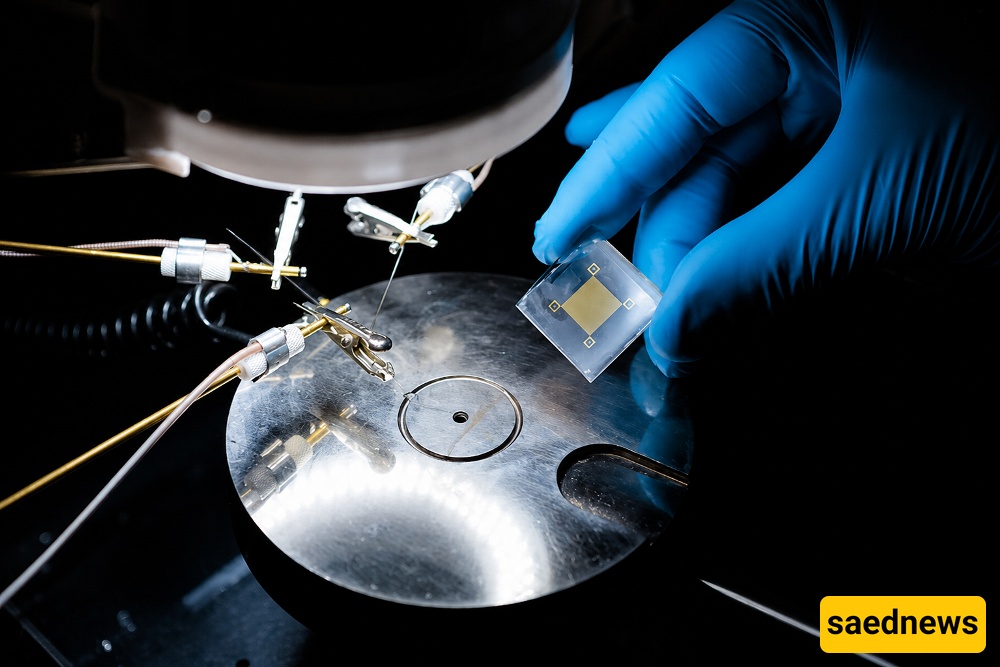
According to SAEDNEWS, this innovative technology was developed by researchers at the Pritzker School of Molecular Engineering at the University of Chicago in collaboration with Argonne National Laboratory. The new patch is soft, flexible, and stretchable, and is capable of performing artificial intelligence computations directly on the human body.
Today, many wearable devices such as smartwatches and fitness bands can collect data like heart rate and physical activity, but they depend on a mobile phone or cloud servers to analyze this information. Although this process takes only a few seconds, in medical emergencies even such a short delay can be critical.
The new patch eliminates this limitation and can process medical data on-device in just milliseconds. Researchers hope that in the future this technology will be used in wearable devices and even implantable medical equipment, enabling rapid health monitoring and response.
The secret behind this advancement lies in the use of a flexible type of transistor called an “organic electrochemical transistor.” These components not only process information but also store data, and they exhibit behavior similar to communication between brain cells, making them highly suitable for running AI algorithms.
To build this technology, researchers designed a special polymer gel that hardens under ultraviolet light, allowing thousands of densely packed transistors to be produced in a very small space. The result is arrays with a density of about 10,000 transistors per square centimeter.
In experiments, the patch was able to analyze the heart’s electrical activity and identify dangerous patterns associated with ventricular fibrillation—one of the most lethal heart rhythm disorders—with an impressive accuracy of 99.6%. Notably, this accuracy was maintained even when the device was stretched to more than 1.5 times its original size.
In another test, the embedded AI system analyzed data such as blood sugar, cholesterol, heart rate, and ECG signals, and was able to predict the risk of a heart attack with 83.5% accuracy.
Researchers believe this technology could form a new generation of intelligent health monitoring systems—systems capable of detecting, analyzing, and even responding to medical issues in real time. Such technologies could reduce reliance on external servers and provide faster and more accurate diagnoses for patients and doctors.
The findings of this study were published in the scientific journal Nature Electronics.