Saed News: Rutherford and his team were working between 2012 and 2014 on detecting Lyman-alpha emissions from Europa, but this research pushed the Hubble Space Telescope to its limits.
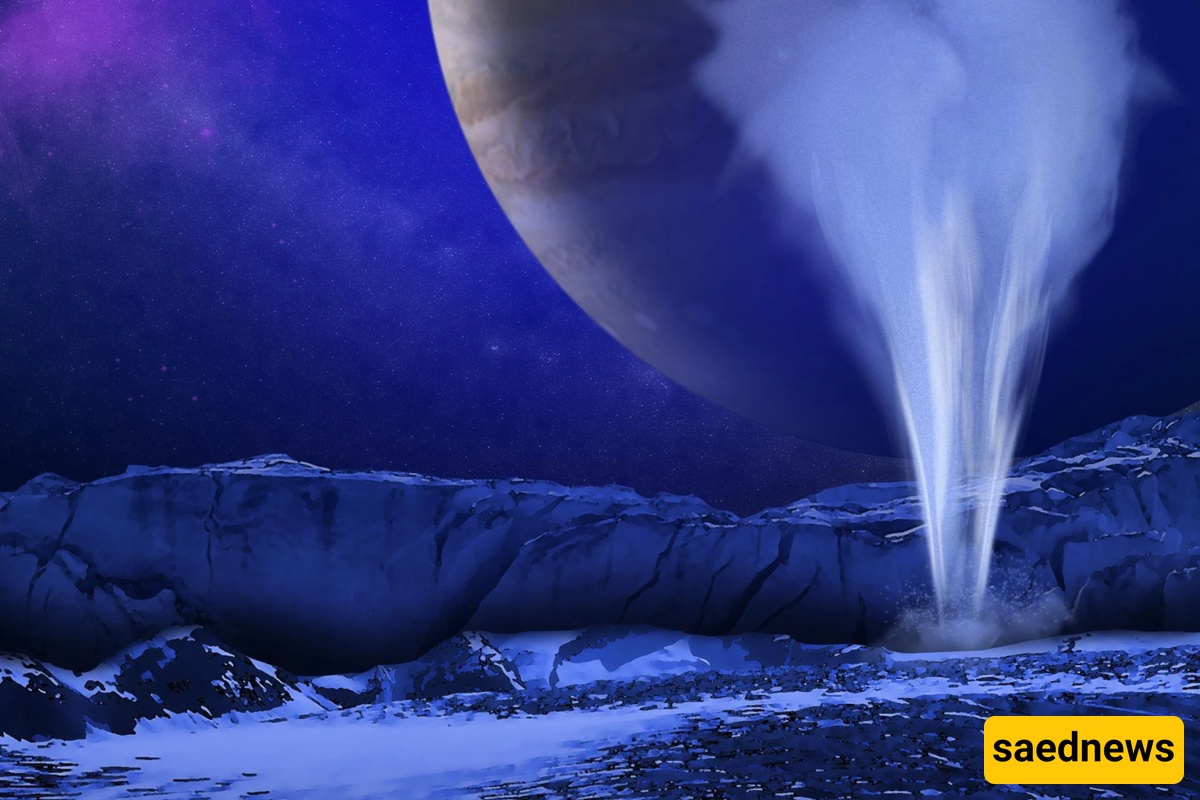
According to SAEDNEWS, scientists previously believed that one of Jupiter’s moons, Europa, had plumes ejecting water vapor. However, they are now less certain and say the evidence for water vapor on this moon is not as strong as initially thought.
Astronomers have reviewed 14 years of observations from the Hubble Space Telescope of Jupiter’s icy moon Europa and now suspect that its supposed water vapor plumes may not exist as previously assumed.
Europa has long been an attractive target for scientists studying the habitability of nearby worlds and the possible existence of life elsewhere in the solar system. This is because the moon is believed to host a global subsurface ocean that may contain essential ingredients for life, including complex organic chemicals beneath its thick icy crust.
Previously, it was thought that these faint and hard-to-detect plumes originated from this global salty ocean beneath Europa’s icy surface and erupted through cracks in the ice. However, earlier evidence supporting these plumes is now being questioned by the same researchers who originally proposed them.
Kurt Retherford, a member of the research team at the Southwest Research Institute (SwRI), said: “The evidence for water vapor plumes on Europa is not as strong as we initially thought.”
Retherford was part of the team that first suggested the existence of these plumes in 2014, but he and his colleagues have now revised that conclusion.
To reassess the existence of plume activity on Europa, Retherford and colleagues analyzed 14 years of data collected by the Hubble Space Telescope using its Space Telescope Imaging Spectrograph (HST/STIS). They focused on a specific ultraviolet wavelength called Lyman-alpha emission, produced and scattered by hydrogen atoms.
Between 2012 and 2014, the team attempted to identify Lyman-alpha emissions from Europa, but the study pushed Hubble to its observational limits.
Retherford explained that one difficulty in interpreting the data was accurately determining Europa’s position in the images. The way Hubble operates introduces uncertainties in positioning within the field of view, and even a one- or two-pixel error could significantly affect interpretation.
The team worried that the detected plume signals might have been caused by noise in the data.
Lorenz Roth, the team leader from the KTH Royal Institute of Technology in Sweden, said: “Our re-analysis reduced our initial 99.9% confidence in the existence of these plumes to below 90%. The evidence is simply not strong enough to support the certainty we originally claimed.”
However, the team cannot fully rule out the existence of vapor plumes on Europa, especially since similar plumes have been more confidently observed on Saturn’s icy moon Enceladus, and sulfur dioxide eruptions have been detected on Jupiter’s volcanic moon Io.
The question of Europa’s plumes and its global subsurface ocean may ultimately be resolved in 2030, when NASA’s Europa Clipper mission reaches the Jupiter system.
The study has been recently published in the journal Astronomy & Astrophysics.