Saed News: The atmosphere of Earth is mostly composed of nitrogen, which is heavier than water vapor, allowing moist air to rise easily. However, Jupiter’s atmosphere is hydrogen-based, and water vapor is heavier than hydrogen, meaning storms require much more energy to rise.
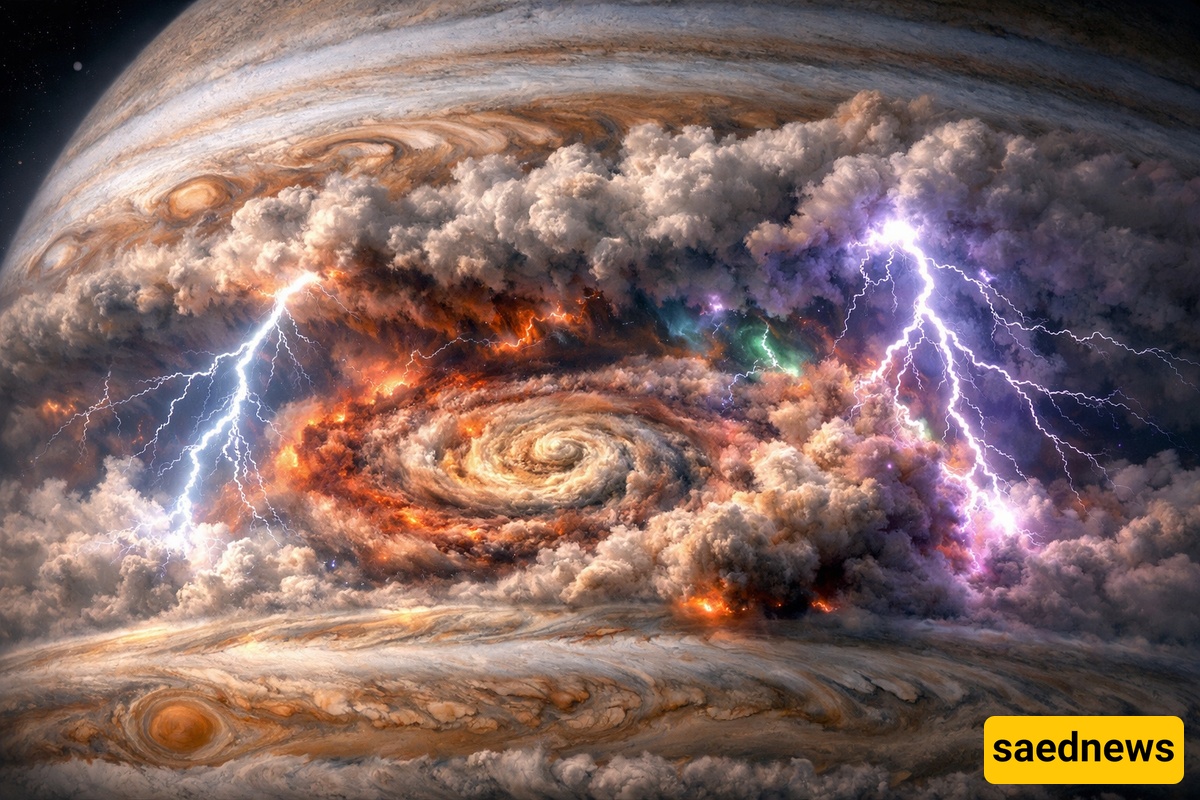
According to SAEDNEWS, researchers at the University of California, Berkeley, using data from NASA’s Juno spacecraft, have discovered that lightning on Jupiter can be up to 100 times more powerful than lightning on Earth. This massive difference is due to Jupiter’s different atmospheric composition (hydrogen versus Earth’s nitrogen atmosphere) and the enormous height of Jupiter’s storms (over 100 km compared to about 10 km on Earth), which allows them to store much more energy before electrical discharge occurs.
NASA’s Juno spacecraft has been orbiting Jupiter since 2016 and uses its microwave radiometer to detect radio emissions caused by lightning. Microwaves, unlike visible light which is blocked by clouds, can pass through them and provide more accurate estimates of lightning energy. Michael Wong, a planetary scientist at UC Berkeley and lead author of the study, said: “We still know very little about lightning on Earth. Studying storms on other planets can help scientists better understand Earth’s weather.”
The atmosphere of Earth is mainly nitrogen-based, where moist air rises easily. But in Jupiter’s hydrogen-rich atmosphere, water vapor is heavier, so storms require significantly more energy to rise.
When these storms form, they release enormous energy, producing strong winds and powerful cloud-to-cloud lightning. Researchers had a rare opportunity in 2021 and 2022 when storm activity in Jupiter’s northern equatorial belt temporarily decreased, allowing them to study isolated storms one by one.
During 12 Juno flybys, they recorded an average of three lightning flashes per second and analyzed 613 microwave pulses, estimating that the intensity of Jupiter’s lightning ranges from Earth-like levels to more than 100 times stronger. A previous study even suggested Jupiter’s lightning could be up to one million times stronger than Earth’s.
Lightning on Earth typically releases about 1 billion joules of energy (enough to power 200 average homes for one hour). Wong estimates that Jupiter’s lightning may release 500 to 10,000 times more energy than Earth’s lightning. However, scientists still do not fully understand why Jupiter’s lightning is so powerful.
Wong concludes by asking whether Jupiter’s hydrogen atmosphere versus Earth’s nitrogen atmosphere is responsible, whether the greater storm height on Jupiter (over 100 km vs. 10 km on Earth) plays a role, or whether Jupiter’s storms require much more heat to form and therefore store more energy. He notes that this remains an active area of research.