SAEDNEWS: Scientists have reached a surprising result in a strange experiment in which light behaved as if it had exited a medium before it even entered it.
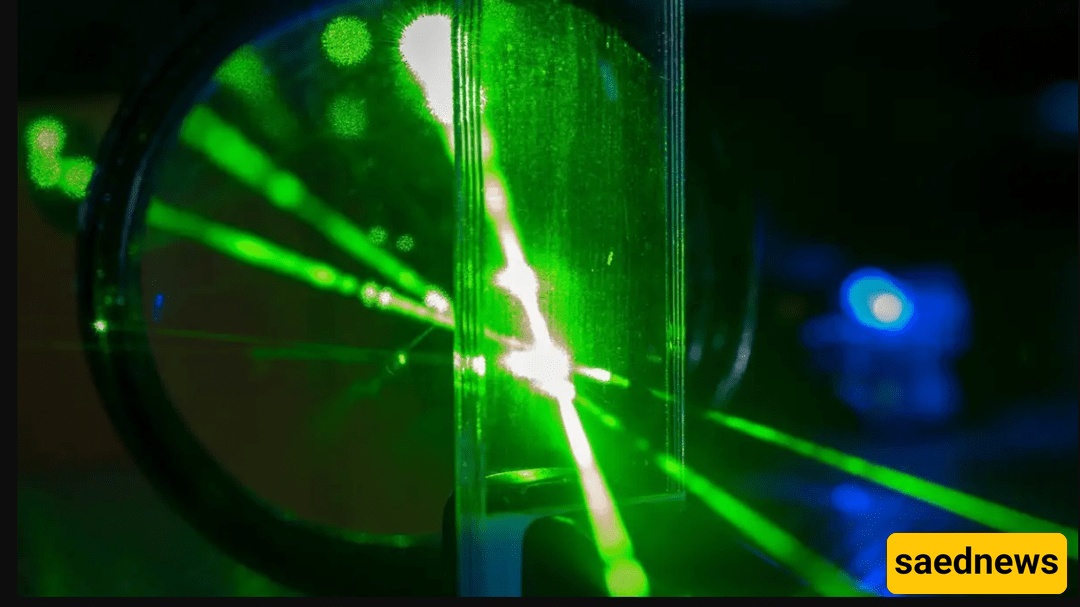
According to a science and technology report by SaedNews, citing APS Magazine, a group of physicists has successfully measured what appears to be an impossible phenomenon: negative time. In a recent experiment, photons (light particles) behaved as if they had exited a medium before entering it—an outcome that seems to contradict our conventional understanding of time.
The study, published in the journal Physical Review Letters, involved sending photons through a cloud of rubidium atoms. During this process, photons can temporarily transfer their energy to the atoms, briefly existing in a stored state before being re-emitted as light.
The unusual effect occurs when photons pass through the atomic cloud without scattering. In such cases, calculations show that the photons arrive at the end of the path earlier than expected—so early, in fact, that it appears as though they spent a negative amount of time inside the cloud, meaning they seem to exit before they even enter, on average.
This phenomenon was previously known and even observed in the 1990s, but many physicists interpreted it as a purely apparent effect arising from the shape of the light pulse. The common explanation suggested that only the leading edge of the light pulse passes through the medium, making the travel time appear shorter than it actually is.
However, the new research takes a different approach. The scientists directly probed the atoms themselves to determine how long the photons actually remained within the medium. They used a highly sensitive, non-invasive measurement technique to examine the excitation state of the atoms without disturbing the system.
The results were striking: the measured interaction time matched the previously calculated negative time exactly. This suggests that the “negative time” effect is not merely an optical illusion or mathematical artifact, but a real and measurable feature of the physical system.