SAEDNEWS: An international affairs expert, questioning what Iran’s actual share of the Caspian Sea is, has examined the historical, political, and legal developments surrounding the sea’s legal regime.
According to the political service of Saed News, international affairs expert Bagher Mohseni, in an article titled “The Caspian Sea: Dwelling on the Past or Moving Toward the Future?”, wrote:
“The Caspian Sea has always been one of the most sensitive issues in Iran’s foreign policy, not only because of its geopolitical significance and energy resources, but also because of its unique legal regime. The fate of this body of water, regarded as a ‘shared natural heritage’ in northern Iran, has experienced many ups and downs throughout history. Following the Islamic Revolution, however, successive Iranian governments adopted a more active approach toward the issue. This article examines the subject and seeks to correct some misconceptions and inaccurate claims.
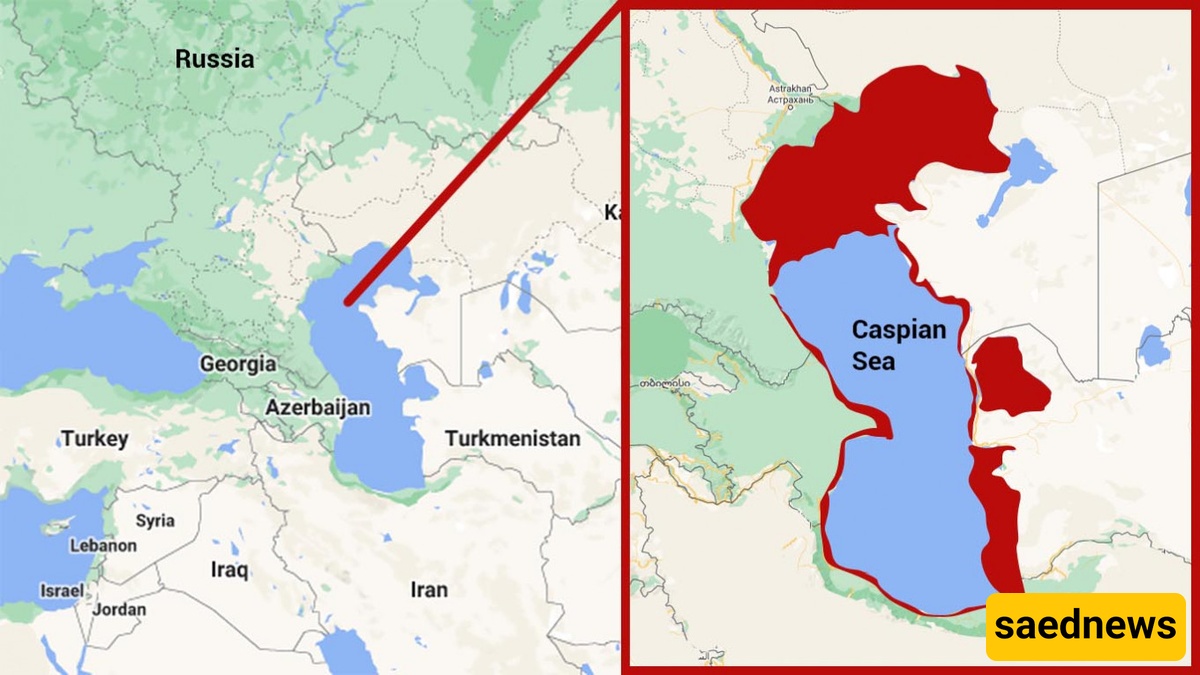
Before the collapse of the Soviet Union, sovereignty over the Caspian Sea was essentially a bilateral issue between Iran and the Soviet Union. The treaties of 1921 and 1940 between the two countries did not establish precise borders or specific shares. However, based on the Soviet Union’s practical control over the area, an unofficial “imaginary line” had emerged in the Caspian Sea that left Iran with less than 11 percent of the area.
The emergence of five independent states along the Caspian coastline transformed this legal vacuum into a multilateral dispute.
Following the Islamic Revolution, the idea of a regime of “full joint ownership” of the Caspian Sea between Iran and the Soviet Union, based on the aforementioned treaties, was raised. Iran simultaneously resisted what it regarded as historical inequality and the new claims put forward by the newly independent states, while seeking to safeguard its rights.
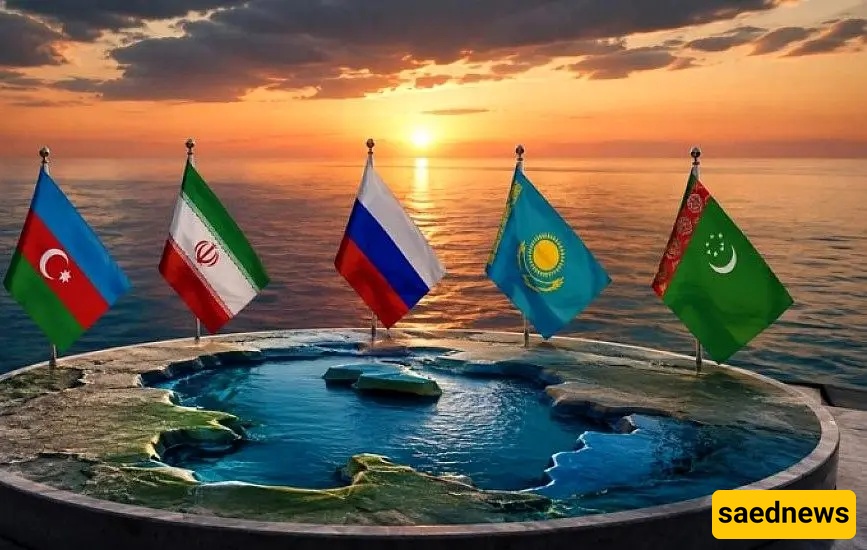
After more than two decades of negotiations, on August 12, 2018 (21 Mordad 1397 in the Iranian calendar), the leaders of the five Caspian littoral states signed the “Convention on the Legal Status of the Caspian Sea” in Aktau, Kazakhstan.
The convention granted the Caspian Sea a “special legal status,” defining it as neither entirely a sea nor entirely a lake.
The main provisions of the convention include granting each country 15 nautical miles of territorial waters and an additional 10 nautical miles of exclusive fishing zone. It also prohibits the presence of military forces belonging to non-littoral states in the Caspian Sea.
However, the convention did not definitively resolve the crucial issue of dividing the seabed and subsoil for the exploitation of oil and gas resources, which has been the most significant aspect of the dispute. Instead, it left this matter to subsequent bilateral and multilateral agreements among the countries concerned.
Many claims have been made in response to the key question of Iran’s share, some of which have been less legal assessments than media tactics serving particular political objectives.
The first claim is that Iran is entitled to a 50 percent share. This claim, however, has no solid legal or historical basis. Clearly, if a 50 percent share were allocated to Iran and Russia, there would be little or no share left for the other Caspian littoral states.
Another claim is that the Caspian Sea should simply be divided into five equal 20 percent shares. This approach not only fails to conform to the relevant principles of international law, but also overlooks the complexities of the issue. These include differences in the use and exploitation of different parts of the sea—such as the surface waters, seabed, and subsoil—as well as variations in water depth and differences in the shape of each country’s coastline, all of which affect the determination of maritime boundaries.
In reality, the complexity of the issue, combined with the need to establish arrangements that prevent unilateral exploitation by other states, led Iran to persuade the other littoral countries to pursue the establishment of the Caspian Sea’s legal regime step by step.
Therefore, the only precise answer to the question of Iran’s share is that Iran’s exact share has not yet been determined. The final outcome will depend on future negotiations with neighboring states, particularly Turkmenistan and Azerbaijan.
At present, the 2018 Convention provides the foundation for the legal regime of the Caspian Sea. Under Iranian law, the convention must also be approved by the Islamic Consultative Assembly, or parliament.
The convention serves as a framework document and a starting point for subsequent negotiations concerning the use of the Caspian waters, living resources, navigation, environmental protection, and security.
In other words, the convention has established the legal framework for future negotiations rather than definitively settling every aspect of the Caspian Sea’s boundaries.
At the same time, the convention’s prohibition on the presence of military forces from non-littoral states is considered a strategic achievement, preventing foreign military powers from establishing a military presence in the Caspian Sea and helping limit an arms race among the neighboring states.
The greatest concerns currently being expressed about the convention, meanwhile, are largely based on inaccurate claims regarding maritime delimitation and overlook the realities outlined above.
Clearly, without a reference document accepted by all the littoral states, negotiations over maritime boundaries in the Caspian Sea would not be possible.
Therefore, a strong and independent Iran today should move beyond historical anxieties rooted in the weakness and lack of capacity of the past. By drawing on specialized legal experts who have been trained over the past several decades and have participated in negotiations concerning the Caspian Sea, Iran can pursue a forward-looking policy, play an active role in shaping the Caspian Sea’s legal regime, and work to secure the rights and interests of the Iranian people.”