SAEDNEWS: U.S. President Donald Trump claimed in an interview with CNBC that Iran has agreed to "almost everything we need." He further alleged that, as part of a potential peace agreement aimed at ending the conflict, Iran would purchase agricultural products from the United States.
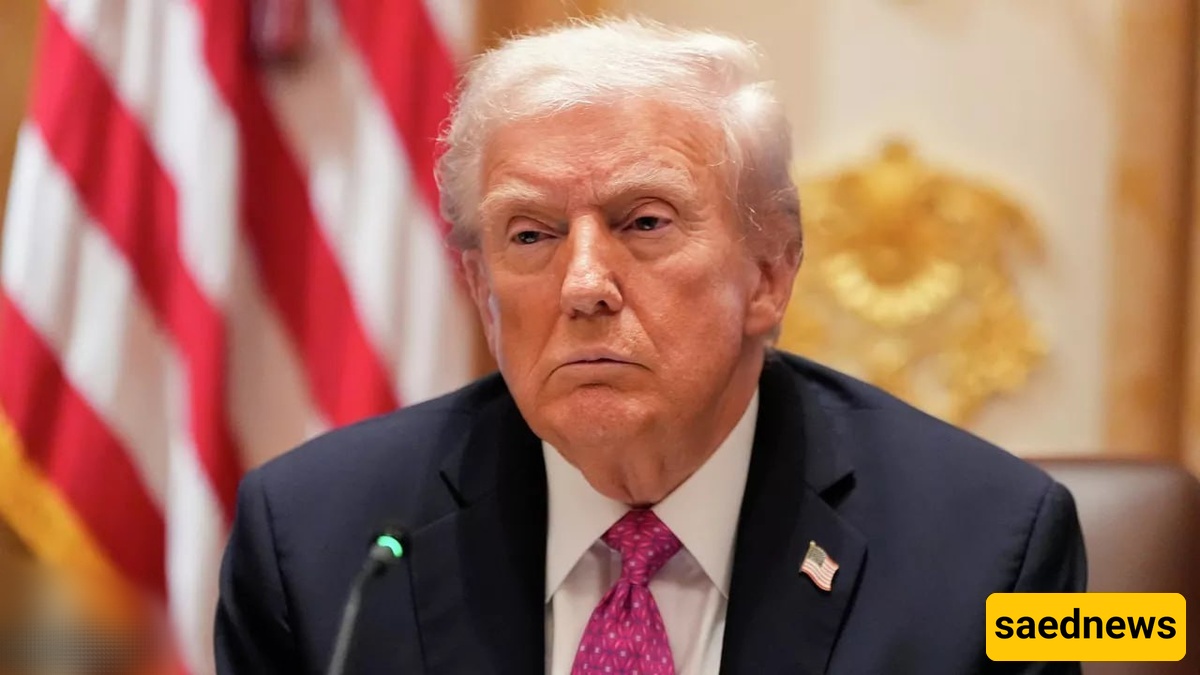
According to Saed News' political desk, U.S. President Donald Trump made a series of claims regarding Iran during an interview with CNBC on Thursday evening (local time), defending U.S. military actions, sanctions, and economic pressure while asserting that Iran has been significantly weakened.
Trump claimed that Iran no longer has meaningful revenue, saying the United States would effectively control part of Iran's financial resources to purchase essential agricultural products.
"They have no income," Trump said. "So we take part of the money and use it to buy what they need. They need food. They need corn, wheat, and soybeans, and we will exclusively allow American farmers to supply those products."
Trump portrayed the U.S. naval campaign against Iran as a major strategic success, claiming it prevented any ships from reaching the country.
"I established a naval blockade that was more than just a blockade—it was a steel wall," he said. "We have the greatest navy in the world. They are incredible. Not a single ship was able to reach Iran."
The U.S. president alleged that Iranian officials are confronting approximately 300 percent inflation and have virtually no revenue. He argued that the United States acted with overwhelming strength during its military campaign, while also suggesting that Iran has managed to preserve some appearance of stability.
Trump once again criticized major U.S. news organizations, accusing them of misrepresenting the consequences of the conflict. Referring to a recent report by The New York Times, he claimed the newspaper suggested Iran was now in a stronger position than it had been four months earlier.
Rejecting that assessment, Trump argued that Iran's military leadership and command structure had been severely damaged and insisted the country's economic conditions had deteriorated dramatically.
Trump maintained that the several-month military campaign against Iran was relatively brief and emphasized that, in his view, preventing Iran from obtaining nuclear weapons remains the United States' primary objective.
He argued that the campaign should not be viewed as a conventional war but rather as an effort to eliminate Iran's nuclear capabilities.
"We cannot allow them to have a nuclear weapon," he said, adding that he has led the disarmament effort for approximately four months.
Trump further asserted that Iran has agreed to nearly all of Washington's demands. He blamed previous U.S. administrations for allowing Iran to expand its regional influence over the past 47 years and repeated his long-standing criticism of former President Barack Obama, claiming that the Obama administration transferred $1.7 billion in cash to Iran, which he alleged was used to strengthen its military capabilities.
Although previous U.S. policies have often been interpreted as seeking political change in Iran, Trump stated that his current objective is not regime change but preventing Iran from acquiring nuclear weapons.
He also claimed that Iran's current leadership is "more reasonable" and suggested that the United States can work with them.
Trump additionally asserted that U.S. forces destroyed Iran's radar systems.
"We blew up their radar systems. They had no radar, and they still don't. They installed a new, advanced radar last week. Everything was ready to activate it, and we destroyed that too."
In another part of the interview, Trump claimed that he had used tariff-related presidential authorities to help resolve eight international conflicts, a statement that has been challenged by analysts as misleading.
He also emphasized that he does not want to be remembered as the president who presided over an economic recession.
"I've always said I don't want to be the president whose legacy includes a recession. I don't want to be Herbert Hoover. Herbert Hoover was probably the president who led America into the Great Depression."
According to the report, the United States and Israel launched a second military operation against Iran on February 28, 2026, while negotiations were still underway. A temporary ceasefire was announced on April 9, 2026, through Pakistani mediation, followed by direct negotiations between Tehran and Washington in Islamabad.
The report further states that Pakistan, Qatar, and several regional countries later helped broker an agreement between Iran and the United States. On June 18, 2026, Iranian President Masoud Pezeshkian and U.S. President Donald Trump electronically signed a memorandum of understanding establishing a framework for ending military operations, implementing reciprocal commitments, and launching a 60-day period of technical negotiations aimed at reaching a comprehensive agreement.