Saed News: About one galactic year ago, meaning roughly 230 million years ago, Earth was in the late Triassic period, and the first dinosaurs were just beginning to emerge.
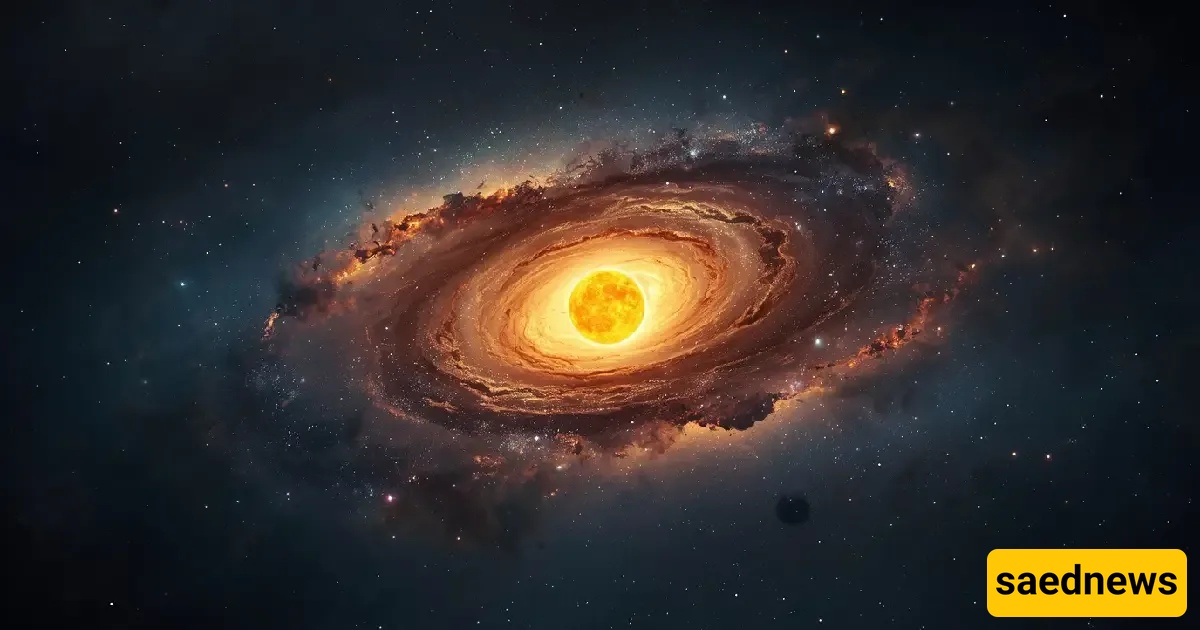
According to SAEDNEWS, citing Fardaad, the Sun is not stationary in space. It carries the entire Solar System around the center of the Milky Way galaxy, completing one full orbit in approximately 230 million years. Therefore, if we go back by one “galactic year,” Earth was in the late Triassic period, when the earliest dinosaurs were just beginning to appear on the stage of life.
This idea is visually and conceptually appealing and is largely scientifically reasonable, but both numbers used in this comparison come with significant uncertainty, and the idea that we return to exactly the same point is not accurate.
The Sun’s orbital period around the galactic center is not a precise, fixed value. Estimates range from 225 to 250 million years, with 230 million years being the most commonly cited value.
Astronomer Keith Hawkins from the University of Texas estimates this period to be about 220 to 230 million years, emphasizing that the “galactic year” depends on a star’s position in the galaxy: stars closer to the center orbit faster, while those farther away move more slowly.
More fundamental measurements are better known. The Sun is about 26,000 light-years from the center of the galaxy and moves at roughly 230 kilometers per second in its orbit. Data from the European Space Agency’s Gaia mission have helped refine estimates toward the lower end of the range. Thus, the figure “230 million years” should be considered approximate, with a possible error margin of tens of millions of years.
The part about dinosaurs, however, is largely correct. If we go back about 230 million years, we reach the late Triassic period, specifically a stage known as the Carnian.
The oldest clearly identified dinosaurs were discovered in the Ischigualasto Formation in northwestern Argentina and date back between 230 and 233 million years. These include Eoraptor, Eodromaeus, and the larger predator Herrerasaurus.
However, what is often omitted in simplified explanations is that these animals were not yet dominant. According to paleontologist Paul Barrett, early dinosaurs were relatively rare, while crocodile-line reptiles dominated ecosystems. Dinosaur dominance only began after the end-Triassic extinction event around 201 million years ago.
The phrase “the last time we were at this point in the galaxy” is commonly used, but in reality, we do not return to the exact same location.
The Milky Way does not rotate like a rigid disk. Different regions move at different speeds. The spiral arms are not fixed structures but wave-like patterns moving through the galaxy. Therefore, the spiral arm near the Sun today is not the same one it was near during the Triassic period.
In addition, the Sun oscillates above and below the galactic plane and crosses it roughly every few tens of millions of years. Its distance from the galactic center also changes slightly over hundreds of millions of years.
As a result, after one full orbit, the Sun returns to a similar distance and orientation relative to the galactic center, but the surrounding environment is entirely different. Neighboring stars, gas clouds, and spiral arm structures all change. In simple terms, time loops back, but space does not.
It is tempting to think that the Sun’s galactic position influences major Earth events, such as mass extinctions. In 1984, researchers James and Schwartz suggested that some extinction events might be linked to the Sun crossing the galactic plane. They proposed that such crossings could disturb distant comet reservoirs and increase impact rates on Earth.
However, this hypothesis has been repeatedly questioned. The timing of galactic-plane crossings does not match proposed extinction cycles, and even the existence of regular extinction periodicity is debated. Therefore, this idea remains unconfirmed.
The more accurate version of the story is this: about one galactic year ago—roughly 230 million years in the past—Earth was in the late Triassic period, and the first dinosaurs were just emerging. However, this value is approximate, and the Sun does not return to the exact same location in the galaxy after completing an orbit. Still, this comparison remains a powerful way to understand the immense scale of geological time and our motion through the Milky Way.