Saed News: Scientists have discovered a supermassive black hole that, contrary to previous astrophysical theories, appears to have formed before its host galaxy was fully developed.
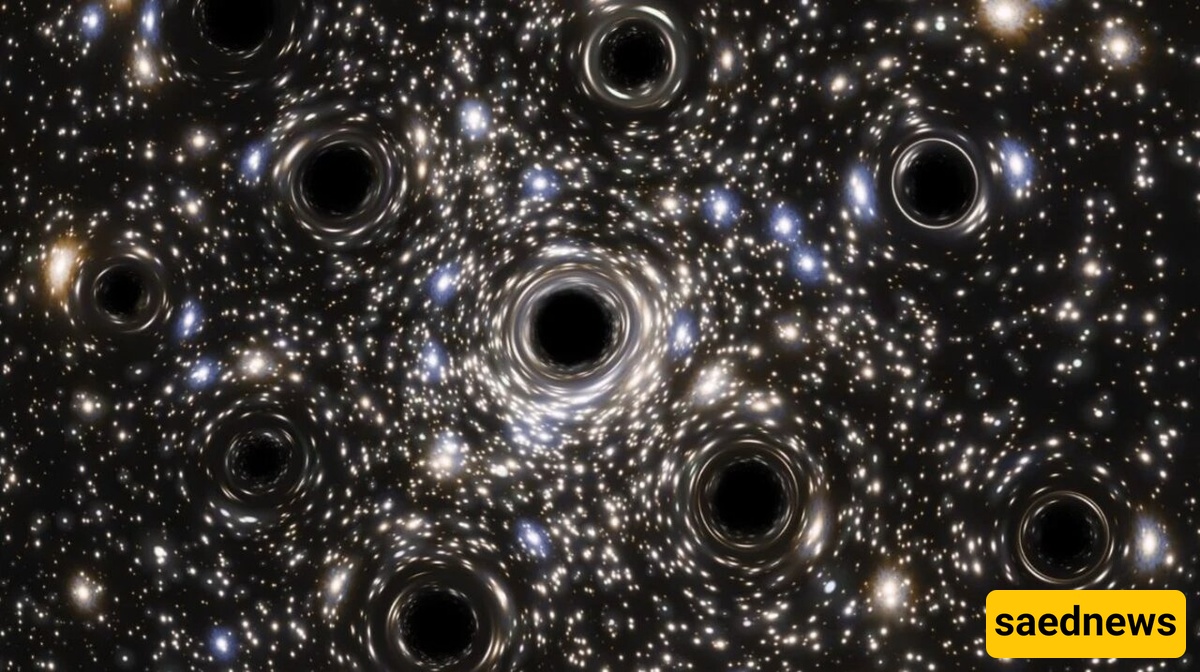
According to SAEDNEWS, researchers using data from the James Webb Space Telescope have identified a supermassive black hole with a mass approximately 50 million times that of the Sun. The object existed only 700 million years after the Big Bang and appears to have formed even before its host galaxy was completely assembled.
According to ScienceAlert, this cosmic object, known as Abell2744-QSO1, belongs to a class of objects called Little Red Dots—extremely distant and compact objects that the James Webb Space Telescope has detected in recent years. The black hole lies behind the massive Pandora Galaxy Cluster, and the phenomenon of gravitational lensing has magnified and brightened its image, enabling more detailed study.
Until recently, astronomers believed that supermassive black holes formed gradually over billions of years. In this model, massive stars collapse to create small black holes, which then grow by accreting gas and dust and merging with one another until they become giants with millions or billions of times the Sun’s mass.
However, the latest James Webb data tells a different story. New analyses indicate that QSO1 is not only much larger than expected but also accounts for a significant fraction of its host galaxy’s total mass—a phenomenon rarely observed in modern galaxies.
Researchers used the James Webb telescope’s NIRSpec spectrograph to directly measure the black hole’s mass. The instrument allowed them to precisely determine the motion of gas surrounding the black hole and measure its gravitational influence. The results showed that the black hole’s mass is about 50 million times that of the Sun—an estimate even larger than initial predictions.
Roberto Maiolino of the Kavli Institute at the University of Cambridge described the discovery as a “paradigm shift,” saying that classical models of black hole formation require serious reconsideration. According to him, the existence of such a massive black hole in a very young universe is difficult to reconcile with many current models.
Even more surprisingly, the host galaxy of this black hole remains chemically underdeveloped. In other words, this enormous object already existed at a time when heavy elements were still scarce in the universe. This has led some researchers to speculate that early black holes may have grown far more rapidly than previously thought or may have formed through mechanisms that remain unknown.
The new James Webb discovery adds another mystery to the study of the early universe—one that suggests the history of the first galaxies and black holes may be far more complex and different from what astronomers have believed for decades.