Saed News: Finger wrinkling in water is one of those strange biological phenomena; however, it has been so constantly in front of us that few people have ever really asked about it.
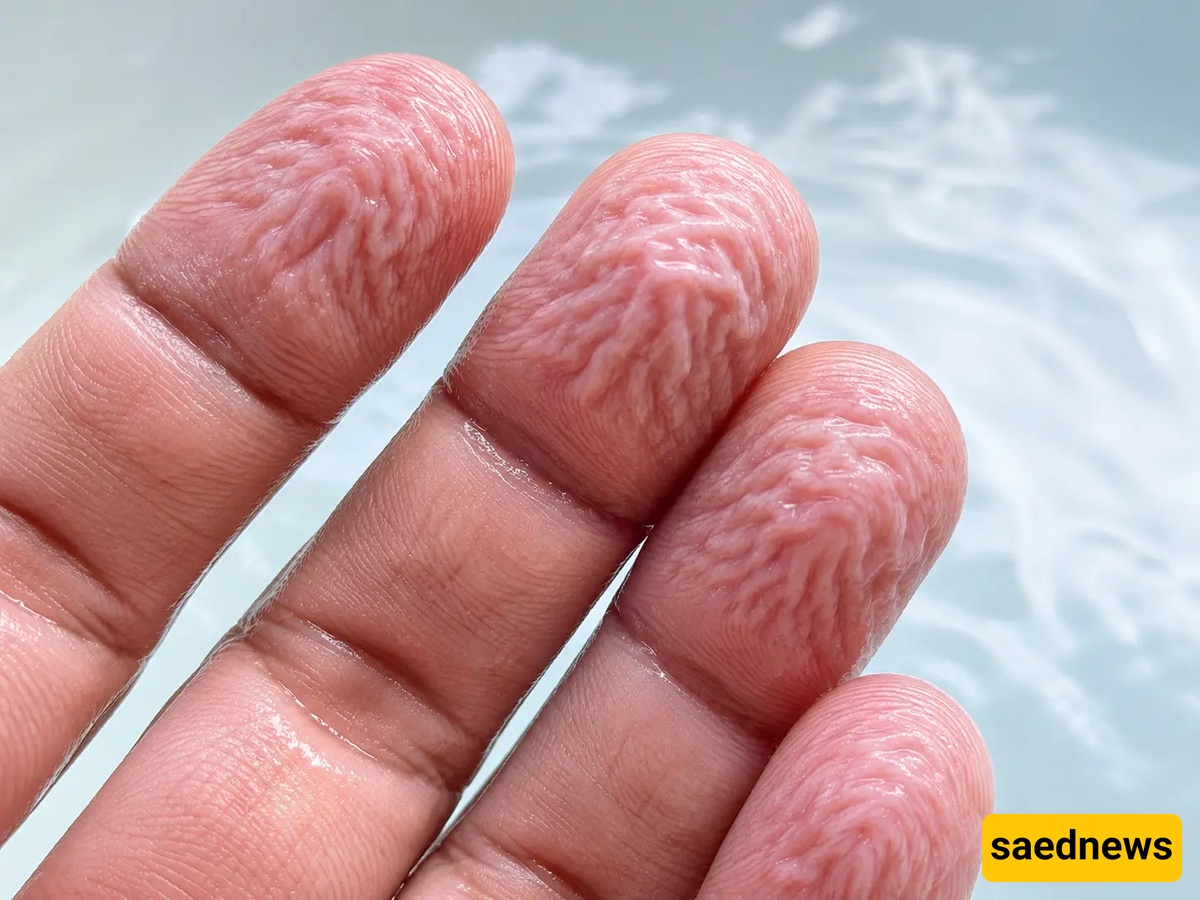
According to SAEDNEWS, throughout most of the twentieth century, the common explanation for finger wrinkling in water was that the skin passively absorbs water, swells, and therefore wrinkles. This explanation was accepted for decades not because there was strong evidence behind it, but because no one had examined it carefully.
However, when researchers finally studied this phenomenon in detail, they reached a much more interesting conclusion: finger wrinkling is an active neural response linked to evolutionary mechanisms and provides a measurable practical benefit under certain conditions. This even later accidentally entered medical science.
The story of this discovery begins with a forgotten neurological observation in the 1930s, passes through the sympathetic nervous system, and ultimately reaches the deep evolutionary past of humans and the moist environments of our ancestors.
The old explanation of “water absorption by the skin” seemed so simple and acceptable that it remained largely unchallenged until the end of the twentieth century. But a 2016 study showed that if skin swelling alone were responsible for wrinkles, the skin would need to expand by more than 20% beyond its normal volume to create the actual wrinkle patterns—something that does not happen in reality.
However, the main blow to this theory came from an observation recorded in the 1930s. Doctors noticed that patients whose peripheral finger nerves were damaged or severed did not develop wrinkled fingers even after a long time in water, and their skin remained smooth.
This finding was not taken seriously for years, until scientists realized its importance: if nerve damage prevents wrinkling, then the nervous system is not merely an observer but the main cause.
In fact, when fingertips are placed in water, a small amount of water enters the sweat ducts on the skin surface. This sends a signal through sensory nerve fibers to the autonomic nervous system, especially the sympathetic branch, which controls heart rate, sweating, and pupil dilation.
The system then commands the blood vessels to constrict. The vessels under the skin narrow, tissue volume decreases, and the skin, now lacking its previous internal support, contracts inward and forms wrinkles along vascular structures.
Today, doctors use this process as a simple neurological test: the patient’s hand is placed in warm water for about 30 minutes, and the degree of wrinkling is assessed. If wrinkles do not form or are very minimal, it may indicate damage to the sympathetic nerves. In fact, wrinkled fingers also serve as a medical diagnostic tool.
An even more interesting point is that these wrinkles appear only in specific parts of the body: the palms, fingertips, and soles of the feet—not the forearm, shoulder, or even the back of the hand. These are the areas that directly contact objects and surfaces. This anatomical precision suggests that the phenomenon likely had a specific evolutionary purpose.
In a 2013 study published in the journal Biology Letters, scientists tested this hypothesis. Twenty volunteers, with either wrinkled or normal fingers, were asked to transfer marbles from one container to another.
The result was interesting: those with wrinkled fingers completed the task about 12% faster. However, when the experiment was repeated with dry objects, wrinkles provided no advantage. This means wrinkles are only useful in wet conditions—exactly what one would expect from an evolutionary adaptation.
Another study showed that people with wrinkled fingers used less force when gripping wet objects and performed almost as efficiently as when their hands were completely dry. However, individuals with wet but non-wrinkled hands had to apply more pressure to hold the same object. In other words, these wrinkles are not just visual lines but a functional structure that improves friction and grip.
From an evolutionary perspective, this feature was likely very useful for early humans, such as when collecting food from wet plants, rivers, or rainy environments. In such conditions, better grip ability could have provided a real survival advantage.
Of course, not all studies have shown the same results. Some research indicates that when handling small and light objects, there is no significant difference between wrinkled and smooth fingers, likely because such objects do not require high friction.
Scientifically, it still cannot be stated with certainty that because a feature has a function, it necessarily evolved for that function. However, the combination of behavioral evidence, structural findings, and the precise location of wrinkling makes the evolutionary hypothesis more plausible than any other explanation.
A 2025 study also revealed another interesting point: because blood vessels beneath the skin are fixed in position, the wrinkle pattern of each individual when wet is almost always the same. Researchers believe this pattern may be unique to each person and could potentially be used in the future for biometric identification or forensic science.
In the end, finger wrinkling is not just a simple skin reaction to water. It is a precise neural response that activates in specific body regions, creates a structured pattern, and improves hand performance in wet conditions—an adaptation that likely helped our ancestors survive millions of years ago.