SAEDNEWS: Scientists say they have finally identified the origin of the mysterious Silverpit crater beneath the North Sea, concluding that it was created by a space rock roughly 160 meters wide around 43 to 46 million years ago.
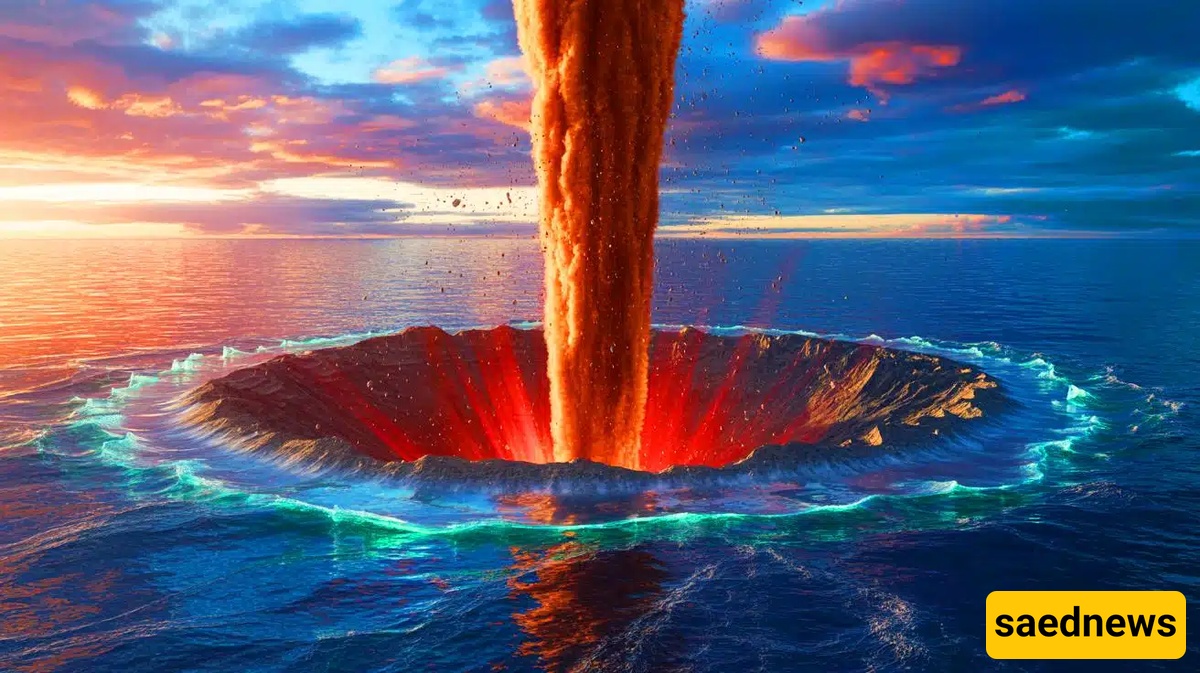
According to SaedNews: More than 700 meters beneath the floor of the North Sea lies the remnant of a catastrophe that unfolded tens of millions of years ago. Scientists now believe they have finally solved the mystery behind the unusual Silverpit crater—and the explanation is dramatic: a space rock roughly 160 meters across slammed into the sea, generating a tsunami that may have risen more than 100 meters above sea level.
The discovery brings an end to a scientific debate that has lasted for more than two decades.
The Silverpit structure, located beneath the southern North Sea about 128 kilometers off the Yorkshire coast, was first discovered in 2002. Since then, geologists have disagreed over what could have created it.
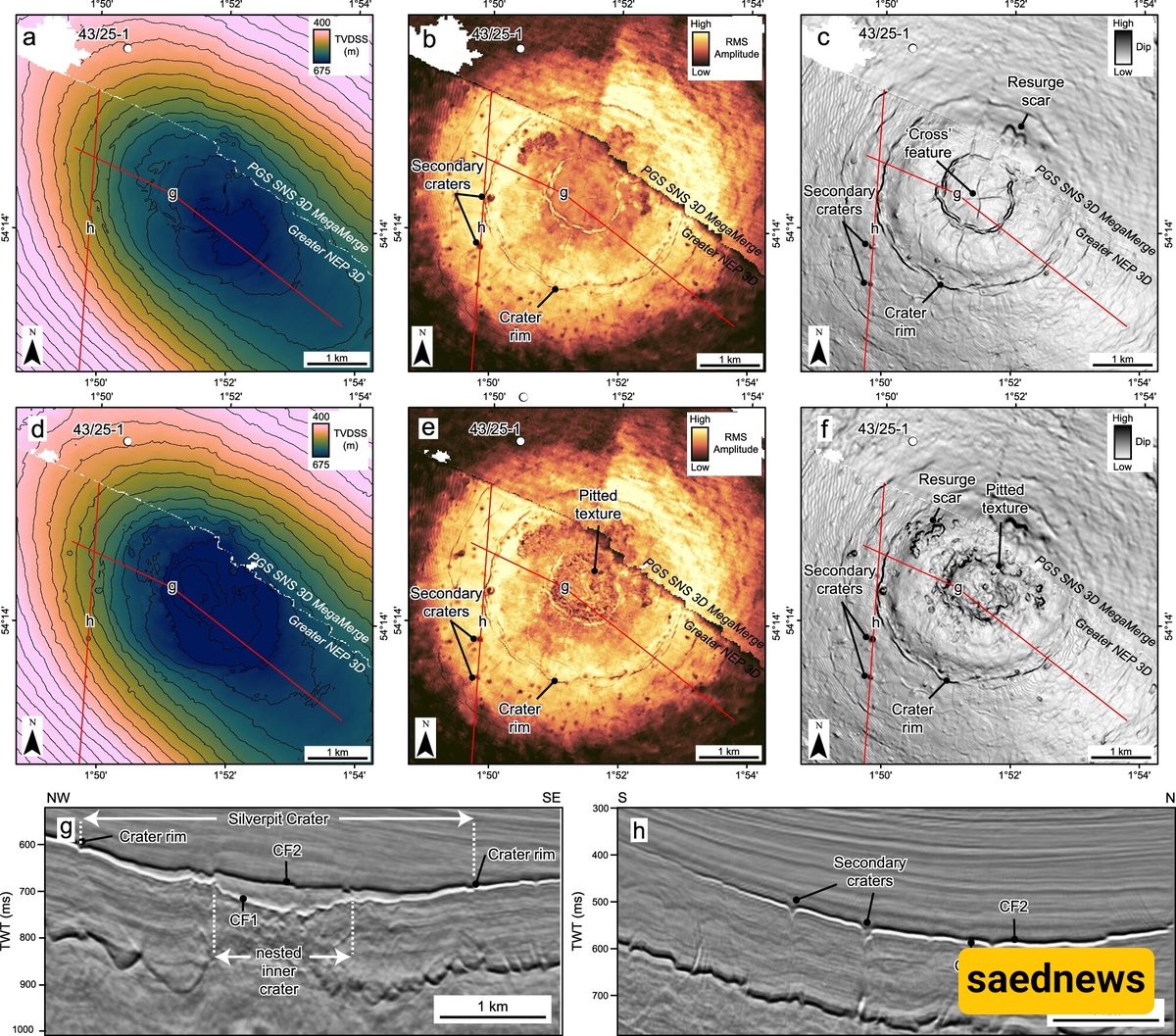
At first glance, however, the structure appeared to have many of the characteristics associated with an impact crater.
The crater itself is about three kilometers wide. Around it is a much larger circular network of faults extending roughly 20 kilometers. Its shape, central peak and surrounding pattern of fractures resemble features found at confirmed impact sites elsewhere on Earth.
But resemblance alone was not enough to settle the argument.
Some researchers suggested that the structure might have formed through the movement of underground salt deposits. Others proposed volcanic activity followed by the collapse of part of the seabed.
The disagreement became so intense that scientists formally debated the crater’s origin in 2009.
Now, researchers have returned to the site with more advanced evidence.
A team led by Dr. Uisdean Nicholson of Heriot-Watt University in Edinburgh combined advanced seismic imaging, microscopic examination of rock samples and computer simulations to build what researchers describe as the strongest case yet for an impact origin.
The new seismic data proved particularly important.
Seismic imaging works somewhat like an ultrasound scan for the Earth. Researchers send waves into the ground and analyze the signals reflected back from underground layers. By studying those reflections, scientists can build detailed images of structures that remain hidden beneath the surface.
In the case of Silverpit, the new data provided an unprecedented look at the crater’s internal structure.
Researchers also examined rock fragments recovered from an exploratory oil well near the crater. Among the evidence they investigated were minerals that had experienced extreme pressure.
These pressure-altered minerals are especially important in impact research. Tiny structures within their crystals can form only when rocks experience enormous pressures far beyond those normally produced by ordinary geological processes.
Together, the evidence strengthened the case that Silverpit was created by a high-speed cosmic impact.
Scientists estimate that the object responsible was around 160 meters wide and approached from the west at a relatively low angle. That is considerably smaller than the asteroid associated with the extinction of the dinosaurs, but its size would still have been more than enough to cause extraordinary destruction in the region.
The most striking part of the reconstruction is what happened immediately afterward.
Within minutes of the impact, a column or curtain of rock and water roughly 1.5 kilometers high is thought to have been thrown upward. As that material collapsed back toward the sea, it generated a huge tsunami.
The resulting wave may have exceeded 100 meters in height.
To put that figure into perspective, a 100-meter wave would tower over many modern buildings. It illustrates just how much energy can be released when a large space rock strikes a planetary surface—or, in this case, the sea.
The event happened around 43 to 46 million years ago, meaning that there was no human witness to the disaster. The North Sea region has also changed dramatically over geological time, while erosion, weathering, volcanic activity and the slow movement of tectonic plates have continually reshaped Earth’s surface.
Those processes explain why so few ancient impact craters remain clearly visible today.
Scientists have confirmed roughly 200 impact craters on land, while only around 33 have been identified beneath the oceans. The rarity of preserved underwater craters makes Silverpit particularly valuable.
The crater is therefore more than an answer to an old geological puzzle. Researchers now have the opportunity to use it as a natural laboratory for studying what happens when asteroids strike Earth.
Understanding ancient impacts can help scientists reconstruct how enormous amounts of energy are transferred into the ground and oceans. It can also provide clues about how similar collisions might affect other worlds in the Solar System.
The Silverpit discovery is especially revealing because the impactor was not exceptionally large by asteroid standards. Yet a body only about 160 meters across could potentially generate a wave exceeding 100 meters and leave a structure several kilometers wide beneath the seabed.
That contrast is perhaps the most unsettling lesson from the discovery: an object that appears relatively small when compared with planetary dimensions can still produce consequences on a massive scale.
For more than 20 years, scientists could see the strange geological signature beneath the North Sea but could not agree on what had created it. New seismic images, microscopic evidence and computer modeling have now provided a much clearer picture.
The mystery that began with an unusual structure discovered in 2002 has effectively become a window into an ancient planetary disaster.
And the Silverpit crater may now serve a new purpose. Instead of simply being an unexplained feature hidden beneath the sea, it can become a rare geological record of how Earth responds when a large object from space arrives at tremendous speed.
Millions of years after the impact, the ocean has erased almost every visible trace of the event. But deep beneath the North Sea, the crater remained.
Today, that hidden scar is helping scientists reconstruct a moment when a 160-meter space rock collided with Earth’s waters and sent a wall of water more than 100 meters high racing across an ancient sea.
The discovery closes one chapter of the Silverpit mystery—but it also opens a much broader scientific question: how many other ancient cosmic impacts are still hidden beneath Earth’s oceans, waiting to be found?