SAEDNEWS: Scientists have identified plasma waves traveling between Saturn and its moon Enceladus, using data captured by the Cassini spacecraft shortly before its final plunge into Saturn. When converted into an audible recording, the signal produces an eerie mixture of whistles, clicks and rising and falling tones.
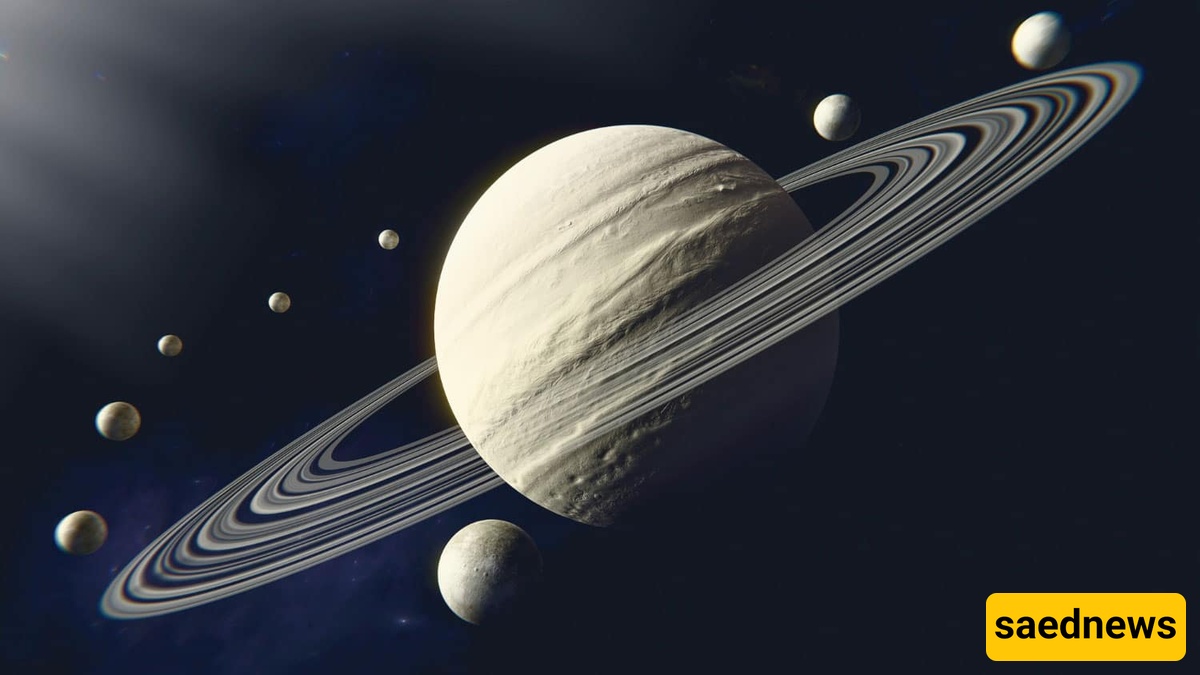
According to SaedNews: Scientists have uncovered an eerie piece of information hidden in the final days of NASA’s Cassini mission: plasma waves were moving through the space between Saturn and its moon Enceladus, traveling along magnetic field lines that connect the two worlds.
The discovery is striking partly because the signal can be turned into something humans can actually hear.
There is, of course, no ordinary sound traveling through the vacuum of space. Sound requires a medium, such as air, through which vibrations can move. The signal detected by Cassini was something fundamentally different — electrostatic plasma waves capable of propagating through space.
But because these waves occurred within a range of frequencies that can be processed as sound, researchers were able to transform the spacecraft’s measurements into an audio recording.
And what emerged was anything but ordinary.
The converted signal has been described as an eerie, whistle-like and clicking sound that rises and falls. Its character resembles the phenomenon sometimes associated with auroral activity, leading researchers to refer to it as an auroral hiss.
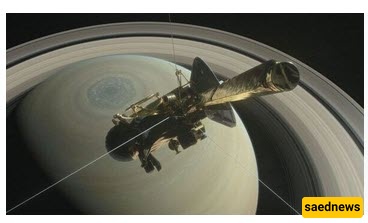
The data came from Cassini during the final phase of its historic mission around Saturn. In 2017, after years of exploring the planet, its rings and moons, the spacecraft was deliberately sent into Saturn’s atmosphere, bringing the mission to an end.
Yet some of its most intriguing scientific discoveries continue to emerge from the data collected before that final dive.
Two weeks before Cassini’s final plunge, during one of its closest approaches to Saturn, the spacecraft used its Radio and Plasma Wave Science instrument, known as RPWS, to detect the plasma waves moving between Saturn and Enceladus.
That observation was particularly important because scientists had previously detected auroral hiss during close encounters with Enceladus. The new observation, however, provided the first detection of this feature near Saturn itself rather than near the moon.
The finding also offered a new perspective on the relationship between Saturn and Enceladus.
Enceladus is far more than a passive satellite orbiting a giant planet. The moon is geologically active, and its famous geysers eject particles of water into space. Some of this material contributes to one of Saturn’s rings.
Scientists also know that Enceladus lies within Saturn’s magnetosphere, creating a relationship with the planet that is very different from the one between Earth and our own Moon.
The newly analyzed plasma waves provide another piece of evidence showing how closely the two bodies interact.
Ali Sulaiman, a planetary scientist at the University of Iowa and a member of the RPWS team, described Enceladus as a small generator orbiting Saturn and said researchers now know Saturn responds by sending signals in the form of plasma waves along magnetic field lines connecting the two bodies across hundreds of thousands of miles.
That description makes the discovery particularly fascinating. The “sound” is not simply an atmospheric noise picked up by a microphone. It is an audible representation of an invisible physical interaction occurring across an enormous distance.
Researchers were able to turn the detected signal into a recording within the range of human hearing. The original 16-minute recording was accelerated to just 28.5 seconds, producing the eerie audio effect associated with the discovery.
The result may sound like something from a science-fiction film, but the underlying phenomenon is grounded in measurements collected by a scientific instrument aboard Cassini.
The discovery was reported in two studies published in 2018 in Geophysical Research Letters. Those studies revealed previously unknown aspects of interactions involving Saturn, its rings and Enceladus.
What makes the finding even more remarkable is its timing. Cassini’s final mission phase, known as the Grand Finale, brought the spacecraft into regions of Saturn’s environment that could not be studied in the same way from greater distances.
By getting closer to the planet during its final orbits, Cassini was able to capture measurements that helped scientists investigate the complicated electromagnetic environment surrounding Saturn and its moons.
Nearly a decade after the mission ended, those measurements are still proving valuable.
The discovery is also a reminder that when scientists say they have “heard” something in space, the phrase does not necessarily mean that a microphone recorded a conventional sound. In this case, an invisible plasma phenomenon was converted into an audible form, allowing humans to experience a small part of a process that would otherwise remain completely beyond our senses.
For Saturn and Enceladus, the finding adds another layer to an already extraordinary planetary system. The moon’s activity, Saturn’s powerful magnetic environment and the field lines connecting them create a dynamic relationship that continues to surprise researchers.
Cassini may have completed its mission in 2017, but its scientific legacy is far from finished. Data gathered during its final days continue to reveal details about Saturn that were impossible to see from afar.
And perhaps that is the most fascinating part of the story: the spacecraft has been gone for years, yet scientists are still finding new ways to listen to what it discovered.