SAEDNEWS: This plant belongs to the Rosaceae family and the genus Fragaria.
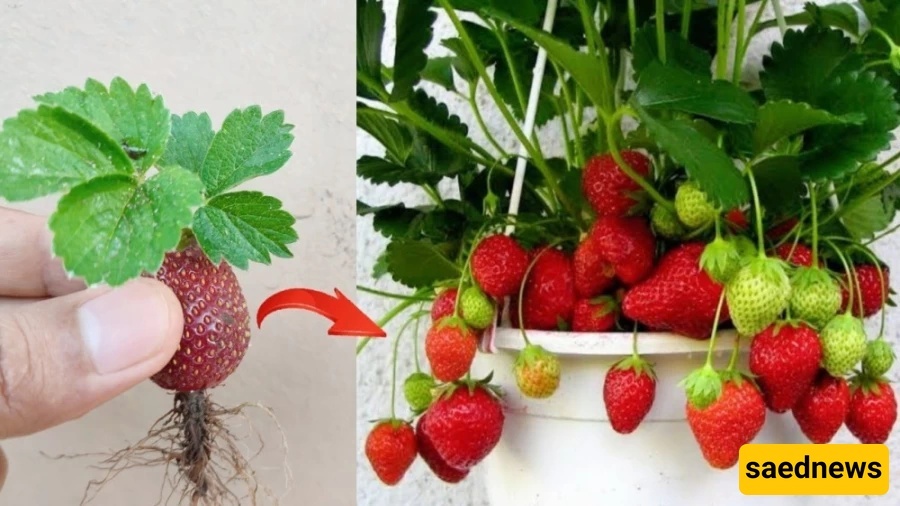
According to Saednews, Sweet and juicy strawberries are edible immediately after harvesting. Supermarket strawberries are sweet due to the natural sugars inside the fruit, which begin to develop as soon as the strawberry is detached from the plant. They can be tasted right away. It is certainly worth the effort spent on growing strawberries, and the good news is that strawberry is an easy-to-grow plant in full sunlight, so you can cultivate strawberries at home.
This plant belongs to the Rosaceae (rose) family and the genus Fragaria. Although wild varieties of strawberry are distributed in many parts of the world, the wild strawberry species F. vesca naturally grows in the United States, Europe, and some regions of Iran, including northern areas, the slopes of the Alborz mountains, and Azerbaijan. It has 14 chromosomes. Today, interspecific hybrid varieties originating from North and South America are used in the cultivation of this plant. The improved and polyploid strawberry cultivars that are widely grown—and can be considered the ancestors of modern strawberries—belong to F. ananassa, which has 56 chromosomes (octoploid) and was obtained by hybridizing a Chilean strawberry species with a North American species.
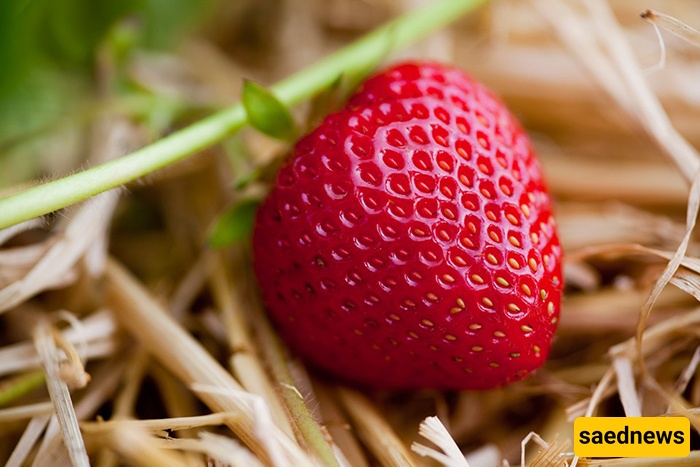
Most strawberry varieties are bisexual, while some are purely male and others purely female. Bisexual varieties are self-pollinating, whereas female varieties are pollinated by insects. Strawberry is a herbaceous perennial plant, with plant height around 15–20 cm, and it can grow for 3 to 5 years. The plant has a very short stem and is classified as a crown-forming plant. Its leaves are compound, consisting of three oval leaflets with long, hairy petioles.
From the lateral buds on the crown of the plant, runners (stolons) develop. When these runners come into contact with soil, they produce new plantlets. In most strawberry varieties, runners have two nodes, and daughter plants are formed from the second node. The first node remains dormant or produces another runner. Strong commercial strawberry plants can produce 10–15 runners during the growing season. For the first few weeks, mother plants supply water and nutrients to the daughter plants, but after 2–3 weeks, the new plants develop roots and become independent.
Flowers and fruit formation
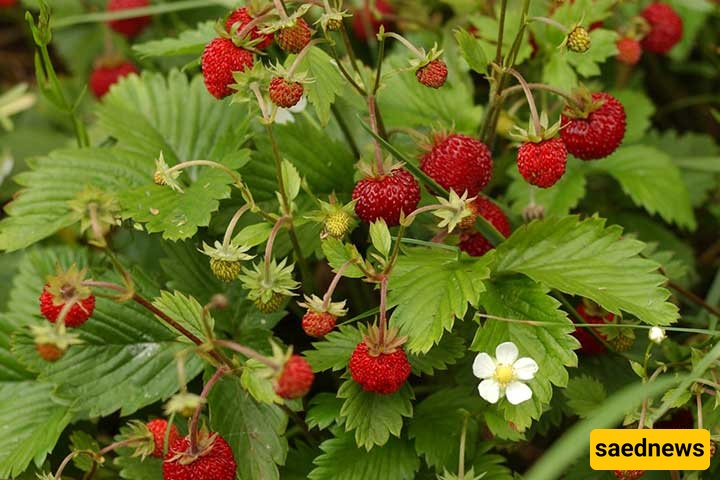
Strawberry white flowers have 10 sepals and 5 petals and are arranged on a cymose inflorescence. The inflorescence, like runners, originates from lateral buds of the crown. Each inflorescence usually produces about 15 flowers, although in some cases it may range from 1 to 39 flowers, indicating the diversity of strawberry species. At the tip of the inflorescence is the primary flower, followed by secondary, tertiary, and quaternary flowers.
Strawberry is a small fruit. Its fruit is an aggregate fruit formed from the union of 50–500 simple ovaries located on a common, fleshy receptacle. Each ovary is individually pollinated and fertilized, producing achene fruits on the swollen receptacle. Strawberries tend to produce irregular fruit development, and successful fruit formation is more common in female varieties than in bisexual ones. Incomplete pollination leads to irregular and misshapen fruits, and fewer fruitlets develop on the receptacle.
The number of fertilized ovaries, levels of endogenous hormones, elasticity of the receptacle epidermis, number of cells in the receptacle, and the ability of cell elongation, along with nutrition and irrigation, all influence fruit size. Strawberry varieties are generally divided into two groups based on flowering time: June-bearing (spring-bearing) and everbearing varieties.
June-bearing varieties
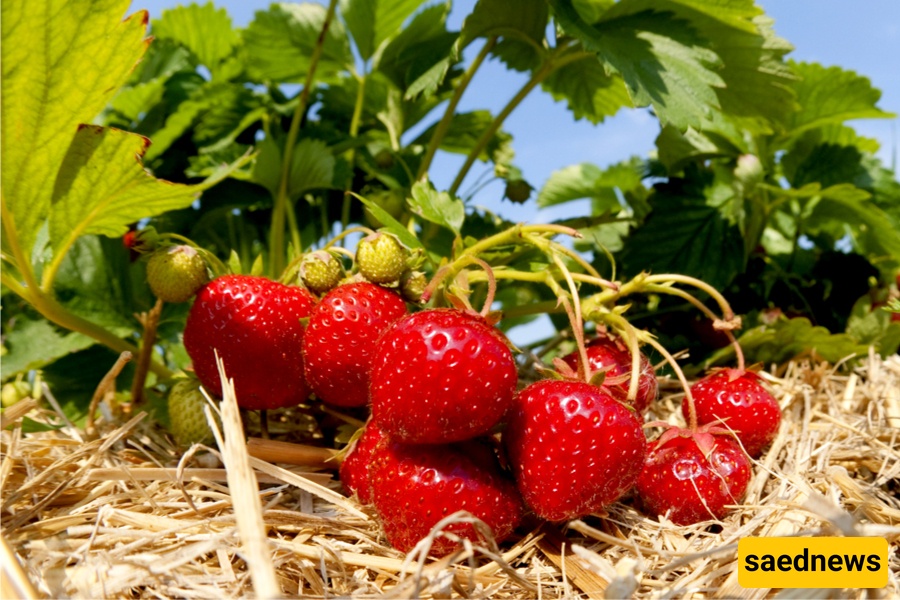
Varieties such as Aliso, Senga, and Atabaki produce flowers and fruit once during the growing season. In these varieties, photoperiod controls flowering. Flower differentiation occurs in late summer (around September) and is induced by leaves. Flower initiation occurs under short-day conditions, including floral induction, floral initiation, organ differentiation, and flower formation, leading to fertile buds.
During floral initiation, natural auxin levels in the plant decrease. In this stage, day length is less than 14 hours and temperature must be below 15°C. In June-bearing varieties, flowers appear in early spring, fruits develop during long days, and harvest occurs from June to July. Long days promote runner formation, increase leaf size, and inhibit flower bud formation in these varieties.
Everbearing varieties
Everbearing strawberries are not sensitive to day length, and flowering occurs throughout the growing season. These varieties produce fruit from spring to late autumn.
Comparing flower fertility, the first flower on the inflorescence produces larger fruits, while flowers on secondary branches produce smaller fruits. The first and second flowers are larger but produce less pollen.
Photosynthetic production, carbohydrate accumulation, and nutrient transport play important roles in fruit development and growth. Increased carbohydrate accumulation and transport capacity significantly affect fruit size. Nitrogen fertilization also influences flowering and fruit development.
In strawberry cultivation, flower removal (de-flowering) is performed to increase yield and improve fruit quality, as well as to strengthen young transplants for the next growing season. In June-bearing varieties, removing flowers also promotes runner development. However, in everbearing varieties, flower removal has little effect on runner formation but influences flowering intensity.
This practice is labor-intensive and costly, so chemicals such as ethephon and phosphonates are sometimes used to facilitate it. In some countries such as Northern Europe, the United Kingdom, Japan, and Korea, plastic tunnels are used to protect strawberries from cold and to produce early yields. Greenhouse cultivation is also used where economically feasible. Plastic tunnels consist of semi-circular wires placed along planting rows, covered with plastic sheets.
Propagation and cultivation
Strawberries are usually propagated through division of healthy young plants or by using plantlets formed on runners. Planting time depends on climate conditions. In regions with mild winters, planting is done in late summer so plants can adapt and produce better yields the following year. In colder regions, planting is better done in early spring.
There is competition between runner production and flower formation. To increase yield and quality, runners are often removed. However, for propagation purposes, flower removal is done to encourage stronger daughter plants.
Strawberries are highly sensitive to viral infections. In commercial production, infected plants are virus-indexed and cleaned before propagation. This can be done through meristem culture on MS medium or through thermotherapy. In heat treatment, infected plants are kept at 36°C for 6 weeks.
Strawberries can grow in various climates. Some northern varieties such as F. virginiana can tolerate temperatures as low as -30°C and are also resistant to late spring frost. Some varieties such as Mussonary and Blakemor are resistant to heat and drought. Cold-sensitive varieties can tolerate down to -10°C during winter. In cold regions, cold-resistant varieties are used, and protection methods such as plastic covers or straw mulching are applied.
Cold-tolerant buds require 200–300 hours of temperatures below 7°C. Strawberries prefer sandy loam soils with organic matter and humus for optimal growth. Organic fertilization improves soil quality. Neutral to slightly acidic soils are suitable.
Regular irrigation after planting is essential, usually every 5–7 days in furrow irrigation systems. Weed control, soil crust breaking, and disease management (such as powdery mildew, leaf spot, gray mold, and soft rot) are necessary agricultural practices. Mulching with straw or plastic is commonly used to retain moisture and control weeds.
Mulch helps stabilize soil temperature, reduce fluctuations, and protect roots from winter damage. Black or semi-transparent plastic mulch is often used in hill systems. Straw mulch is also used for cleanliness and frost protection.
Strawberries are typically grown in either mounded (raised bed) or flat row systems, depending on climate, planting time, irrigation method, replanting strategy, and mulch type.
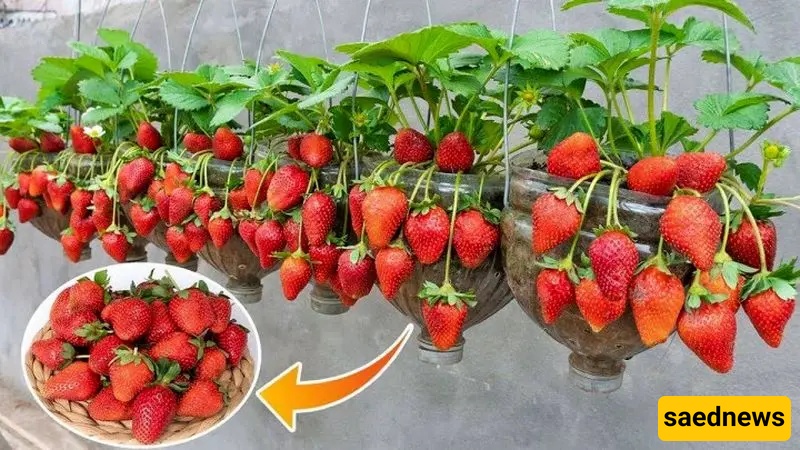
The raised-bed system is used in regions with long summers and mild winters. In this system, strengthening mother plants is the main goal, and runners are not allowed to develop. Planting is usually done in summer or autumn. Bed height is about 15–25 cm. Drip irrigation is commonly used, and beds are covered with plastic mulch. Black plastic is used in warm climates, while white plastic is used in colder climates. Plant spacing is 20–30 cm. Beds may be single or double row, and sometimes four-row systems are used.
Plants are kept for 1–2 years in this system. Runner removal is necessary for replanting. Advantages include easier weed control, early yield, higher productivity, and easier harvesting. However, higher cost and limitations in cold climates are disadvantages.
The row system is used in regions with short summers and cold winters. Runner development is important in this system. Planting is done in early spring after frost danger has passed. Beds are flat and not elevated. Straw mulch is commonly used. Furrow or sprinkler irrigation may be used. Drip irrigation is more economical, but sprinkler irrigation is preferred in areas with late spring frost risk.
Plant spacing is 45–60 cm. Wider spacing produces larger fruits, while closer spacing increases yield but reduces fruit size. In this system, plants are kept for 3–5 years.
In Western countries, under proper conditions, yields of around 40 tons per hectare can be achieved, whereas in Iran the average yield is about 5 tons per hectare.