SAEDNEWS: Celery belongs to the Apiaceae (Umbelliferae) family and is scientifically known as Apium graveolens L. var. dulce Mill. It is a biennial plant, although in horticulture it is commonly cultivated as an annual crop.
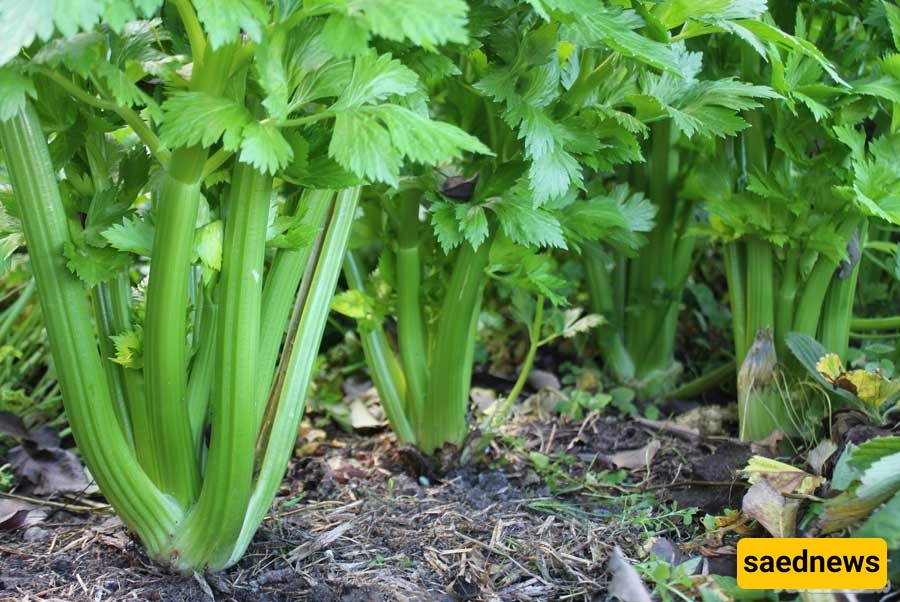
According to Saednews, Several types of celery have been developed, of which two are the most well known:
Leaf Celery: The stems and leaves are used for consumption.
Celeriac (Root Celery): The thickened root, which develops at soil level, is used.
This type of celery is not widely consumed in Iran. Celery is sensitive to both extreme cold and heat; therefore, proper irrigation is very important for its growth.
This project is very simple, similar to growing onions at home. For this purpose, the lower part of celery—usually discarded—is used.
Make sure the base of the celery is clean and free of any soil or contamination. Place it in a small container with a small amount of lukewarm water, ensuring the stem is facing upward. It is best to keep the container in a sunny location. The water level must be maintained and should not dry out during this stage.
The celery should remain in water for at least one week. During this period, small yellowish inner leaves begin to grow, gradually becoming thicker and turning dark green. Side stems may dry and shrink, while the central leaves grow slowly but visibly.
After planting, water the plant regularly. After about one week, noticeable growth of green leaves will appear. The plant should be kept in a sunny place and watered appropriately.
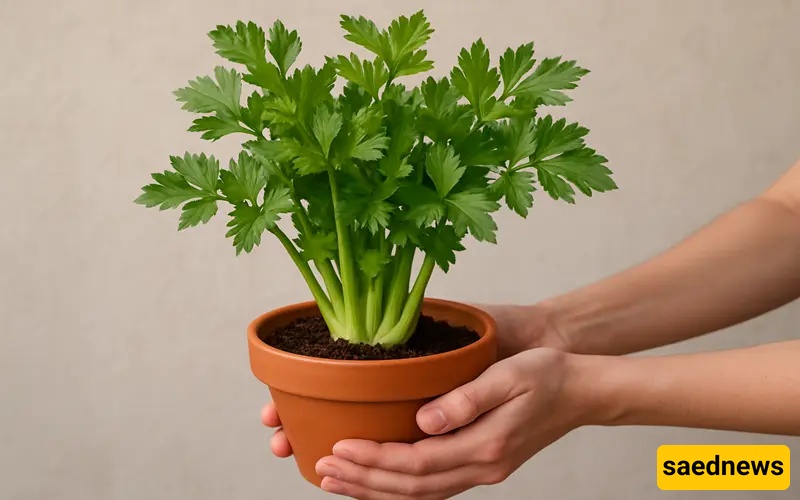
Celery can be grown either by direct seeding in the field at a spacing of 60–100 cm or by transplanting seedlings that are 10–15 cm tall. Celery seeds are very small and should not be planted deeper than 0.5 cm.
After germination, thinning is carried out by removing weak and small seedlings.
The best time to sow celery seeds is when the temperature is around 15°C. Although seeds can germinate at 5°C, the optimal temperature range is 15–20°C.
During the nursery stage, night temperatures should be around 12–15°C and daytime temperatures around 20–25°C. In cold regions, greenhouses or cold frames are used, and seedlings are transplanted once weather conditions improve.
In regions with mild winters, such as Khuzestan, nursery preparation begins in early autumn, and seedlings are transplanted when ready.
Celery is a cool-season vegetable that requires a long growing period. In cold regions, it is grown in greenhouses or protected environments before being transplanted outdoors when conditions become favorable.
It grows best in cool, humid weather—especially cool nights—with sufficient sunlight. In areas with uniform rainfall, celery develops strong roots.
Celery is highly sensitive to water shortage, although it can tolerate short periods of limited irrigation better than many other vegetables.
For high-quality celery production, soil must be deep, fertile, and never dry or lacking moisture. Good drainage is essential. The soil should be rich in organic matter and humus.
Peaty soils are particularly suitable. Sandy loam or silty loam soils are also good if they contain enough organic matter and moisture. Celery does not tolerate acidic soils unless they are corrected with lime.
It can tolerate slightly alkaline conditions and, in some cases, mild salinity. In salty soils, celery may absorb salts into its stems, giving them a slightly salty taste without harming the plant.
The optimal soil pH for celery is 6–7.
Celery is a nutrient-demanding plant. Soil should be enriched with animal manure and organic fertilizers. Chemical fertilizers are also recommended, especially those rich in readily available nitrogen, such as ammonium nitrate and superphosphate.
Studies in the United States show that celery removes large amounts of nitrogen, phosphorus, potassium, and magnesium from the soil. For this reason, up to 950 kg/ha of complete fertilizer (NPK) is used in some regions to achieve high yields.
Celery yields in some areas can reach 70 to 100 tons per hectare.
Recommended fertilizer amounts depend on soil type, organic matter content, climate, and fertilization method. Generally, fertilizers should be incorporated into the soil before planting at a depth of about 30 cm.
Typical recommendations per hectare include:
200–250 kg nitrogen fertilizer
150–200 kg phosphorus fertilizer
Similar amounts of potassium fertilizer
Nitrogen is usually applied in 2–3 split doses during growth.
Calcium and boron are also essential. Calcium deficiency can cause black heart, where young leaf tips and edges turn brown and black, eventually affecting the entire plant. Boron deficiency causes cracks in petioles and reduces quality.
Calcium chloride sprays can help control calcium deficiency. Applying about 10 kg/ha of borax has been shown to prevent boron deficiency issues.
Celery can be harvested at any stage, but the ideal time is when the petioles are fully developed, forming a compact bunch, and the leaves are light green in color.