SAEDNEWS: In this article, you will learn how to build a simple force meter using easily available materials and Hooke’s law. This force meter can be used to measure the force and mass of objects.
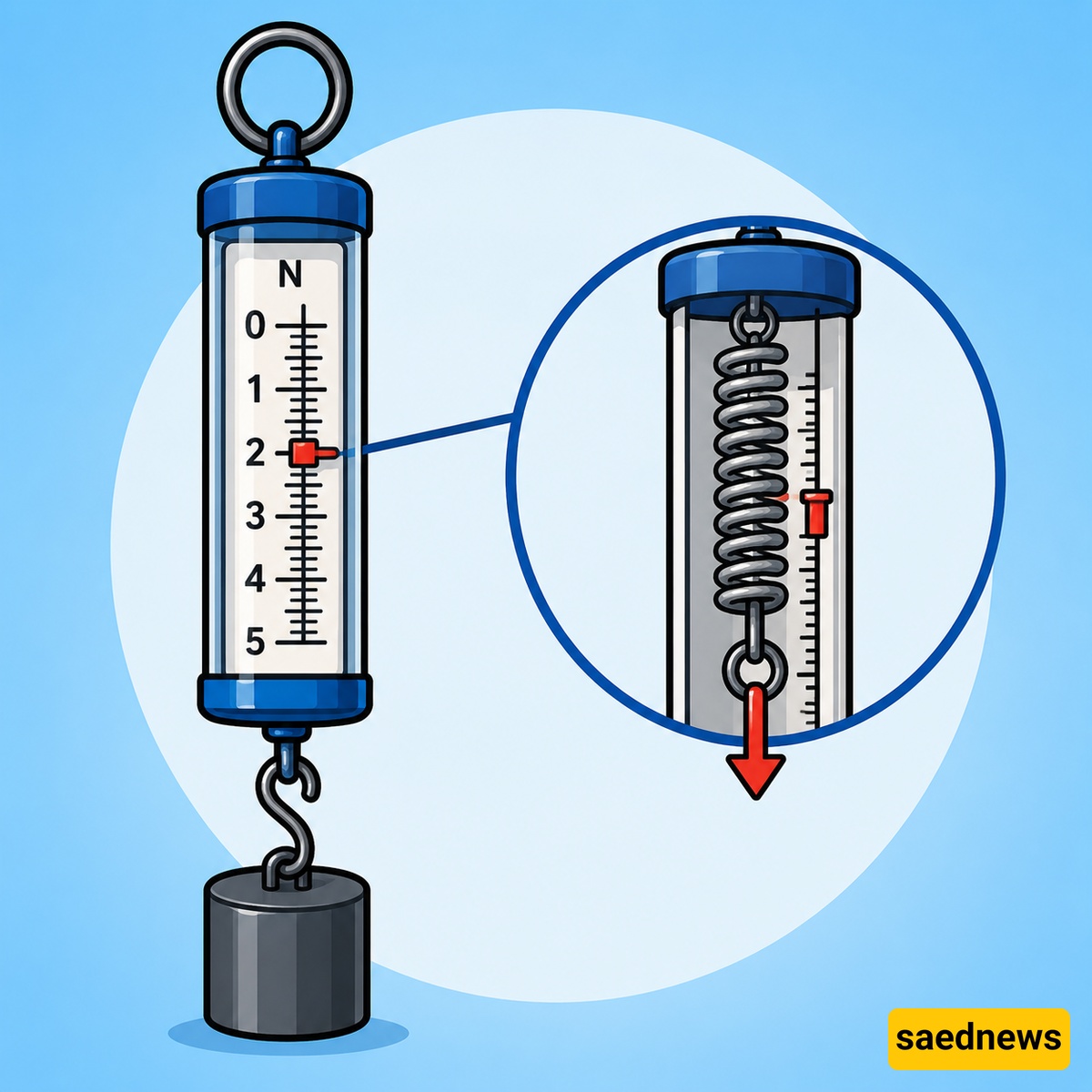
According to Saednews, Force is a valuable physical quantity and plays an important role in physics. Newton established the foundation of classical physics by formulating his three laws of motion concerning force.
For this reason, the unit of force was named the newton (N) in honor of this great scientist. One important aspect of studying force is being able to measure it accurately.
In laboratories, force is usually measured using precise force meters. However, in this experiment, the goal is to construct a simple force meter using only a few basic materials.
The force meter described here works according to Hooke’s Law. Hooke’s Law applies to springs and states that when a force is applied to a spring—provided that the force does not exceed the spring’s elastic limit or permanently deform it—the change in the spring’s length is proportional to the applied force.
Each spring has a constant known as its spring constant, which represents its stiffness. This constant converts the proportional relationship into an equation.
In other words, if the applied force is represented by F, the change in length by ΔL, and the spring constant by K, Hooke’s Law can be written as:
F = KΔL
A 0.5-meter-long piece of copper or iron wire
One rod
One stand or base
One ruler
One weight of known and suitable mass

First, wrap the copper or iron wire around a pen or pencil so that the wire takes the shape of a spring. Secure the rod to the stand so that it remains horizontal.
Hang the spring from one point on the rod. The two ends of the spring should be bent into hooks so that it can be easily suspended.
Measure the length of the unloaded spring carefully using a ruler and record the measurement. Let this initial length be L₁.
Next, hang the weight of known mass from the other end of the spring. The mass should be chosen carefully so that it is not large enough to permanently stretch or deform the spring. Wait until the spring reaches equilibrium.
Measure the new length of the spring with the ruler and record it as L₂.
The change in the spring’s length is then calculated as:
ΔL = L₂ − L₁
If the known mass of the weight is represented by m and the gravitational acceleration at the location is represented by g, the spring constant K can be calculated using:
mg = KΔL
Therefore:
K = mg / ΔL
Once the spring constant has been determined, the device can be used to measure unknown masses. By measuring the change in the spring’s length and using:
mg = KΔL
the unknown mass m can be calculated as:
m = KΔL / g
It is important to remember that every spring has its own specific spring constant. Also, weights that are too heavy should never be attached to the spring, as they may stretch it beyond its elastic limit and permanently change its shape.