SAEDNEWS: A striking astronaut-captured image shows concentric stone rings in the African desert, resembling nested walls topped by a hat-like formation. The site also contains traces of ancient artwork within the structures.
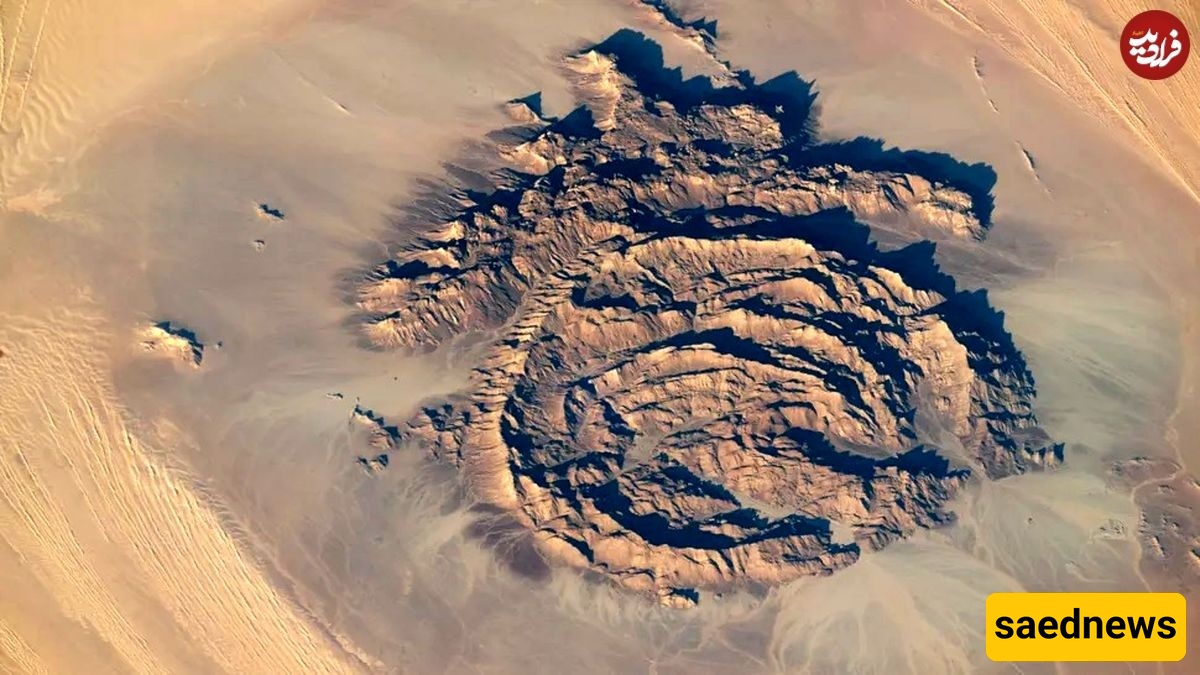
According to the Society Desk of Saed News, this immense formation known as “Mount Arkanu” is a mountainous massif made up of concentric rings of rock that rise about 800 meters above the surrounding sand. At its widest point, it spans roughly 25 kilometers. It is located in southeastern Libya, near the Egyptian border.
In the past, scientists believed this structure to be an impact crater formed by the collision of a massive meteorite with Earth. However, recent research has shown that these ring formations are not of extraterrestrial origin.
Instead, the mountains were formed through repeated upwelling of magma toward the Earth’s surface, which intruded into the surrounding rock layers. This process likely ended hundreds of millions of years ago, although the exact timing remains uncertain. These successive intrusions created overlapping circular patterns, with the center of the formation slightly tilted toward the southwest. The complex consists of igneous rocks such as basalt and granite, while its northern section is capped by a “roof-like” layer of sandstone, limestone, and quartz.
On the outer southern wall of the massif, two large fissures can be seen, gradually carved over time by wadis—seasonal river channels that only carry water during rainfall and remain dry for most of the year. Even so, their winding paths are still visible across the surrounding plains.
The region is part of the extremely arid Sahara Desert, receiving only 1 to 5 millimeters of rainfall annually. However, the massif itself receives slightly more precipitation—about 5 to 10 millimeters per year—due to orographic rainfall, where clouds release moisture upon encountering elevated terrain.
As a result, limited vegetation has developed within the ring structure, including grasses, shrubs, and even some trees, which are partially protected from the desert heat by the shade of the peaks.
This combination of shade, sparse vegetation, and limited water has made the area historically suitable for nomadic groups. Nearby lies another similar massif known as Mount Awaynat, which provides comparable environmental conditions.
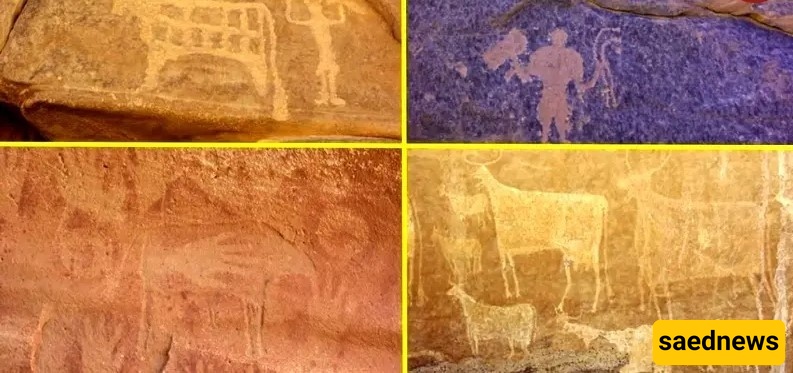
Perhaps even more fascinating is the presence of ancient rock art (petroglyphs) found on the canyon-like walls of the mountains, discovered in 2003. These carvings depict humans, cattle, and other animals such as giraffes.
The artwork suggests that the region was used for livestock herding thousands of years ago. Even in the early 20th century, reports indicated that Bedouin tribes brought their herds into these mountains for extended periods, sometimes blocking exit routes to prevent animals from escaping.
Overall, this remarkable structure is not only a unique geological formation but also a testament to the deep connection between nature and human life across thousands of years.