SAEDNEWS: Boxwood (Buxus sempervirens), also called Hyrcanian boxwood (Buxus hyrcana), is an evergreen shrub first described by Carl Linnaeus in 1753. The subspecies B. hyrcana grows in northern Iran and the eastern Caucasus. It is also used as a medicinal plant.
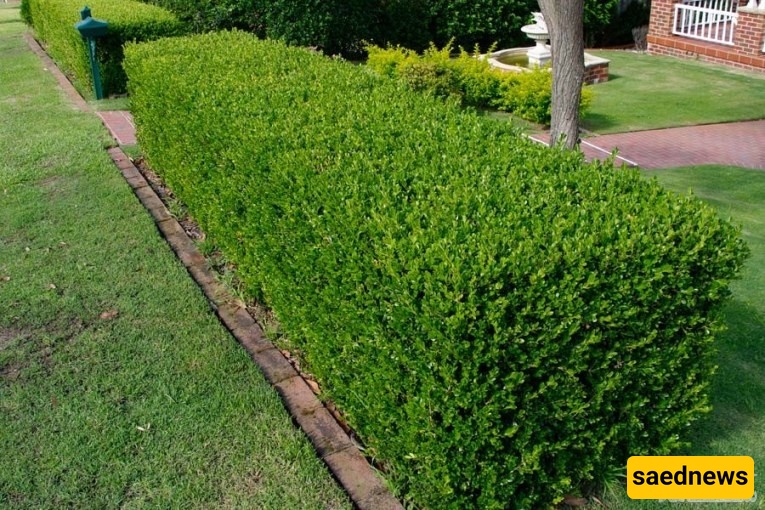
According to Saednews, The boxwood tree, with the scientific name Buxus and the English name Boxwood, is an ornamental plant that includes several species. These plants are commonly used in urban and residential landscaping due to their attractive appearance. Boxwood is typically a low-growing shrub with a tendency toward bush-like or small tree form. By learning about the conditions required for its growth, one can better cultivate this remarkable plant.
Boxwood species are evergreen plants that are nourished mainly by rainfall. In Iran, they are mostly found in the northern provinces such as Gilan, Mazandaran, and Golestan, where rainfall is abundant.
These plants belong to the order Buxales and the family Buxaceae (and in some classifications Celastraceae is also mentioned due to similar ornamental species often confused with boxwood).
Boxwood is considered an endangered and prohibited-cut species in some regions.
Its natural habitat includes Asia, Europe, and Africa.
These plants are slow-growing perennials; under normal conditions, they may reach about 1 meter in height after 5 years.
Boxwood seedlings are usually first grown in pots and then transplanted to gardens, green spaces, and landscapes once they mature.
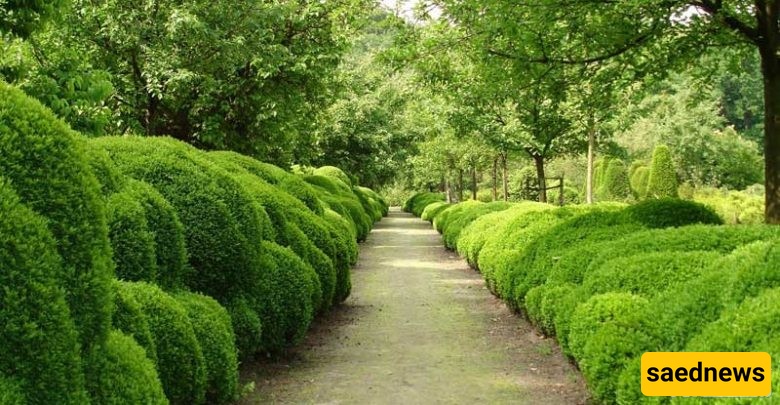
They perform best in warm and humid regions.
Boxwood forests cover approximately 72,000 hectares of northern Iran’s forested areas. However, in recent years, more than 4,000 hectares have been affected by pest outbreaks. If neglected, this valuable natural heritage may be lost.
Boxwood is one of the most valuable and unique species of the Hyrcanian forests. In recent years, it has been severely threatened by pests and diseases, including boxwood blight caused by the fungus Cylindrocladium buxicola, as well as the invasive box tree moth, which entered the Hyrcanian forests in late June and has become a major threat.
Scientific characteristics:
Another commonly cultivated ornamental plant often confused with boxwood is Euonymus japonicus, belonging to the family Celastraceae. This genus includes about 176 species of evergreen ornamental plants suitable for hedges and pruning.
This species is native to Japan and can reach up to 4 meters in height in natural conditions. Its leaves are glossy, dark green, leathery, and oval-shaped with slightly serrated edges. The inflorescence is about 5 cm long, and its flowers are greenish-white, appearing in mid-spring. It produces pink to orange fruits.
One important note for cultivation is that during summer it should be kept outdoors, while in winter it requires sufficient fertilization and may be kept indoors in a cool environment.
Light and temperature:
It grows well in full sun or partial shade and tolerates minimum temperatures of about 5°C.
Watering:
Regular watering is required. The soil should remain slightly moist before the next irrigation.
Humidity:
Optimal humidity is between 50% and 70%.
Fertilization:
Apply fertilizer at a concentration of about 5 grams per liter every two weeks from May to September.
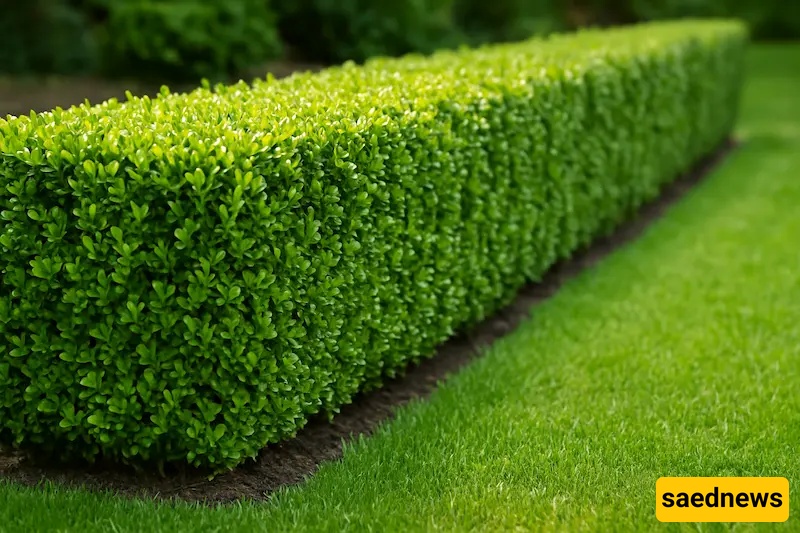
Boxwood and related ornamental shrubs include around 176 species.
This species has small, rounded leaves with smooth edges and a dark green color. It is an evergreen plant.
It can grow between 4 to 10 meters and is widely used for hedges and decorative shaping due to its high pruning tolerance. Its trunk diameter may reach up to 20 cm.
The flowers are small, greenish-white, slightly fragrant, and bloom in spring. It prefers cooler climates over warm regions.
Despite its name, this plant is not a true boxwood. It is native to Japan, Taiwan, Korea, and China and is often mistakenly called Japanese boxwood in Iran.
It has large, leathery leaves with yellow and green spots. It is evergreen but differs significantly from true boxwood species.
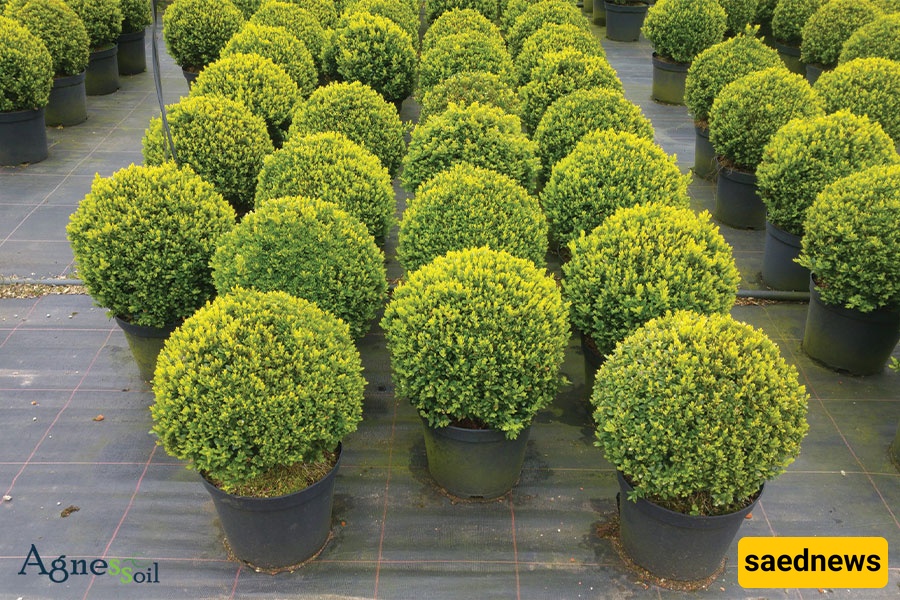
Also known as golden boxwood or ornamental boxwood, this plant has small green or variegated leaves. It is evergreen and often used in landscaping.
It grows up to 1–1.5 meters and is suitable for hedges and decorative shaping. It produces small fragrant flowers and pink-orange fruits.
This evergreen plant has variegated leaves ranging from yellow to light orange. It can grow in a creeping or climbing form, covering soil or surfaces.
In its natural habitat, it may reach up to 20 meters, but cultivated varieties usually grow only 1–2 meters.
Pruning is essential for boxwood maintenance. Young plants should be pruned regularly to promote dense growth. Plants used for hedges or ornamental shapes require continuous trimming.
Proper pruning improves airflow inside the plant canopy and helps prevent fungal diseases such as powdery mildew. In hedge forms, the lower part should always be wider than the upper part to ensure sunlight reaches all sections.
For temperate climates, pruning is often done in late autumn to maintain shape during winter. Regular tip pruning also encourages lateral branching and denser growth.