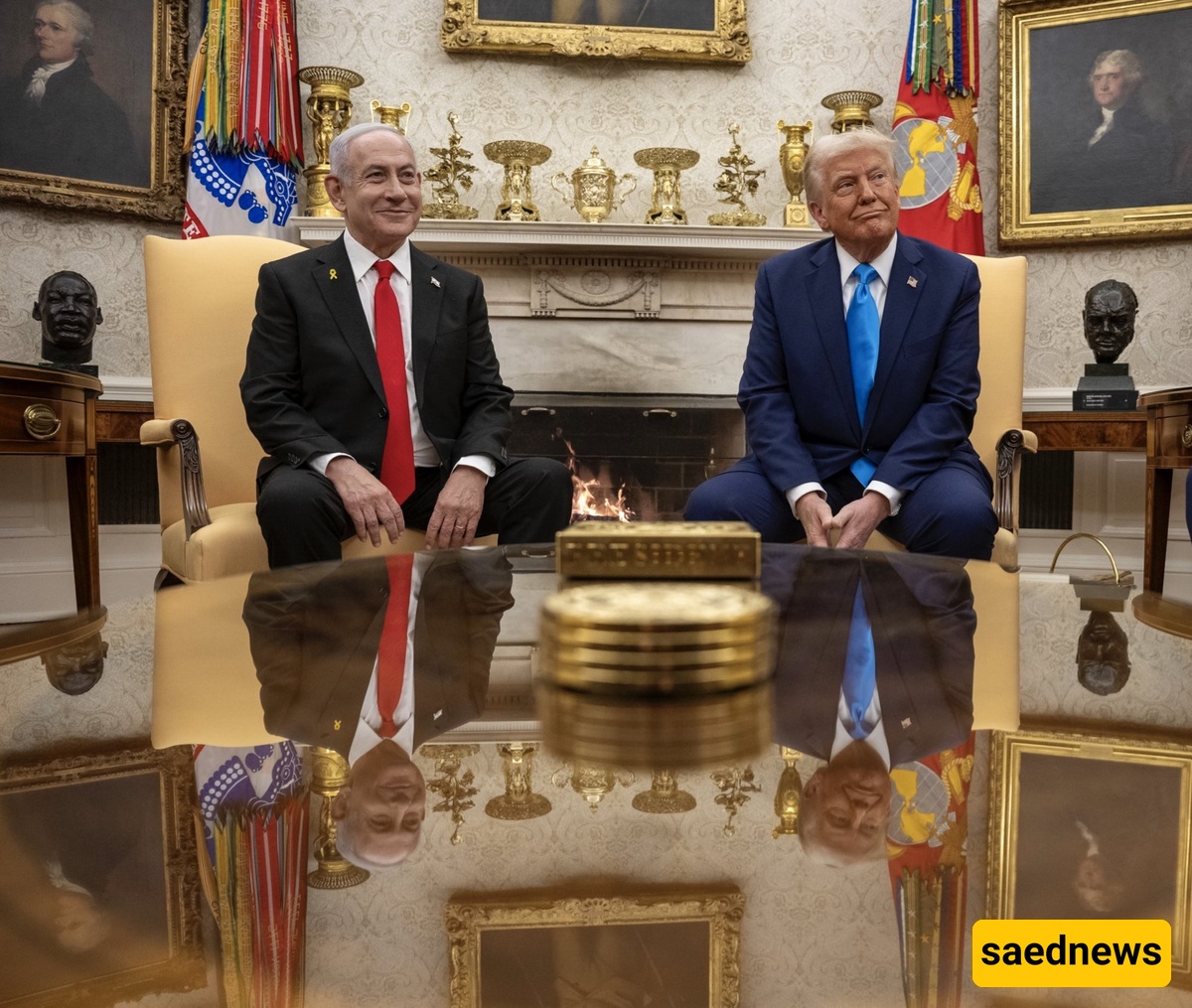
SAEDNEWS: A West Asia expert said Benjamin Netanyahu's urgent visit to Washington is his eighth trip to the U.S. in two years. The analyst believes he is trying to secure U.S. support for a new phase of tensions with Iran as Israel's Knesset elections approach in October.
According to Saednews, Ahmad Zarean, a West Asia affairs analyst, argued that the United States failed to achieve its declared objectives during its recent confrontation with Iran. According to him, Washington had aimed to weaken Iran's military capabilities and challenge its control over the Strait of Hormuz, but the outcome was the opposite.
Zarean said that while the United States sought to reduce Iran's military strength, it instead faced significant difficulties replenishing its own strategic weapons stockpiles, particularly advanced air defense missiles such as the Patriot system. He noted that sophisticated weapons are produced in limited numbers each year, and restoring depleted inventories below half of standard levels could take five to six years. He added that although U.S. planners reportedly expected the conflict to last only a few days, military operations continued for approximately five months.
Referring to the intense exchanges during the most recent 13 nights of fighting, Zarean claimed that some nights saw around 200 attacks. He argued that U.S. officials expected Iran to concede to American demands and reopen the Strait of Hormuz, but instead encountered stronger resistance.
He also stated that Washington believed strikes against Iranian military installations, radar sites, air defense systems, and missile facilities would significantly weaken Iran's defensive capabilities. According to Zarean, Iran instead demonstrated its ability to retaliate by targeting U.S. military bases in several countries. He claimed that Iran carried out coordinated attacks against American facilities in Jordan, Bahrain, and Kuwait over multiple days.
Zarean cited reports from The Wall Street Journal and The New York Times, saying they highlighted U.S. limitations in maintaining strategic weapons supplies and discussed Iran's ability to impose military costs on the United States. He also referred to the concept of Iran's "mosquito fleet"—its use of fast attack boats and asymmetric naval tactics.
According to Zarean, the United States not only failed to accomplish its objectives during the 13-night campaign but also suffered military setbacks and operational disruptions at regional bases. He described the campaign as a "maximum-intensity war," arguing that Washington had already employed nearly all of its available military options.
He further stated that the United States faces greater constraints in conducting large-scale ground operations because of its reliance on naval power, limited regional basing, and restricted airborne deployment capabilities.
Discussing Ukraine's recent actions, Zarean claimed that Ukraine acted with encouragement from Israel. He suggested there was close coordination between U.S. President Donald Trump and Ukrainian President Volodymyr Zelenskyy and argued that the attack was intended to provoke an Iranian response that could draw European countries into the conflict.
However, he said Europe and NATO have shown little willingness to become directly involved in military action against Iran. He also argued that many countries now view the conflict as serving U.S. and Israeli strategic interests rather than broader international security concerns.
Zarean noted that NATO did not actively participate during what he described as the "40-day war," adding that disagreements between the United States and NATO members reduced the likelihood of European military involvement against Iran.
He maintained that Iran would respond firmly to Ukraine's actions, although he did not specify the timing or nature of any potential response.
Turning to Iran's relationship with Oman, Zarean described bilateral ties as historically strong and based on mutual trust. He said Oman has an interest in cooperating with Iran on the security and management of the Strait of Hormuz.
According to him, discussions between Iranian and Omani officials had progressed toward an agreement after a ceasefire, but U.S. pressure allegedly persuaded Oman to withdraw from closer cooperation.
He argued that without external pressure, Iran and Oman could jointly contribute to regional security in the Strait. Otherwise, he said, Iran would have to pursue its own policies independently to safeguard its national interests.
Zarean said Israeli Prime Minister Benjamin Netanyahu's latest visit to the United States was prompted by rapidly changing regional developments rather than long-term planning. He noted that it was Netanyahu's eighth trip to the U.S. in two years.
According to Zarean, Netanyahu sought to persuade Washington that Iran's nuclear program should remain a major security concern. He suggested that the visit was part of broader efforts to frame Iran's nuclear activities as an urgent international security issue.
He also argued that continued tensions between Iran and Israel could provide Netanyahu with domestic political advantages ahead of Israeli parliamentary elections.
Zarean predicted that regional confrontations could continue, citing previous cycles of conflict followed by renewed fighting. He concluded that repeated escalation would not benefit the United States or its regional allies and stressed the need to break the recurring cycle of war, ceasefires, negotiations, and renewed conflict.
Zarean claimed that Israel is currently facing one of its most challenging security and political periods in decades. He pointed to domestic political divisions, upcoming elections, and public opinion polls suggesting increased competition for Prime Minister Netanyahu.
He also argued that Israel has not achieved decisive strategic victories in regional conflicts since the October 7 attacks and continues to face economic pressure, outward migration, declining public resilience, and concerns about domestic security.
According to Zarean, Israel's military defenses have become more vulnerable, while Iran has expanded and preserved its missile capabilities through recent conflicts. He claimed that Israel is now primarily focused on defense and has expressed concern about the possibility of a preemptive Iranian strike.
In his concluding remarks, Zarean stated that many U.S. aircraft have been stationed at Israeli bases because of growing security concerns elsewhere in the region. He argued that this reflects a shift in the regional military balance and claimed that Israel has increasingly adopted a defensive posture in its confrontation with Iran.