SAEDNEWS: The Iranian newspaper Farhikhtegan wrote that Donald Trump is caught in a lose-lose dilemma. He must either accept an agreement in which Iran holds the upper hand or return to a costly conflict whose failure has already been experienced in the past.
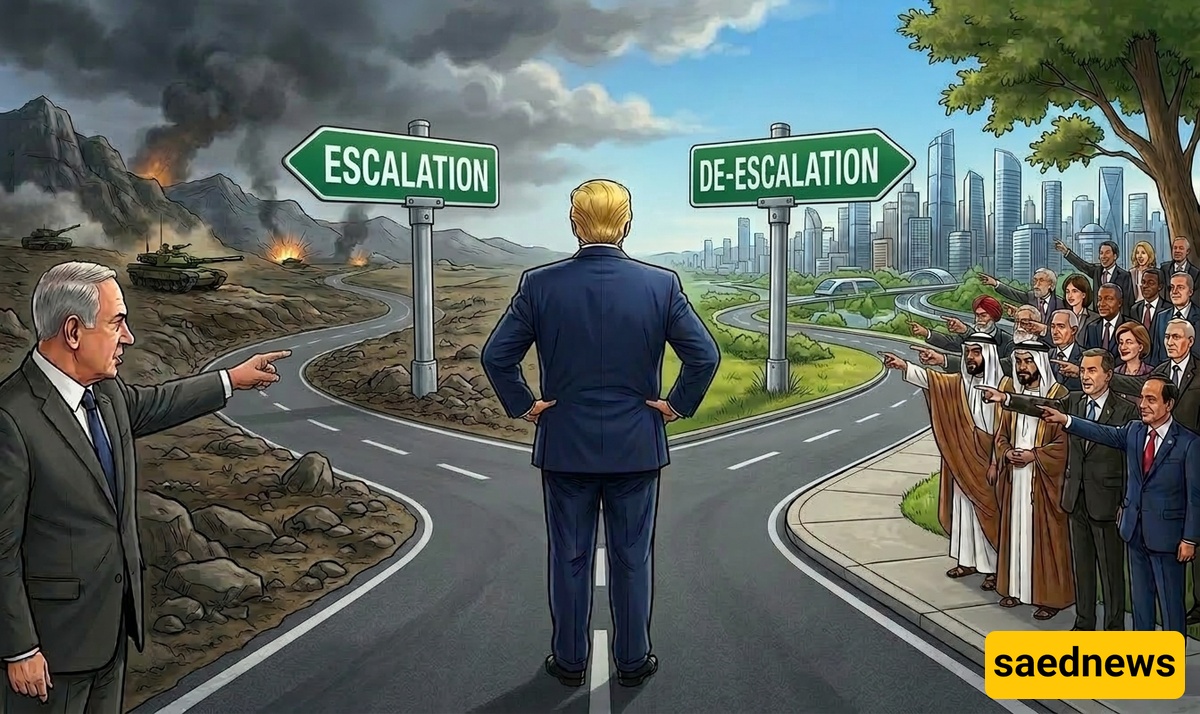
According to a report by the political desk of Saed News, citing the Iranian newspaper Farhikhtegan, U.S. President Donald Trump has reached a position where any decision he makes could end in failure. Negotiations reportedly collapsed at the last moment yesterday, pushing the situation back into uncertainty, while regional mediators from Pakistan to Qatar continue efforts to bridge the gap between the two sides.
Although Trump publicly claims he is in no hurry to sign an agreement, growing diplomatic activity across the region suggests otherwise. His recent statements hinting at progress have already sparked criticism from some pro-war Republicans and monarchist opposition groups.
The report states that Trump now has only two choices: either accept an agreement largely shaped around Iran’s demands or return to a path of confrontation that has already failed twice before. Continuing conflict would impose heavy costs on the United States, particularly through damage to oil reserves and financial markets, while Washington’s regional allies appear unwilling to support an endless military escalation.
At the same time, accepting such a deal could trigger intense backlash from the hardline base of the Republican Party. One of the key elements of the proposed framework is Iran’s step-by-step strategy, which first focuses on ending hostilities, lifting blockades, and ensuring security before moving to additional details within a 30-to-60-day timeline.
The report further claims that, regarding the Strait of Hormuz, management of the waterway would continue under Iranian protocols until preliminary nuclear negotiations take place, allowing Tehran to secure new strategic advantages. The United States is also said to have committed to fully lifting maritime restrictions and releasing frozen Iranian assets, while a regional reconstruction fund would reportedly be established to provide compensation payments.
Perhaps the most controversial aspect of the proposal is that Iran has reportedly made no nuclear commitments at this stage, postponing the issue to a later phase of negotiations. The reported agreement has deepened divisions within Republican circles, with figures such as Ted Cruz, Lindsey Graham, and Mike Pompeo strongly criticizing the approach, leaving Trump politically squeezed.
The situation highlights how the U.S. “maximum pressure” strategy is once again confronting realities on the ground, while Iran appears to have used a combination of diplomacy and resistance to impose its priorities on the opposing side. Securing influence over the Strait of Hormuz and establishing a reconstruction fund without making nuclear concessions would represent a significant achievement for Tehran and could potentially ease the country’s economic crisis.
However, Trump’s final decision is expected to be heavily influenced by domestic Republican pressure and America’s own economic challenges. Whatever path he chooses is likely to carry major consequences for Washington’s foreign policy and could become a turning point in regional developments.