SAEDNEWS: Prayer begins with the words “Allahu Akbar.” Saying “Allahu Akbar” at the beginning of prayer symbolizes turning away from everything other than God and turning wholeheartedly toward Him. It is a declaration of the greatness of the Lord and a rejection of all false powers and authorities.
According to Saednews, The word Salat (prayer), along with its derivatives, appears 98 times in the Qur’an. It holds such a prominent position that in many verses it is mentioned alongside faith as one of the most important and fundamental individual and social duties of believers.
On the other hand, the Qur’an not only mentions the abandonment of prayer among the first complaints of the people of Hell (Al-Muddaththir 74:42), but also places those who are negligent about their prayers alongside those who deny the religion (Al-Ma‘un 107:5).
No obligatory act is emphasized in the Qur’an as strongly as prayer. Prayer is described as a means of preventing sin, attaining success and salvation, receiving help in the difficulties of life, and one of God’s important instructions to His prophets. It was also a major concern of the great prophets of God, particularly with regard to their families.
Prayer also holds a very high position in the teachings and conduct of the Prophet Muhammad (peace and blessings be upon him and his family) and the Imams. More than 11,600 narrations concerning prayer have been recorded in the two books Wasa’il al-Shi‘a and Mustadrak al-Wasa’il.
In this article, we address several questions and answers concerning prayer.
When reciting the obligatory words and formulas of prayer, the body must remain still. According to obligatory precaution, the body should also remain still when reciting recommended supplications.
— Imam Khomeini, Tawdih al-Masa’il (Hashiyah), Vol. 1, p. 538, ruling 965.
If a person deliberately recites an obligatory formula while moving their body, the prayer becomes invalid.
If a person recites a recommended formula while moving—for example, saying the takbir while going into bowing (ruku‘) or prostration (sujud)—then, if it is recited merely with the general intention of remembering God (dhikr), the prayer is valid.
However, if it is recited with the intention that it is the specific recommended formula prescribed for that particular part of the prayer, most religious authorities state that, as a matter of obligatory precaution, the prayer should be repeated. Imam Khomeini issued a ruling requiring the prayer to be repeated in this situation.
Some jurists, however, consider the prayer valid even in this case, including Ayatollahs al-Khoei, al-Sistani, and al-Tabrizi.
— See Imam Khomeini, Tawdih al-Masa’il (Hashiyah), Vol. 1, p. 538, ruling 966.
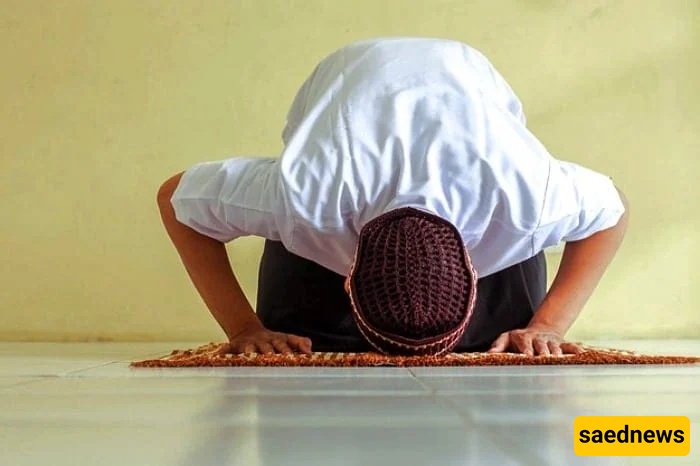
There are 11 obligatory acts of prayer:
Intention (niyyah)
Standing (qiyam)
The opening takbir (takbirat al-ihram)
Bowing (ruku‘)
Prostration (sujud)
Recitation (qira’ah)
Remembrance or prescribed formulas (dhikr)
Testimony (tashahhud)
Salutation (salam)
Proper sequence (tartib)
Continuity (muwalat), meaning that the different parts of the prayer are performed consecutively without inappropriate interruption.
The difference between a pillar and a non-pillar is that if a pillar is deliberately or accidentally omitted, the prayer becomes invalid.
By contrast, if a non-pillar is deliberately omitted, the prayer becomes invalid, but if it is omitted unintentionally, the prayer remains valid.
— Imam Khomeini, Tawdih al-Masa’il, ruling 942.
No. It is not necessary to verbalize the intention. It is sufficient to know what you intend to do. If someone were to ask you what you were intending to do, and you could answer them, that is sufficient.
— Imam Khomeini, Tawdih al-Masa’il, rulings 943 and 945; Istifta’at, Vol. 1, p. 151, question 82.
For religious rulings, it is necessary to know which religious authority the person follows. Nevertheless, since this particular issue is relatively common, the following rulings may be useful.
For prayer to be performed properly, the place where the worshipper is praying should be stable and free from disturbing movement, except in cases of necessity. The worshipper's own body should likewise remain still.
Minor movements of the head or hands that are not generally considered to disturb the required stillness do not invalidate the prayer.
However, if intentional or unintentional movement of the head causes the worshipper to turn away from the direction of the qiblah—for example, turning significantly to the right or left—the prayer becomes invalid.
With this in mind, consider the following rulings:
Ruling 968: If, while reciting Surat al-Hamd and another surah, or while reciting the tasbihat, a person involuntarily moves to such an extent that they are no longer considered to be in a state of stillness, the obligatory precaution is that, after becoming still, they should repeat what they recited while moving.
Ruling 967: Moving the hands or fingers while reciting Surat al-Hamd is not problematic, although it is recommended as a precaution not to move them either.
Imam Khomeini, Tawdih al-Masa’il (al-Muhashsha), Vol. 1, p. 490, ruling 880.
Ibid., ruling 965.
Ibid., Vol. 1, p. 617, ruling 1131.
Ibid., Vol. 1, p. 540.
Ibid., Vol. 1, p. 539.