SAEDNEWS: The National Museum of Scotland, with more than 160 years of history, showcases a remarkable collection of Scotland’s archaeological, artistic, and natural heritage in the heart of Edinburgh, and is recognized as one of the most important national museums in the world.
According to Saednews, The National Museums Scotland, located in the heart of Edinburgh, is a unique treasure trove of world history, science, and culture. From the preserved body of Dolly the cloned sheep to 3,000-year-old swords, everything is housed under one roof. With free admission and over 2 million annual visitors, it is one of Scotland’s most popular attractions. This article introduces the most important sections of the National Museum of Scotland.
The National Museum of Scotland is one of the world’s most prominent cultural and scientific institutions, located in the heart of Edinburgh. Known in Scottish Gaelic as Taigh-tasgaidh Nàiseanta na h-Alba, it represents Scotland’s national identity and holds an extensive collection of historical, cultural, scientific, and natural objects.
The museum was formed in 2006 through the merger of two neighboring institutions: the Museum of Scotland (focused on archaeology and Scottish history) and the Royal Museum (focused on science, technology, and global cultures). Its buildings are located on Chambers Street, at the junction with George IV Bridge, and it is part of National Museums Scotland. Entry is free, and in 2019 it attracted more than 2.2 million visitors, making it the most visited attraction in Scotland.
The museum not only preserves archaeological treasures from Scotland and medieval artifacts, but also houses global collections in geology, archaeology, natural history, science, technology, art, and world cultures. Among its most notable exhibits are Dolly the sheep (the first cloned mammal from an adult cell), an Ancient Egypt exhibition, Elton John’s flamboyant stage outfits, Jean Muir fashion collections, the Millennium Clock (a large kinetic sculpture), and the “Scottish Maiden,” an early guillotine-like execution device popular with school visitors.
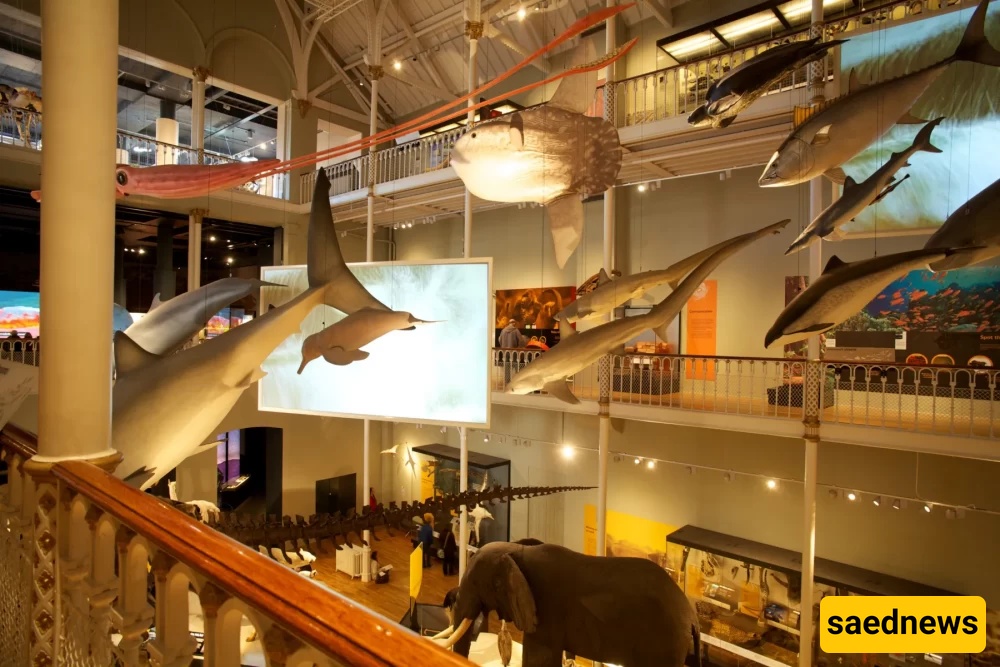
The museum’s origins date back to 1697, when Robert Sibbald, a physician and naturalist, donated a collection of natural history specimens to the University of Edinburgh’s medical school. Developed with Andrew Balfour, it became one of the earliest museum collections in Britain.
In 1737, Daniel Defoe described it as a “cabinet of curiosities,” unique in Europe in some respects. The collection expanded under professors such as Robert Ramsay and John Walker. In 1804, Robert Jameson transformed it into a public institution, later renamed the Royal Museum of the University.
Over time, donations from naval voyages and scientific expeditions enriched the collection. Taxidermist John Edmonstone worked there and even taught Charles Darwin. By the mid-19th century, overcrowding led to the decision to move the collection to state control.
Construction of the Chambers Street building began in 1861, and it opened in 1866 as the Industrial Museum of Scotland (later renamed multiple times). Major expansions followed in 1875 and between 1888–1890. In 1904, it became the Royal Scottish Museum.
In 1985, it became part of National Museums Scotland. The Museum of Scotland opened next door in 1998, and the two were formally merged in 2006. A major renovation closed the building in 2008, and it reopened in 2011 after a £47 million redevelopment. In recent years, discussions have also included the repatriation of cultural artifacts, such as a totem pole returned to the Nisga’a Nation in Canada.
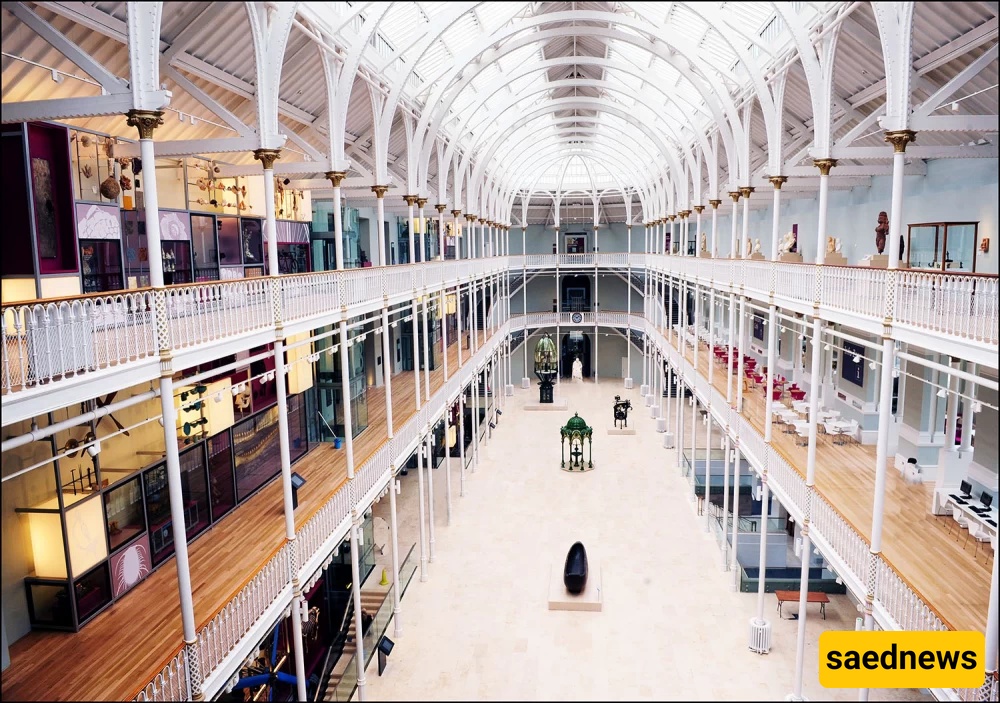
The museum consists of two distinct buildings.
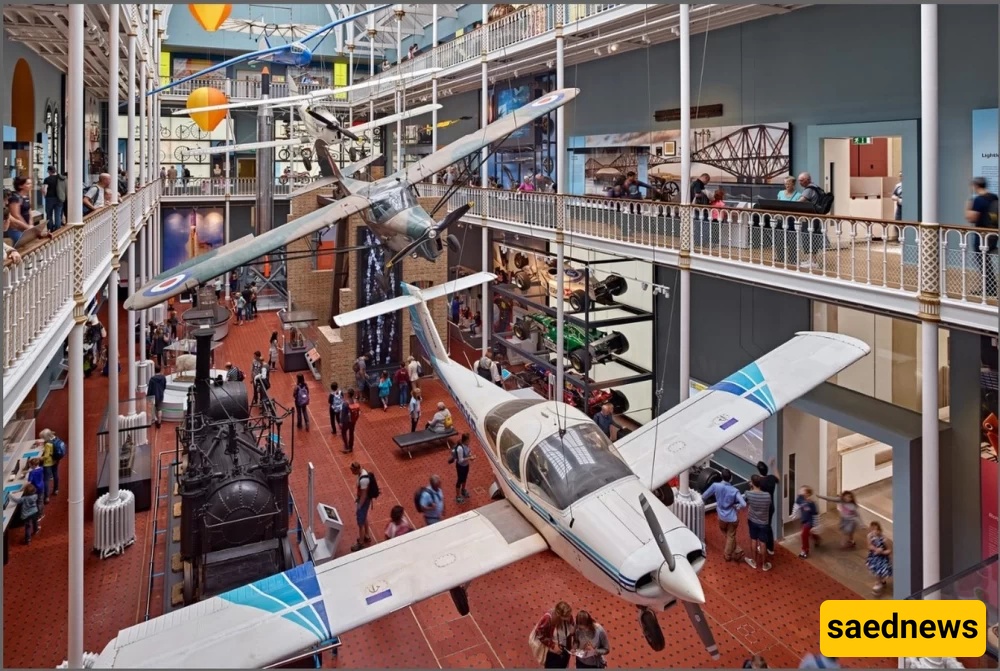
The older Victorian building (Royal Scottish Museum) was constructed between 1861 and 1888. Its Venetian Renaissance-style façade was designed by Francis Fowke and Robert Matheson. The central Grand Gallery features a dramatic iron-and-glass structure inspired by the Crystal Palace.
Later extensions were added in the 1930s. The 2011 renovation by Hoskins Architects created a large modern entrance hall with improved accessibility, including lifts and escalators.
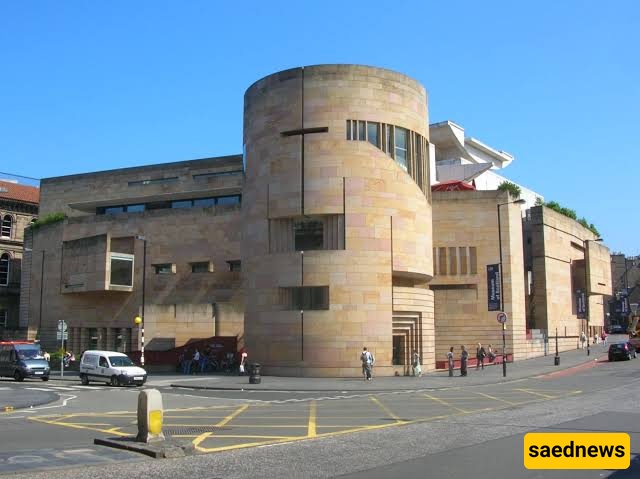
The newer Museum of Scotland building (opened in 1998) was designed by Benson & Forsyth. Its geometric forms are inspired by modernist architecture and Scottish defensive structures such as brochs and castles. Clad in golden Moray sandstone, it blends modern design with national heritage themes. It also features a rooftop garden with panoramic views of Edinburgh.
The museum’s collections include Scottish archaeology, medieval artifacts, and global cultural objects. The Museum of Scotland building presents Scottish history chronologically from prehistoric times to the modern era.
The Victorian building focuses on natural history, global cultures (including Oceania, East Asia, and Ancient Egypt), European art and design, and science and technology.
Highlights include the Grand Gallery, featuring large objects, and the 20-meter “Window on the World,” showcasing over 800 items. The “Discoveries” gallery highlights notable Scottish inventors, explorers, and adventurers.
Other notable exhibits include Dolly the sheep, Egyptian artifacts, Elton John’s costumes, Jean Muir fashion pieces, the Millennium Clock, the Scottish Maiden, Percy Pilcher’s Hawk glider (rebuilt after a 1899 crash), and the Bonnie Prince Charlie sword and targ.