SAEDNEWS: A rainbow is an extremely beautiful phenomenon that is also quite rare, and for some people it raises the question of what causes its formation and why it appears in the shape of an arc or bow.
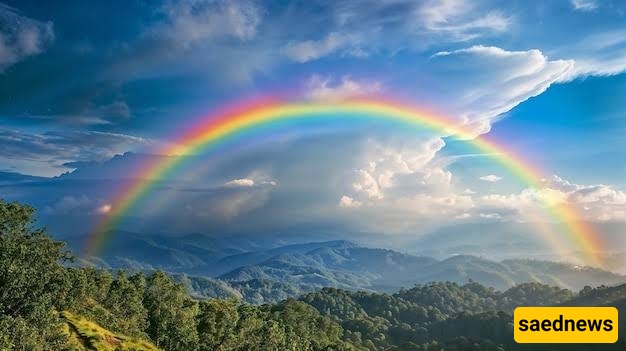
According to SAEDNEWS, Rainbows are very beautiful phenomena, aren’t they? Up there in the sky, you can see an arc made of seven colors, where each shade appears even more stunning and dazzling than the next. Rainbows are quite rare because their formation requires a combination of both sunny and rainy conditions at the same time. I often used to wonder why rainbows are not straight lines or even square-shaped, but instead always curved. However, to properly understand this natural phenomenon, we first need to know why a rainbow is formed in the first place.
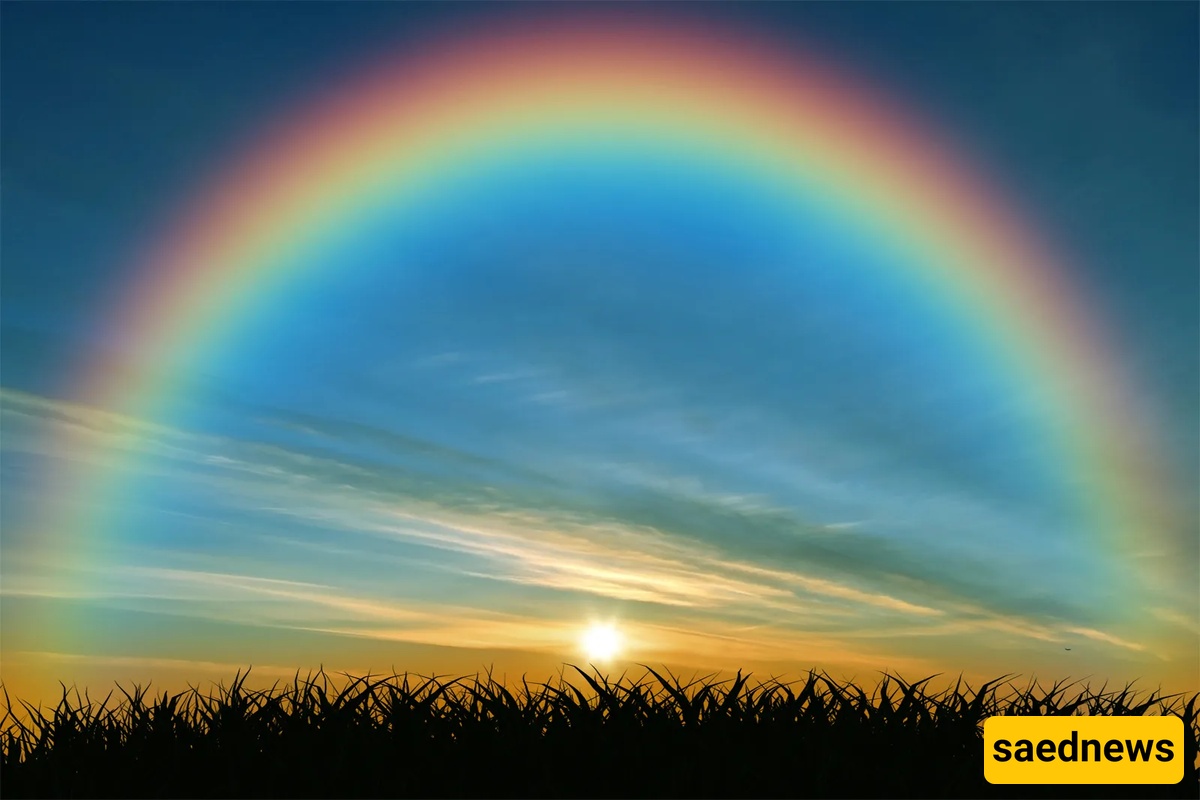
A rainbow needs two things to form—water droplets and sunlight.
Under suitable conditions, each water droplet acts like a prism, which means that when a beam of sunlight hits a droplet, two things may happen: the light passes through easily, or it bends into an arc; it can also reflect off the surface and then, as it exits, it bends again, breaking the white light into seven visible color wavelengths that form the rainbow.
A rainbow is not actually a semicircle or an arc as it appears to us. In reality, it forms a complete circle, but we cannot see the full shape because the horizon blocks its lower half. However, if you were flying high in the sky without any obstruction, you could observe a full circular rainbow. Its appearance also depends on the observer’s position—if you move, the rainbow seems to move with you. In fact, each person sees a slightly different version of it.
To observe a rainbow properly, you must stand with your back to the sun, and the sun should be low in the sky. If the sunlight is too strong, the rainbow becomes difficult to see. The angle between the sunlight entering water droplets and the light reaching our eyes, influenced by the refractive index of water, ranges from about 40 to 42 degrees for different colors. This specific angle is what creates the curved shape of the rainbow.
Let’s do a few creative visualizations to help us understand this topic a little better.
Imagine you are standing directly in front of the Sun, with countless water droplets suspended in the air ahead of you, waiting to be struck by sunlight. As the sunlight enters each droplet, it is refracted, internally reflected, and then dispersed into the familiar spectrum of colors, with the outgoing light emerging at an angle of about 40–42 degrees in every possible direction.
Given this, how do you perceive the colors?
Only those light rays that travel directly toward your eyes become visible, meaning you see color only from those droplets that are positioned at the correct angle relative to both you and the Sun. The only geometric arrangement that allows light to reach your eyes at this precise angle is a cone of rays forming a circle (or arc) centered on you.
Naturally, we do not see the full circle because the horizon cuts off the lower portion of our field of view.