SAEDNEWS: Nasir al-Mulk Mosque is one of the most remarkable attractions in Shiraz in Iran, which has attracted a great deal of attention, especially in recent years as the popularity of mobile photography and selfie-taking has increased.
According to Saednews, Shiraz is a historic and remarkable city that hosts some of the most beautiful cultural and sightseeing attractions in Iran. Among its famous monuments are mosques built by past rulers, many of which are open to visitors. One of the most well-known is the Nasir al-Mulk Mosque. This mosque was built in 1293 (AH solar calendar) by the order of a man named Hassan Ali Khan Nasir al-Mulk, and its name is derived from him. In 1965, it was registered on Iran’s list of national heritage sites and has since become one of the most attractive historical landmarks in the city.
Hassan Ali Nasir al-Mulk, the son of Mirza Ali Akbar Qavam al-Mulk, was one of the wealthy figures of his time. He ordered the construction of a mosque with a total area of 2,730 square meters. Construction began in 1293 and was completed after 12 years in 1305.
Apart from building mosques, he was also involved in charitable activities, and his descendants continue this tradition today.
Over time, the Nasir al-Mulk Mosque has undergone several restoration projects to preserve its original appearance. The first restoration took place during the Pahlavi era, focusing on parts of the western prayer hall floor. Later, minor repairs were carried out in 1991, and additional restorations continued until 2006 without altering the building’s original appearance.
The design of the mosque was not the work of a single architect. Mohammad Hassan Memar, Mohammad Reza Kashipaz, and Mohammad Hosseini, a painter from Shiraz, all contributed to its construction and decoration.
In its early years, the complex also included a house, water reservoir, and bathhouse, which no longer exist today.
The mosque has no dome and covers an area of approximately 2,980 square meters. It was mainly built using brick, plaster, and stone. Its entire facade is decorated with colorful tilework. Wooden elements were also used in some walls to improve earthquake resistance.
Upon entering the Nasir al-Mulk alley, visitors are greeted by a stunning entrance portal decorated with muqarnas and seven-color tiles depicting floral patterns such as roses and Shirazi irises. The lower sections are made of Gandomak stone, and the wooden doors are framed with stonework. Above the entrance is a carved stone arch with Islamic motifs and inscriptions.
A small marble plaque bears a poem by the poet Shorideh Shirazi, along with the name of the founder and the construction date.
After passing the entrance, visitors enter a brick-built vestibule with limited light filtering through its lattice windows. Inside, there is a poetic inscription attributed to Saadi and the names of the architects. The right corridor leads to the roof, while the left leads to the courtyard.
The courtyard features a large rectangular pool measuring 16.5 by 4.5 meters, surrounded by clay flowerpots filled with geraniums. The northern side houses the main prayer hall. The walls are decorated with seven-color tiles and inscriptions of Quranic verses in white Thuluth script on a deep blue background.
The northern iwan is considered the most beautiful part of the mosque. It features intricate muqarnas, colorful tiles, and Quranic inscriptions. With a height of about 8 meters, it includes multiple arches and the famous Pearl Arch. The walls are richly decorated with verses and hadiths.
The southern iwan does not have a functional role and was mainly built for symmetry and aesthetics. It is shorter than the northern iwan and features two minarets. Its pink stone base and floral tilework create a visually striking appearance.
This section is separated from the courtyard by a 6-meter iwan and eight arches. It was used in winter but remained comfortable in summer due to its architectural design. It contains seven columns and brick-and-tile decorations. Small openings above the wooden doors allow airflow control.
Historically, this section also had access to a well system operated by animals (a “gavro” mechanism for water extraction).
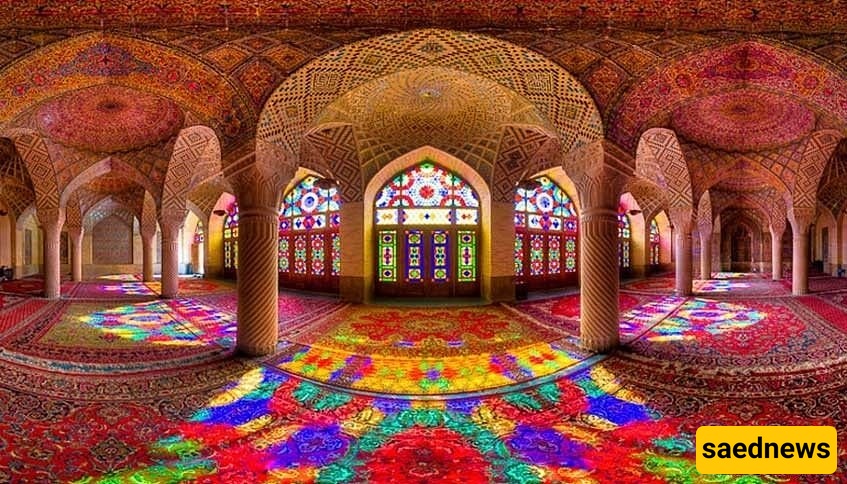
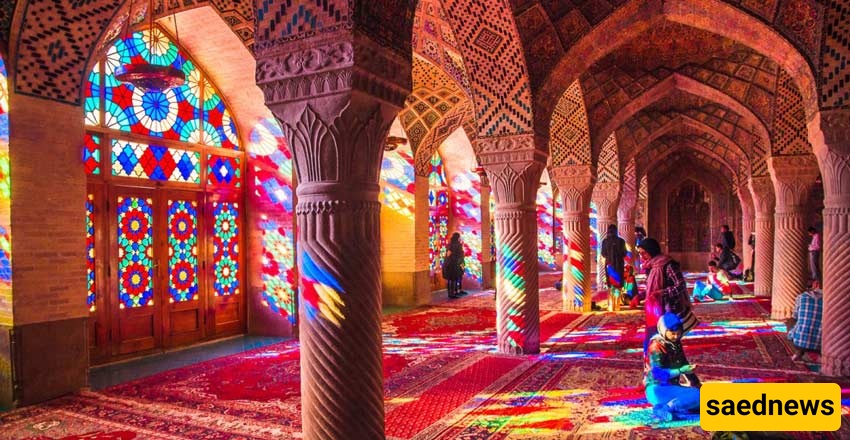
The western prayer hall is one of the finest examples of Qajar-era architecture and is the most photographed part of the mosque.
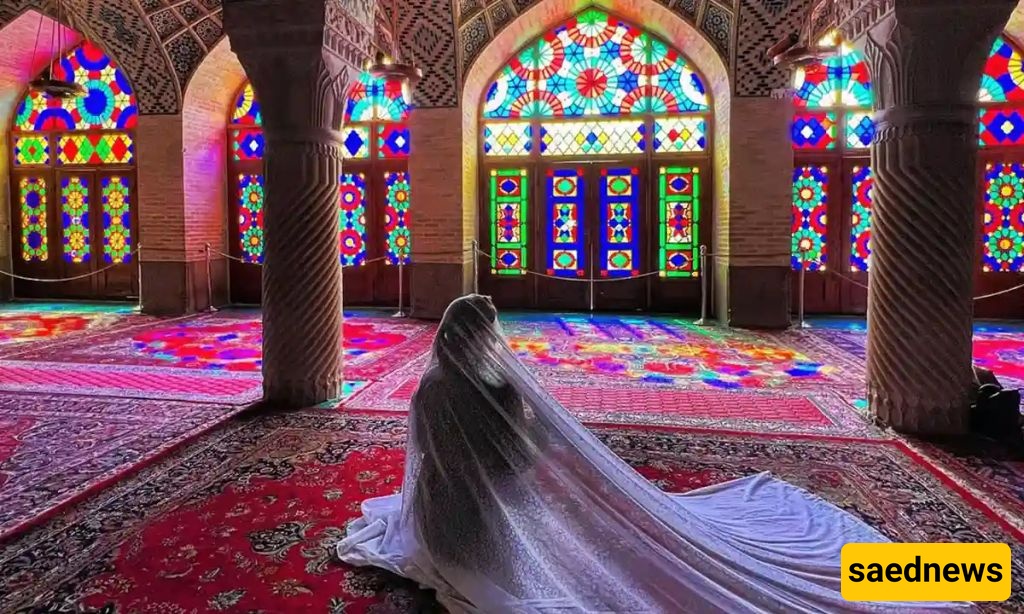
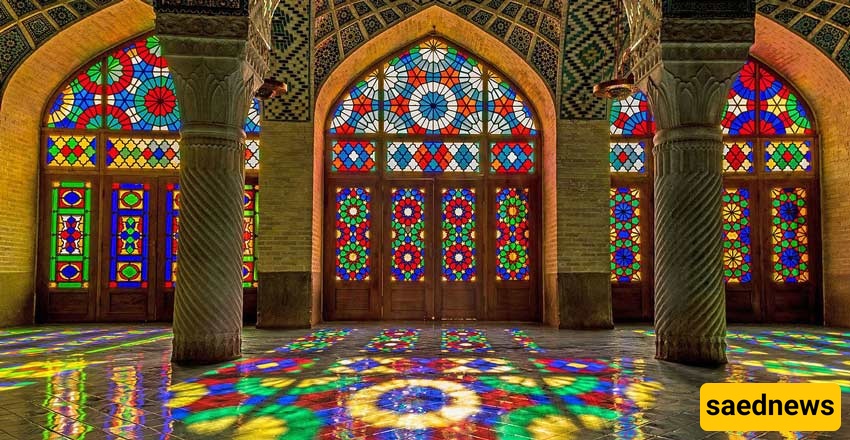
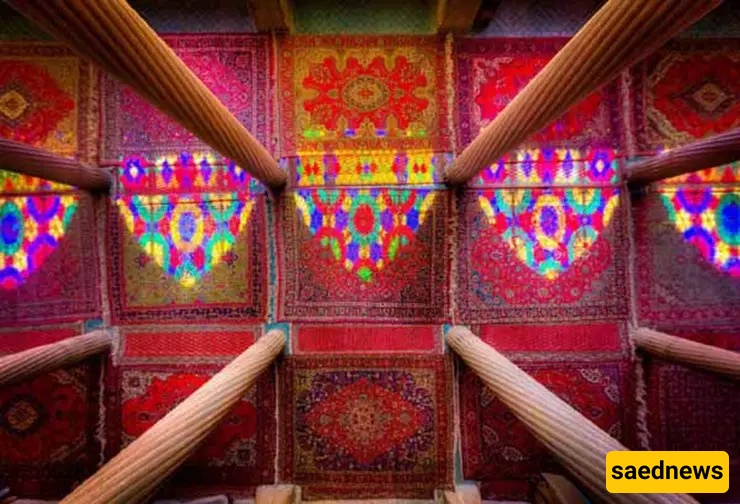
It features beautiful tilework, multiple columns, artistic panels, a prayer niche (mihrab), and stained-glass windows that create a magical light display. The floor is brick with turquoise tile accents, and the ceiling is decorated with floral and geometric motifs as well as Quranic inscriptions.
Wooden doors with colored glass enhance the lighting effects, making this hall especially famous for the “morning light” phenomenon.
The mosque is located on Lotf Ali Khan Zand Street, at the end of Nasir al-Mulk Alley in Shiraz.
Nearest metro station: Vali-e Asr Station
Nearest bus station: Chaharrah-e Meshir
You can reach the mosque by private car, taxi, or public transportation.
Spring and summer (April–September): 8:00 AM – 5:00 PM
Autumn and winter (October–March): 4:30 PM – 7:00 PM
The best time to visit is between 8:00 and 10:00 AM, when sunlight passes through the stained-glass windows and illuminates the prayer hall.
The mosque is closed on certain religious days such as Ashura and Tasua. An entrance ticket is required.
Qajar Mansion Eco Lodge
Golestan Raz Eco Lodge
Golshan Traditional Hotel, Shiraz
Lotf Ali Khan Hotel, Shiraz
After visiting the mosque, you can also explore:
Zanjiri Shrine
Zinat al-Mulk House
Seyed Alaeddin Hossein Shrine
Khan School
Nasir al-Mulk Mosque is located in the historic Goud Araban neighborhood, at the end of Nasir al-Mulk Alley on Lotf Ali Khan Zand Street in Shiraz, Iran.