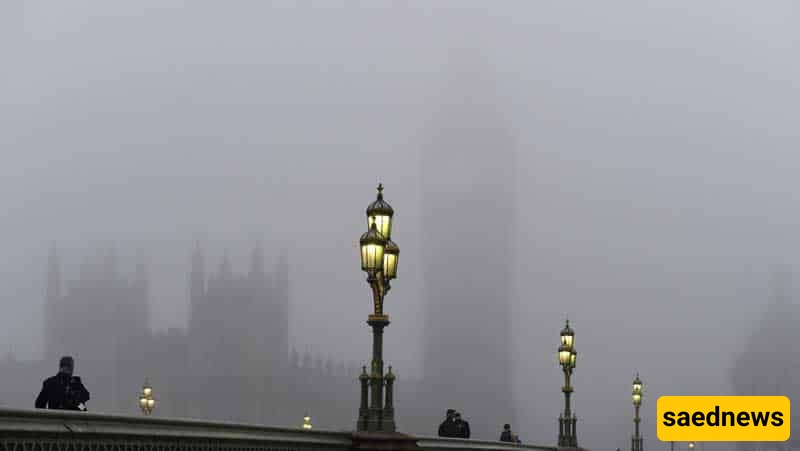
SAEDNEWS: In fact, fog is a cloud that forms at the Earth’s surface. It can develop through several different processes, but in general, high humidity is required for fog to form in an area.

According to SAEDNEWS, Fog is essentially a cloud that develops close to the ground level. Although it can form through various mechanisms depending on weather conditions, a high level of moisture in the air is generally necessary for fog formation in any region.
This type of fog requires a moist air mass to be located above or near a cold surface. The cold surface can be snow- or ice-covered ground, the surface of a cold ocean, or simply a very cold land area.
When the moist air mass remains in contact with the cold surface, it gradually loses heat and its temperature drops until it reaches the saturation point, leading to fog formation. If the surface is an ocean or is near a moisture source such as a lake, river, or snow-covered area, additional moisture entering the air mass can further support fog development. The presence of moisture-absorbing particles in the air also plays an important role in the formation of this and other types of fog.
Radiation fog typically forms under calm conditions with little or no wind. The air mass needs enough time to stay close to the cold surface so that its temperature can decrease and reach saturation. Wind can disrupt this process by moving the air away and preventing sufficient cooling. These conditions are most commonly found during cold, clear winter nights. On such nights, the Earth’s surface loses heat through radiation, causing it to cool. When a moist air mass is present near the ground, condensation occurs and fog forms. This is why it is called radiation fog.
This type of fog forms when a cold air mass moves across a moist surface and absorbs water vapor until it becomes saturated. It commonly develops over lakes, seas, and coastal areas.
When a cold air mass is carried by wind over a wet surface, moisture from the surface evaporates and enters the air. Since cold air can hold less water vapor than warm air, it quickly reaches saturation, resulting in fog formation. In this type of fog, gentle wind is an essential factor because it helps transport the cold air over the moisture source, which is why it is known as advection fog. However, strong winds can mix saturated and unsaturated air, preventing fog from developing.
Mountain fog forms when a moist air mass is forced upward along mountain slopes by wind and rising air currents. As the air moves to higher elevations, its temperature gradually decreases until it reaches saturation, causing fog to develop. At lower elevations, this type of fog may appear as clouds covering mountain slopes and peaks.
In general, fog formation requires three main conditions: sufficient moisture, low temperatures, and the presence of moisture-attracting particles (condensation nuclei) near the Earth’s surface. Although sunlight and daytime warming usually prevent fog from forming or cause nighttime fog to disappear, temperature inversions near the ground or air pollution from factories and human activities can help fog remain stable even during the day.
Over seas and large lakes, the amount of airborne particles and impurities is usually lower; however, the large supply of moisture makes conditions more favorable for fog formation. Winds blowing from land toward water can also contribute to fog development by carrying suspended particles into the air above the water surface.
In extremely cold conditions, when temperatures fall below the freezing point, ice fog may form. This type of fog consists of tiny ice crystals rather than water droplets. The bright and sparkling appearance of these ice crystals when illuminated by light sources, such as vehicle headlights, can help identify this special type of fog.