SAEDNEWS: Most silver products are made according to the Sterling standard, so alongside the purity number, the letter “S” is often visible on them. For example, they may be stamped with codes such as “925” or “S925”.
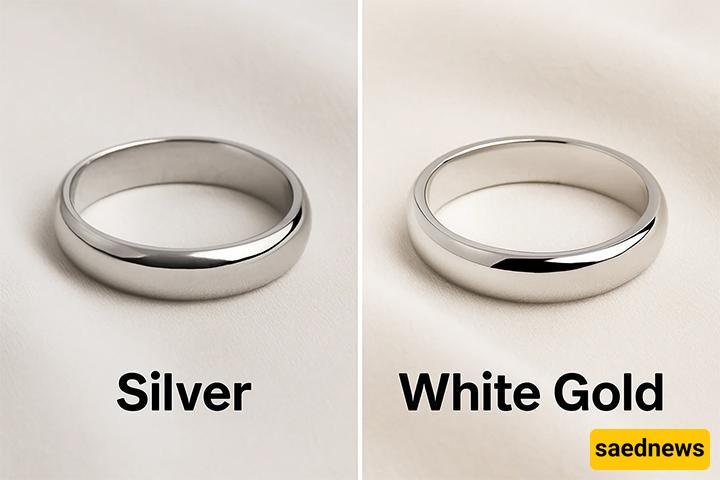
According to Saednews, Marks called “hallmarks” or “stamps” are engraved on gold and silver items. Many fraudulent sellers plate silver to make it look like white gold. They use a rhodium coating, which makes silver appear shinier and similar in color to gold, white gold, and imitation jewelry.
This makes it difficult for ordinary people to distinguish white gold from silver. In general, silver has a distinct appearance: a light white color with a slightly matte tone. The only reliable way to distinguish silver from white gold is the identification number engraved inside the item.
White gold and silver look very similar, making it hard for many people to tell them apart. However, despite their visual similarity, they have several important differences:
White gold is an alloy made by combining gold with other metals, while silver is a pure element.
White gold is more valuable due to its rarity compared to silver.
White gold is more resistant to scratches than silver.
White gold has greater resistance to rust and tarnish compared to silver.
White gold is coated with rhodium, while silver usually does not have such a coating.
White gold is more malleable and easier to engrave than silver.
The marking system is also different. White gold is marked by karat (K) or purity, while silver is usually marked only by purity. The color tone of silver is more grayish, whereas white gold may have a slight yellow or gray tint.
In addition to decorative uses, silver is also used in medicine, confectionery, and engineering. White gold, however, is mainly used in jewelry and ornamental items.
Silver jewelry can reach up to 99.9% purity, while the maximum purity of white gold is typically 75% (18 karat).
Despite all these differences, the best way to distinguish silver from white gold is the engraved number inside the item.
Most silver products are made with Sterling standard, so they are marked with a number like “925” or “S925”.
Gold products are marked with a karat code such as “18K” or “21K”. Sometimes gold is also marked with a 1000-based purity system like “750” or “925”. In some cases, additional letters indicate color: “YG18K” (yellow gold), “PG75018K” (pink gold), or “WG21K” (white gold).
White gold is marked with “W”, yellow gold with “Y”, and pink gold with “P”.
Iodine can be used to test gold. If iodine leaves a stain, the item is fake. If it disappears, the jewelry is real.
Silver can be tested with sulfur ointment. If a blue mark appears, it indicates real silver, and it can be easily cleaned.
For white gold, ammonia may darken the surface.
Gold and silver conduct heat well. Placing them on ice causes faster melting due to high thermal conductivity.
A real gold bar produces a clear ringing sound that lasts 1–2 seconds; a fake one sounds different.
Acid can change color if the gold is real, but this method may damage jewelry.
Sound waves pass through metals at different speeds, allowing measurement of purity.
Gold purity can be estimated by density:
Gold = 19.32
Silver = 10.49
Gold is soft and may show bite marks, especially in higher purity forms.
When buying gold, do not rely only on seller claims such as origin or quality. Always keep the purchase receipt as proof in case of disputes or verification issues later.