Saed News: The discovery of fossils of giant finned octopuses suggests that ancient ocean food webs were far more complex than previously thought.
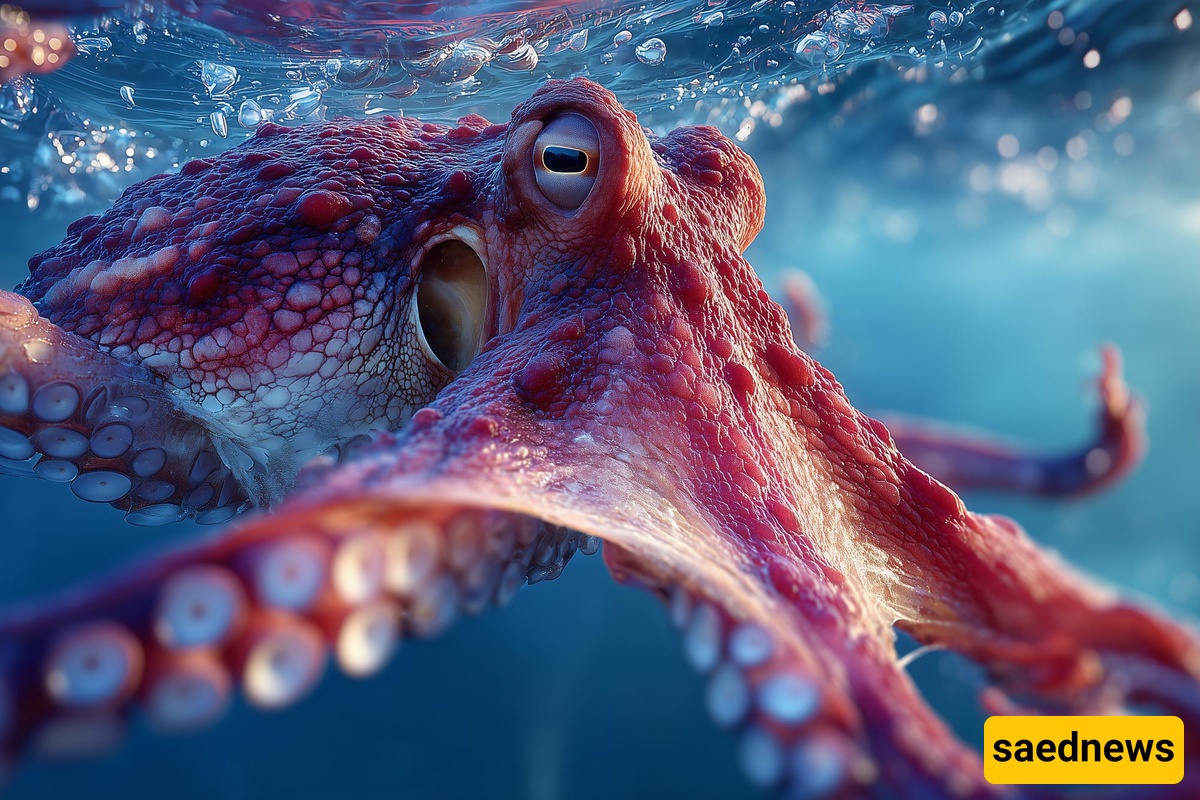
According to SAEDNEWS, for a long time in paleontology, the common belief has been that over the past 370 million years, the main predators in the seas were large vertebrates such as mosasaurs, plesiosaurs, sharks, and large fish. In this view, invertebrates like squids and ammonites were mostly considered prey.
A recent study led by a team of scientists headed by Yasuhiro Iba from Hokkaido University in Japan now suggests a different picture. According to this research, some very large octopuses also existed among apex predators in the oceans of the late Cretaceous period.
Scientists describe two species of finned octopuses from the late Cretaceous: Nanaimoteuthis haggarti and Nanaimoteuthis jeletzkyi. These creatures lived around 100 to 75 million years ago, and their estimated length could have reached up to about 19 meters.
Yasuhiro Iba told the journal Refractor: “The oceans of the Cretaceous period may not have only hosted large marine reptiles and sharks; giant octopuses were also present as important predators.” He emphasized that these invertebrate predators have long been overlooked, which has led to the assumption that ancient food webs were simpler than they actually were, whereas they were in fact more complex.
To understand the importance of this finding, we must go back about 200 million years to the late Mesozoic era, when the expansion of shell-crushing predators began an evolutionary arms race between predators and prey. During this period, many marine invertebrates existed as small prey in ecosystems, and in response to predation pressure, some evolved hard, mineralized shells for protection.
At the same time, some octopuses took a different evolutionary path. Unlike many mollusks, they gradually lost their external protective shells. The result was soft-bodied, highly agile swimmers with advanced vision and likely higher cognitive abilities—traits still seen in modern octopuses.
Numerous fossils of a group of cephalopods called Octobrachia, which includes shell-less octopuses with eight arms, have been found before. However, their exact place in the food chain remained unclear due to the lack of direct evidence such as stomach contents. Features like jaw shape alone are not sufficient to determine diet, as they can serve different functions in different species.
To solve this, researchers at Hokkaido University used a different method from traditional fossil studies. Instead of relying solely on fossil shape, they examined wear patterns and physical damage on fossilized jaws to reconstruct feeding behavior.
In total, 27 large fossilized jaws of these octopuses were analyzed. Researchers looked for signs such as chipping, deep scratches, and polished surfaces—patterns that in modern cephalopods occur when they crush hard shells or bones of prey.
The degree of wear was extremely high in some samples, with up to about 10% of the original jaw length lost due to abrasion. This indicates that these octopuses were capable of exerting strong bite forces and could crush hard shells and even bones of large prey.
Based on the largest fossilized jaw, Nanaimoteuthis jeletzkyi likely measured between 2.8 and 7.7 meters in length, while Nanaimoteuthis haggarti may have reached a much larger size of about 6.6 to 18.6 meters.
Researchers also noted an interesting behavioral trait in these fossils: asymmetrical jaw wear. This suggests that these animals likely preferred using one side of their body while feeding. In modern animals, such lateralized behavior is often associated with more complex neural organization and advanced cognitive behavior, as seen in some present-day octopuses.
Although it is not possible to directly measure the intelligence of these ancient octopuses from fossils, the available evidence suggests they likely exhibited complex behaviors similar to modern octopuses.
It also appears that giant Cretaceous octopuses lived in different habitats compared to their modern relatives, and after major changes in marine ecosystems, they were gradually replaced by smaller deep-sea species.