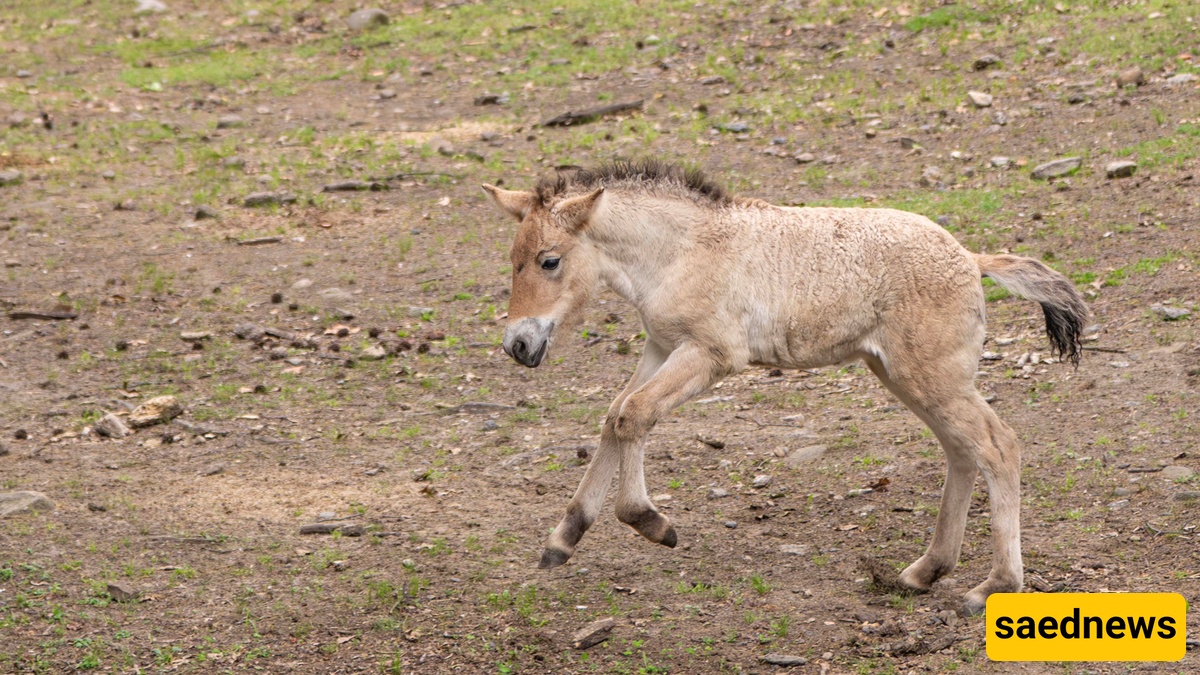
Saed News: The Bronx Zoo in New York has announced the birth of a new foal from the Przewalski’s horse species (Equus ferus przewalskii). The birth of this foal is an important sign of the continued success of global conservation programs for a species that became extinct in the wild several decades ago.
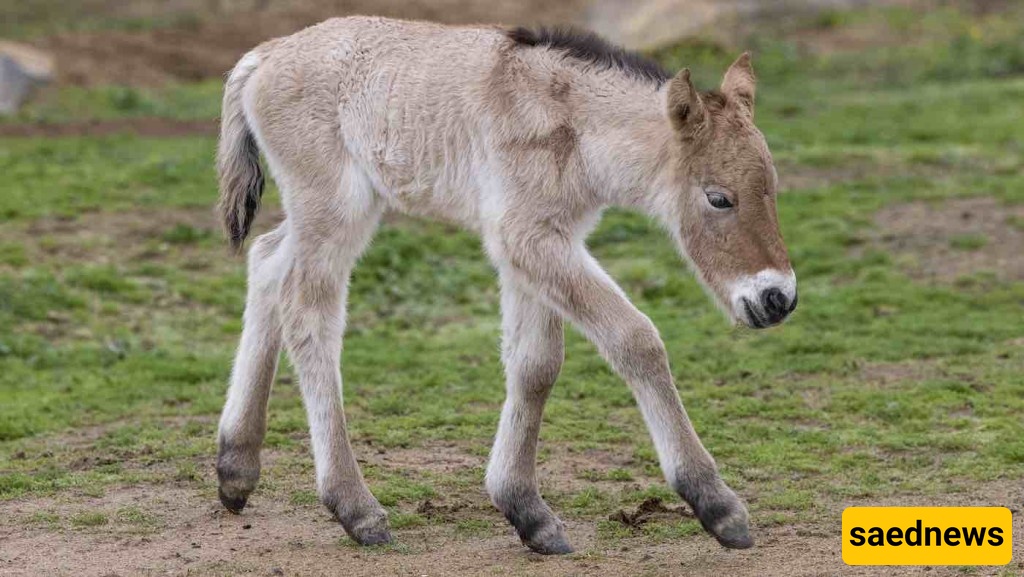
According to SAEDNEWS, Przewalski’s horses have clear physical differences from domestic horses. Their bodies are more compact and muscular, they have shorter legs, and their manes are short and upright, unlike domestic horses. Their appearance is sometimes described as resembling donkeys or ancient horses. More importantly, this species was never domesticated by humans, which is why it is called the “last truly wild horse.”
The species is named after Nikolai Przhevalsky, a 19th-century Russian geographer and explorer who first described it for European scientists. However, historical evidence suggests that humans were aware of this animal centuries earlier. Tibetan writings from the 9th century mention horses that are believed to have been this species.
Historical and environmental studies show that Przewalski’s horses once lived across vast regions of Central Asian steppes, from Russia to Mongolia, Kazakhstan, and northern China. However, their population began to decline gradually from the late 18th century.
Scientists identify several factors behind this decline, including climate change, competition with livestock for food and grazing land, habitat loss, and hunting pressure. As a result, their numbers dropped sharply, and by the 1960s the species was declared extinct in the wild.
However, the species was not completely lost. Its survival depended on a small number of horses that had previously been taken into captivity in zoos and breeding centers. In fact, the modern population traces back to just 12 wild individuals that formed the basis of later breeding programs.
Since then, zoos and conservation centers worldwide have launched extensive breeding efforts. The Bronx Zoo, operated by the Wildlife Conservation Society, is one of the institutions participating in these programs.
According to IFL Science, the goal of these projects was not only to keep the animals in captivity but also to eventually reintroduce them into their natural habitat. This goal became a historic success in 1992, when 16 Przewalski’s horses were successfully released in Mongolia.
Since then, the horses have been reintroduced in several other regions, including China, Kazakhstan, and the Chernobyl Exclusion Zone in Ukraine. Chernobyl, largely abandoned after the 1986 nuclear disaster, has in recent decades become an unexpected refuge for wildlife.
Researchers have recently studied the presence of Przewalski’s horses in the Chernobyl Exclusion Zone. Svitlana Kudrenko, a researcher involved in one of these studies, said that after major forest fires in the region in 2020 and 2021, new vegetation grew on the forest floor, attracting herbivores such as Przewalski’s horses. Camera traps recorded these animals more than a thousand times.
Despite these advances, the species remains fragile. The International Union for Conservation of Nature (IUCN) still lists Przewalski’s horses as endangered, with an estimated global population of fewer than 2,000 individuals.
One of the major challenges for scientists is maintaining genetic diversity. Since the current population descends from a very small number of founding animals, there is a risk of inbreeding. Low genetic diversity can increase the likelihood of inherited diseases and reduce the animals’ ability to adapt to environmental changes.
In 2024, researchers successfully mapped the complete genome of the Przewalski’s horse for the first time. This achievement helps scientists better assess genetic health and design breeding programs that preserve genetic diversity as much as possible.
In addition to traditional conservation methods, new technologies have also entered the field. In 2020, the first cloned Przewalski’s horse was successfully born. Scientists hope cloning may one day help restore some of the lost genetic diversity of the species.
Nevertheless, the birth of a new foal at the Bronx Zoo shows that classical conservation methods still play a crucial role. This birth is not only a hopeful sign for the survival of one of the world’s rarest horses, but also a reminder that long-term conservation efforts can succeed—even for species once thought to be extinct in the wild.