SAEDNEWS: Gomishan County is one of the counties in Golestan Province, Iran. It is bordered by Turkmenistan to the north, Torkaman County to the south, Aq Qala County to the east, and the Caspian Sea to the west.
According to Saednews, Numerous historical documents indicate that Gomishan was one of the Parthian settlements, at a time when the Gorgan River flowed through the middle of the town before emptying into the Caspian Sea.
This is why some historians believe that goods destined for Golestan Province, after passing through Bandar Torkaman and Bandar-e Gaz, were unloaded on the shores of Gomishan and left there overnight. The following morning, they would be transported by ship toward the northern and western shores of the Caspian Sea. In other words, Gomishan was the final stop along the overland Silk Road and the starting point of its maritime route.
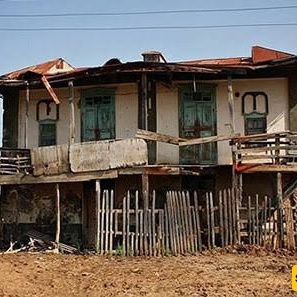
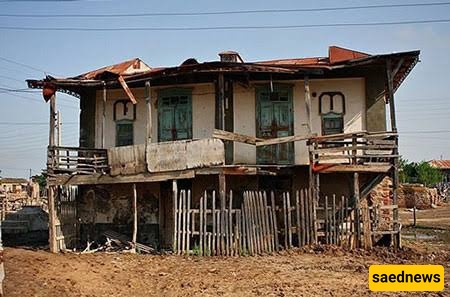
So, where are we? We are on the outskirts of Golestan Province, where the small, sparsely populated town of Gomishan displays a distinctive architectural style through its old houses, many of which have survived from a bygone era.
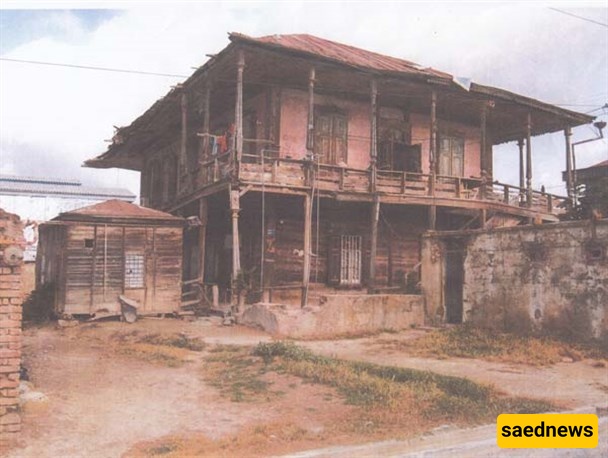
If you walk through Gomish Tappeh, it is impossible to mistake this town for any other place in Iran. Its distinctive two- and three-story wooden buildings have no real counterparts elsewhere in the country—or, arguably, in the world.
But why would a coastal town in a region with few trees be home to some of its most authentic and valuable houses, built of wood and requiring several massive timber beams for each structure?
I meet Nematollah Armideh in Gomishan to find answers to my questions. He is a historian specializing in these houses and understands the artistic vision and ambition that shaped their construction.
According to Armideh, the overall design of these buildings was largely influenced by the region's geographical conditions. Proximity to the sea, high groundwater levels, increased rainfall, and the town's closeness to forested areas all influenced the architectural character of Gomishan's old quarter.
Another factor that shaped these buildings was the influence of Russian architecture on local tastes and architectural styles at the time.
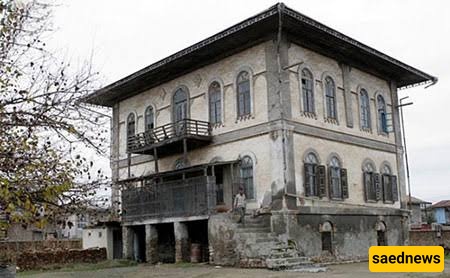
As we walk through the town's streets, Armideh continues:
"It appears that during the reigns of Mozaffar al-Din Shah and Mohammad Ali Shah of the Qajar dynasty, some Turkmen merchants grew wealthy through maritime trade and travel to Russia. Inspired by the architectural styles of Russian cities, they began constructing wooden buildings in this town."
He then mentions several prominent merchants from Gomish Tappeh, including Anne Mohammad Sari, Ata Haji Khozin, and Ashur Khazin, as well as Shokhbay from the village of Khajeh Nafas. If their houses still stand in the area, they are often known by the names of their original owners.
Armideh believes that these imposing two- and three-story mansions were built to protect their occupants from ground moisture and to make better use of the wind. In this sense, the buildings can be described as outward-oriented in their design.
Most were constructed entirely from timber and wooden beams imported from Tsarist Russia, using distinctive architectural techniques.
Once again, the sea emerges as a central part of life in Gomishan. I imagine ships arriving from distant shores, bringing new lifestyles and influences to the region, and listen more closely as Armideh explains:
"A large proportion of the wood and planks, particularly fir timber, was transported by sea by Turkmen merchants and seafarers from Russia, including the cities of Astrakhan and Baku, as well as several other places."
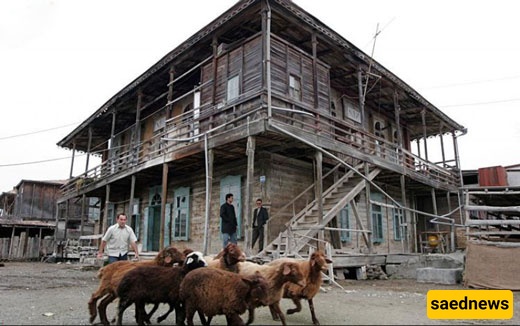
Mohammad Ali Qorqanji, an officer in the Qajar government's military forces who visited Gomish Tappeh in 1321 AH (1903–1904 CE), described this trade in his book:
"...Today, 150 wooden shops have been brought from Russia to Gomish Tappeh. They are very beautiful, and business in their market is flourishing..."
These imports did not provide all the materials needed for construction. Some timber also had to be sourced from the forests south of Livan and Kordkuy.
Inside one of these houses, the interconnected rooms, long corridors, and fireplaces stand out for their unusual design, reflecting the engineering knowledge and careful planning involved in their construction.
Staircases, railings, columns, doors, windows, the wooden flooring of the verandas in front of the rooms, and the timberwork beneath the ceilings were all characteristic features of Gomishan's traditional architecture.
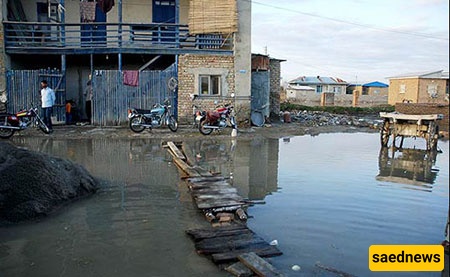
I must leave Armideh to explore other parts of Gomishan. Before we say goodbye, however, he points out several historic houses known by the names of their original owners.
"We must pay attention to this historical heritage," he says. "With these unique houses, Gomishan could sustain its economy for many years through tourism. Unfortunately, the authorities have failed to recognize this potential. Instead, the town's historic district, which contains such precious architectural gems, has become a neighborhood for lower-income residents."
I jot down the names of several old neighborhoods in Gomishan, hoping to visit them along the way: Khozinis, Mozaffaris, Shir-Mohammadis, Shirvanis, and Mostafais.