SAEDNEWS: Yemen’s “blockade for blockade” strategy against Saudi Arabia has sharply increased pressure on the kingdom’s oil export routes through the Red Sea, while alternative pipelines and shipping routes remain limited, costly and vulnerable.
According to SaedNews: The implementation of Yemen’s “blockade for blockade” and “escalation for escalation” equations against Saudi Arabia has placed significant pressure on the kingdom’s oil exports through the Red Sea, according to international sources, with consequences for its economy expected to become clearer over time.
Since Yemen began imposing a maritime blockade on Saudi supply lines in the Red Sea, economic pressure on Riyadh has intensified. The move has also disrupted Saudi Arabia’s established strategy of bypassing the Strait of Hormuz through its east-west land route.
In an analysis titled “Yemenis Have Limited Saudi Export Options,” the Qatari Al-Araby Al-Jadeed examined the economic impact of the Yemeni blockade. It reported that continued Yemeni attacks on Saudi ships and economic facilities are choking the alternative shipping route on which Saudi Arabia relies to compensate for disruptions around the Strait of Hormuz.
The development creates a second pressure point in the Red Sea, through which roughly 12% to 15% of global maritime trade passes, while also threatening to prolong maritime instability and delay the recovery of oil supplies.
On July 20, Yemen implemented its “blockade for blockade” equation in response to the blockade imposed by Saudi Arabia. Under the measure, Saudi vessels or ships linked to the kingdom were barred from passing through the Red Sea. Since then, Yemen’s armed forces have continued attacks against Saudi positions.
The escalation has affected direct exports to Asian markets, particularly those carried by Saudi-owned vessels, turning the vital waterway into a high-risk zone with sharply rising insurance premiums.
Saudi Arabia operates the East-West Pipeline, also known as Petroline, with a maximum capacity of 7 million barrels per day for moving crude from the eastern province to Yanbu on the Red Sea. However, estimates published by Kpler, a platform specializing in maritime traffic and energy flows, indicate that actual exports remain constrained by Yanbu’s physical port capacity.
Shipping data suggests that Yanbu’s operational loading capacity during conflict conditions does not exceed roughly 3.8 million to 4 million barrels per day, significantly below the pipeline’s maximum capacity.
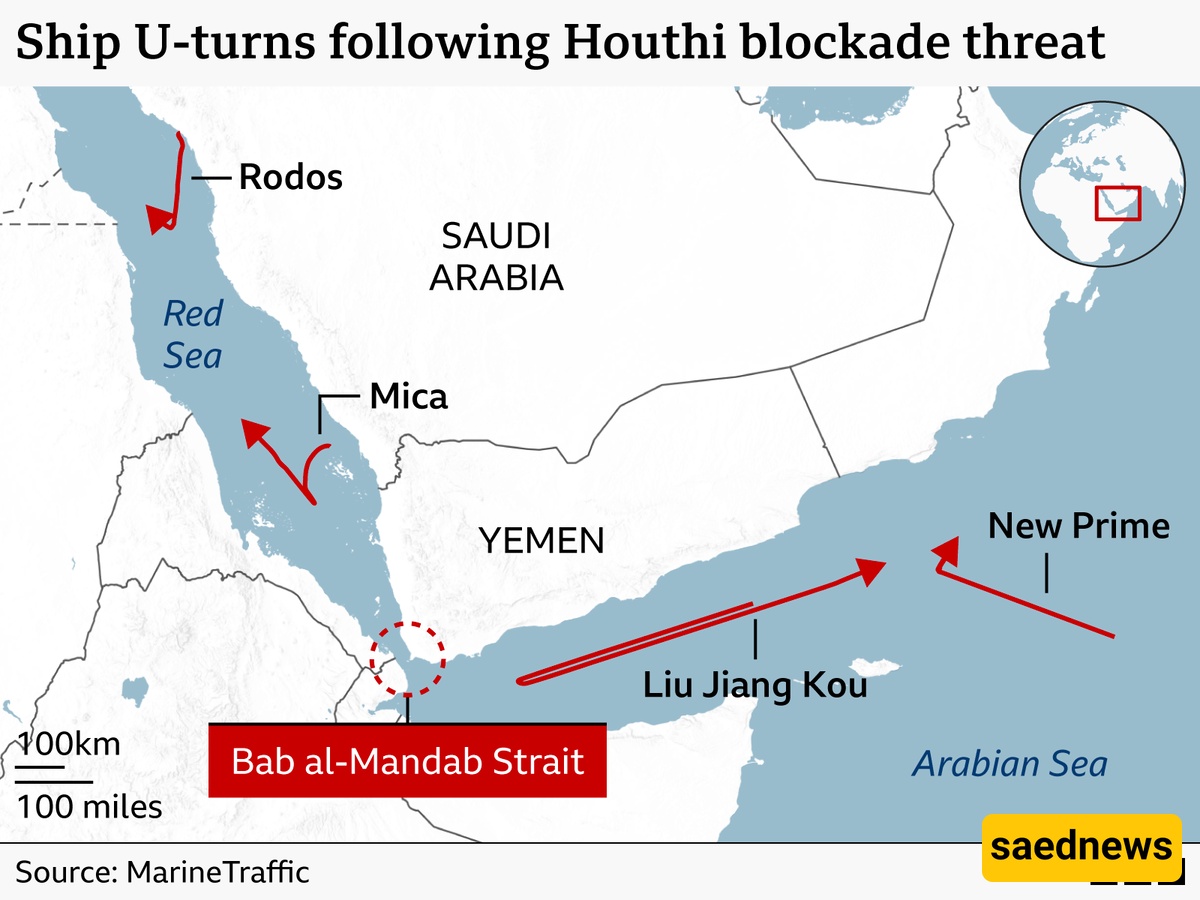
At the same time, the number of vessels passing through Bab el-Mandeb has fallen to about 24 ships per day from 34 before the escalation. According to the same estimate, these geographic and technical constraints limit the pipeline’s effectiveness as a complete substitute for the Strait of Hormuz.
Other export options that avoid Bab el-Mandeb face additional difficulties. Rerouting oil tankers northward toward the Suez Canal and Egypt’s SUMED pipeline involves greater logistical complexity and substantial financial costs.
Compared with direct passage through Bab el-Mandeb, the alternative route adds 20 to 25 days to journeys toward eastern markets. The Maritime Executive has also reported that the route contributes to a shortage of large tankers and forces them to unload parts of their cargo in order to pass through the canal.
As the risk of further escalation rises, the possibility of relying on northern routes as a permanent and comprehensive export alternative becomes weaker. No engineering solution or pipeline can completely eliminate the need for secure waterways and regional stability.
Moreover, moving oil shipments from the Strait of Hormuz to another unstable waterway such as the Red Sea does not eliminate the risks; it merely shifts them geographically, leaving Saudi infrastructure and ports exposed to continuing threats.
An assessment published by Energy Connects, a platform focused on global energy and infrastructure, concludes that Saudi Arabia’s available alternatives are partial and costly, while remaining dependent on port operating capacity and the availability of oil tankers. The assessment therefore points to the need for international protection of shipping lanes rather than reliance solely on fixed structural alternatives.
The alternative route chosen by Saudi Arabia moves oil from Yanbu to Egypt’s Ain Sokhna port on the Red Sea and then through the SUMED pipeline to Sidi Kerir on the Mediterranean. From there, the oil continues through the Mediterranean and the Strait of Gibraltar before reaching Asian markets after passing around the Cape of Good Hope.
Because this maritime route is longer than the usual passage through Bab el-Mandeb, its use has forced Saudi Aramco to seek a new pricing mechanism for crude shipments as rerouting increases transportation costs.
Reuters reported that the diversion could add $10 million to the cost of each shipment for Asian buyers, or roughly $5 per barrel.
Those expenses come on top of costs Reuters previously associated with expanding the East-West Pipeline. Adding 2 million barrels per day to its capacity would, according to the report, take years, cost billions of dollars and require a new pricing mechanism for Saudi crude.
Speaking to Al-Araby Al-Jadeed, political economy expert Ziad Zawaneh said Saudi Arabia should adopt a rational and realistic approach and pursue a strategy aimed at reducing tensions with Yemen, arguing that the continuation of the current situation is not in Riyadh’s interest.
He said Bab el-Mandeb represents an important pressure lever available to Yemen against Saudi Arabia, particularly under current sensitive conditions. If Yemeni forces were to partially or completely disrupt the East-West oil pipeline, he added, the cost of the confrontation for Saudi Arabia would rise further.
According to Zawaneh, the best option for Saudi Arabia is to reach an accommodation with Yemen and respond to its demands, allowing Riyadh to protect its strategic and economic interests and avoid the security and political consequences of continued tensions.