SAEDNEWS: The U.S. president reiterated his claim of having “complete control” over the Strait of Hormuz, describing the strategic waterway as “American territory.” Tehran firmly rejected the assertion and warned that it is prepared to launch a military response against any U.S. naval blockade.
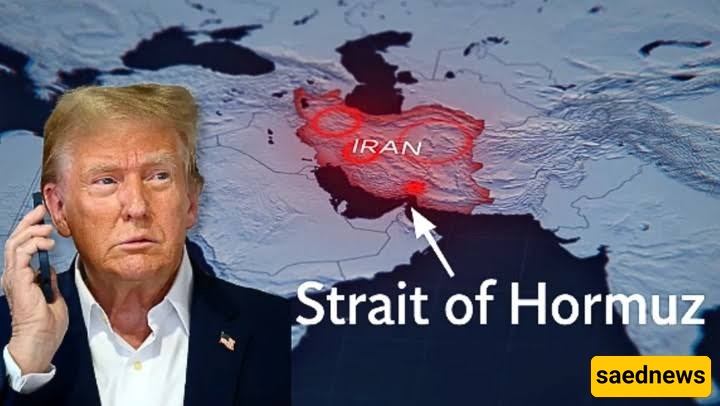
According to Saed News’ political desk, the US-based website Breitbart reported a sharp escalation in tensions between Tehran and Washington over the Strait of Hormuz. Donald Trump repeated his claim of having “full control” over the strategic waterway and even described it as “US territory,” while Iran responded by warning that it was prepared to launch military action against the naval blockade and deliver a “strategic surprise.”
Speaking to reporters in the Oval Office on Monday, Trump described the idea of declaring the Strait of Hormuz US territory as “a great idea.” He said: “We control it. We control it with a blockade. We have complete control of the strait.”
Referring to the volume of oil passing through the waterway, Trump claimed: “We move millions of barrels of oil every week.” He also asserted that oil prices would continue to fall unless Washington decided to take “much more severe” action.
The US president further claimed that Iran was “in big trouble,” saying: “Their inflation is 300 percent. Their country is a mess, and their military has been completely defeated.”
His remarks came as the 60-day deadline for negotiations outlined in a June memorandum of understanding between the United States and Iran expired on Monday. The fragile arrangement had effectively collapsed much earlier following US attacks.
Trump said Washington was not seeking to extend the memorandum, adding: “They want to make a deal, but they will not make the kind of deal that I believe is necessary.”
He also repeated claims regarding Iran’s nuclear program and stated his main red line: “Iran cannot have a nuclear weapon. And it will not.”
According to the American website’s report, Tehran, in response, imposed a new timeline on Washington. The outlet claimed that a senior Iranian official told Reuters that Washington had only “a few weeks” to fully implement Iran’s interpretation of the June memorandum before further negotiations could take place.
The official warned that if diplomacy failed, Iran would launch a “timely and precise” military operation aimed at breaking the US naval blockade. He said: “Iranian institutions must prepare for an escalation of tensions in the Strait of Hormuz and the broader region.”
He emphasized that Tehran was moving away from what it described as a defensive approach toward a more aggressive strategy.
The threat came as The Wall Street Journal claimed on Monday that Iran had used the period following the June memorandum to prepare for a potentially larger and longer conflict.
According to the report, Iran has further unified its military command structure, accelerated missile and drone production, expanded domestic counterintelligence and surveillance operations, and deepened coordination with regional resistance groups in Yemen, Iraq, and Lebanon.
The report also referred to comments by Brigadier General Yadollah Javani, the political deputy of the Islamic Revolutionary Guard Corps, who said Iran’s armed forces had adopted a “transformative” approach. He warned: “Perhaps they should expect strategic surprises.”
Separately, the Islamic Revolutionary Guard Corps announced on Monday that its forces would “decisively crush any threat or aggression,” describing its strategy as one of “maximum deterrence and powerful offensive operations.”
Meanwhile, Mohammad Bagher Ghalibaf, the Speaker of Iran’s Parliament and one of Tehran’s main negotiators with Washington, stressed that Iran had achieved victory both militarily and politically. He said: “I say with complete certainty that we have won this war both militarily and politically.”
The American website also highlighted new threats by the Trump administration against Oman, a traditional US partner, suggesting that tensions were no longer limited to Tehran and Washington.
Reacting to Oman’s negotiations with Iran over future maritime transit arrangements in the Strait of Hormuz, Trump reportedly issued an extraordinary warning, saying: “If Oman gets in the way, we’ll bomb them heavily.”
When later asked whether he had lost patience with the longtime US partner, Trump said no, but strongly criticized Muscat’s behavior. “I don’t think they have behaved very well, but we can deal with them very easily,” he said.
This came after Iranian Foreign Ministry spokesman Esmail Baghaei announced that Tehran and Muscat had reached an understanding on a maritime transit route through the Strait of Hormuz, adding that negotiations were continuing “seriously.”
Despite recent reports in US media claiming that American weapons stockpiles had been significantly depleted following the war with Iran—and that several US military plans, including weapons sales to allies and military exercises, were being canceled—Trump continued to insist that the United States possessed substantial military capabilities.
In an interview with Fox News, he said that what the US had used so far was “peanuts” and claimed that Washington still possessed “a large amount of medium-range weaponry.”
The report concluded that the latest statements highlight the widening divide between the two sides following the expiration of the June framework. Trump claims “complete control” over the Strait of Hormuz and demands Iranian concessions, while Tehran threatens to attack the blockade and says it is preparing its forces for a new stage of confrontation—one it now openly describes as more offensive in nature.