SAEDNEWS: The main characteristic of Sunni Muslims is their perspective on Imamate, which distinguishes them from Shia Muslims. There are numerous differences between Shia and Sunni Islam in matters of both fundamental beliefs and religious practices. This article explores these key differences in detail. Join us as we take a closer look.
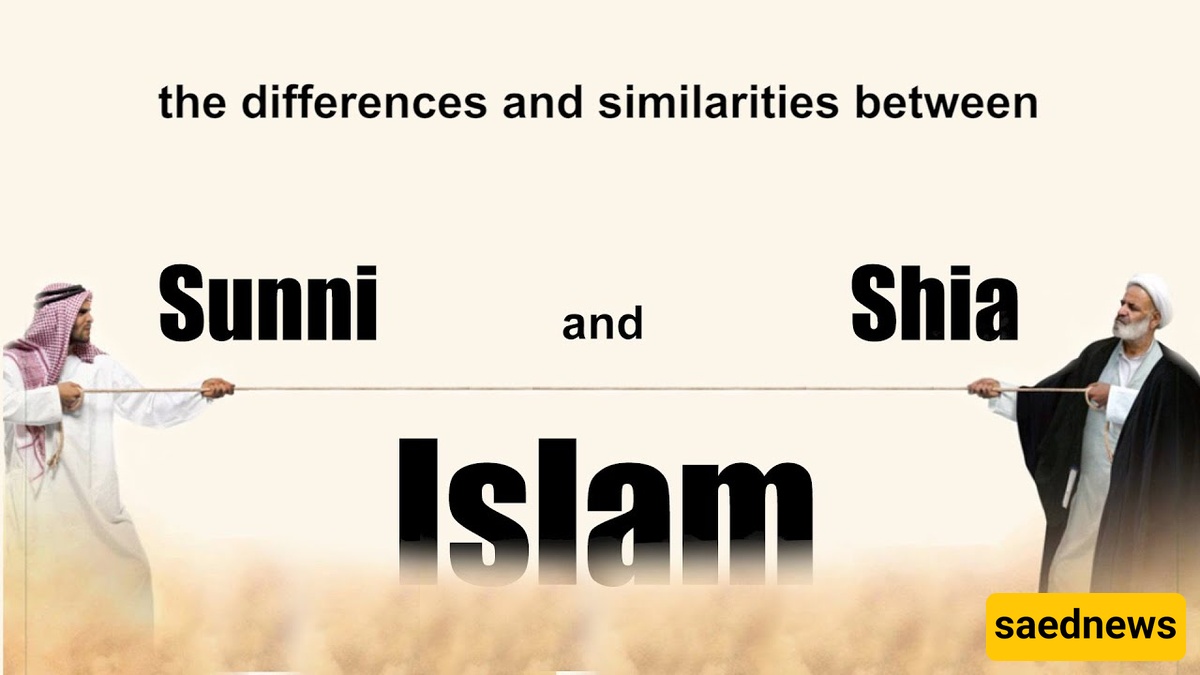
The Main Differences Between Shia and Sunni Islam: Beliefs, Leadership, and Religious Practices
One of the defining characteristics of Sunni Islam is its understanding of the concept of Imamate, which is one of the major areas distinguishing Sunni thought from Shia Islam. There are numerous differences between Shia and Sunni Islam concerning both fundamental beliefs and religious practices. A complete discussion of all these differences would require several volumes.
Here, we will briefly outline some of the most important differences between Shia and Sunni Islam.
Differences concerning Imamate and succession to the Prophet
Different definitions of the Imam in Shia and Sunni theology, including the question of the Imam’s infallibility
Differences concerning the event of Ghadir
Differences concerning the Mahdi and Islamic messianism
Differences regarding the possibility of seeing God
Different views concerning the Companions of the Prophet
Differences concerning ijmaʿ (consensus) as a source of religious law
Differences in religious rulings and acts of worship, including prayer, fasting, pilgrimage, and khums
One of the most significant differences between Shia and Sunni Islam, and a source of many other theological differences, concerns succession and Imamate.
Shia and Sunni Muslims differ fundamentally regarding both the concept of Imamate—the status and role of the Imam—and who should have succeeded the Prophet Muhammad.
According to Shia Islam, the role of the Imam, as the successor to the Prophet, includes:
Governing and administering society
Religious authority, meaning the authoritative and infallible explanation and interpretation of religious teachings concerning theology, ethics, and religious law
In Shia theology, Imamate is a divinely appointed position and is considered one of the fundamental principles of religion. An Imam is appointed by God.
In contrast, Sunni theology generally regards political leadership or the caliphate as a matter of religious and communal governance rather than a divinely appointed pillar of faith. The leader is selected through the community or its representatives.
In other words, Sunni Muslims generally maintain that the Prophet did not explicitly designate a particular individual as his successor and that the selection of a leader after his death was left to the Muslim community.
Regarding the identity of the Prophet’s immediate successor, Shia Muslims argue, based on Qur’anic, transmitted, and rational evidence, that Ali ibn Abi Talib and his descendants were the rightful Imams after the Prophet.
Sunni Muslims, while holding the members of the Prophet’s family (Ahl al-Bayt) in very high regard for their knowledge and piety and acknowledging various miracles and virtues attributed to them, do not generally believe that God explicitly appointed them as the twelve successors of the Prophet. They also do not consider them infallible from sin and error. Sunni tradition generally identifies the four rightly guided caliphs in the following order:
Abu Bakr
Umar
Uthman
Ali
Several prominent Sunni theologians, including Sa'd al-Din al-Taftazani, Mir Sayyid Sharif al-Jurjani, and Sayf al-Din al-Amidi, defined Imamate as a form of general leadership:
“Imamate is general leadership vested in a particular person.”
Qadi Adud al-Din al-Iji defined it as:
“The succession to the Messenger in establishing religion, such that obedience to him is obligatory for the entire community.”
Sayf al-Din al-Amidi also described Imamate as the succession of an individual to the Prophet in establishing religious law and protecting the Muslim community, in a manner that makes obedience to that person obligatory for the entire community.
Ibn Khaldun similarly wrote that Imamate is the succession to the holder of the religious law in protecting religion and administering worldly affairs.
Shaykh al-Mufid defined the Imam as:
“The person who possesses general leadership over religious and worldly affairs as the representative of the Prophet.”
Sharif al-Murtada described Imamate as general leadership in religious matters in its own right.
Allama al-Hilli defined it as:
“General leadership over religious and worldly affairs for a particular person as the representative of the Prophet.”
Fadil al-Miqdad offered essentially the same definition, using the term “successor to the Prophet” rather than “representative of the Prophet.”
These definitions suggest that Shia and Sunni theologians do not differ radically over the basic conceptual definition of Imamate. Their major disagreements concern its source, authority, qualifications, and rightful holders.
According to these theological definitions:
Imamate constitutes general leadership over the entire Muslim community, rather than authority limited to a particular geographical area.
The Imam is responsible for both religious and worldly affairs, not merely one or the other.
The Imam is the successor to the Messenger of God in both religious and worldly matters.
Obedience to the Imam is considered obligatory upon the entire community.
Thus, in theological terminology, an Imam is neither simply a political ruler or president nor merely a religious scholar or jurist. Rather, the Imam possesses the comprehensive authority associated with the Prophet’s governance.
On this basis, Shia theology argues that the Imam must possess complete knowledge of religious rulings and the deeper meanings of the Qur’an and must be protected from error, forgetfulness, and sin.
The argument is based in part on the Qur'anic verse:
“O you who believe, obey God, obey the Messenger, and those vested with authority among you.”
— Qur’an 4:59
According to the Shia interpretation, obedience to the Imam is unconditional, just as obedience to God and the Messenger is unconditional. Therefore, they argue, it would be inconsistent for God to command absolute obedience to someone capable of sin or error.
The argument continues that if Muslims are commanded by God to obey the Imam unconditionally after the Prophet, then that Imam must possess infallibility comparable, in this respect, to the Prophet.
The Qur’an also states:
“Is one who guides to the truth more worthy of being followed, or one who cannot find guidance unless he himself is guided? What is the matter with you? How do you judge?”
— Qur’an 10:35
From the Shia perspective, this raises the question of whether a person who himself requires guidance can serve as the ultimate religious guide for others.
The argument then asks whether the early caliphs required guidance. If they did not, Shia theologians argue, such a claim would require justification. If they did require guidance, then they themselves would need an Imam to guide them.
According to this line of reasoning, the person most qualified to fulfill the role would be someone whose knowledge and guidance correspond to that of the Qur’an and the Prophet. Shia scholars cite traditions such as the Hadith of the City of Knowledge and the Hadith of al-Thaqalayn in support of their position that this person was Ali.
The argument also maintains that if one of the Imam’s responsibilities is to implement and safeguard religion, the Imam must possess comprehensive knowledge of religion so that he implements divine teachings rather than personal opinions.
The event of Ghadir and the Prophet’s sermon there occupy an important place in Islamic religious literature. Shia sources emphasize that the event is transmitted through numerous chains of narration and that many Companions and later transmitters reported it.
The central disagreement between Shia and Sunni Muslims is not necessarily over whether the event occurred, but over its meaning and implications.
Sunni Muslims generally interpret the Prophet’s statement:
“Whoever has me as his mawla, Ali is his mawla”
as emphasizing the love, loyalty, and support that Muslims should have for Ali. Some interpretations may also regard it as indicating Ali’s special status, but not necessarily as an explicit appointment to political or religious leadership.
One reason given is that the Arabic word wilayah/walaya and related terms can carry several meanings, including friendship, loyalty, authority, guardianship, and leadership.
Shia Muslims understand the event of Ghadir as an explicit declaration of Ali’s leadership and Imamate, implying the obligation of Muslims to follow him.
Shia scholars argue that the surrounding circumstances and statements of the Prophet make it difficult to interpret the declaration merely as an instruction to love or support Ali.
They also point to classical Arabic dictionaries, including works attributed to scholars such as Raghib al-Isfahani, Ibn al-Athir, and others, which contain meanings of wali and mawla related to authority, guardianship, responsibility, and leadership.
A large body of Shia literature has been devoted to defending this interpretation, including the extensive work Al-Ghadir by Allama Abd al-Husayn Amini.
Another major area of disagreement concerns whether the Mahdi is already a known individual or an individual who will appear in the future.
Many Sunni scholars have traditionally held that the Mahdi will be a future individual who will emerge near the end of time. The exact identity and circumstances of his birth are not generally understood in the same way as in Twelver Shia Islam.
Twelver Shia Muslims, along with some Sunni scholars, believe that the Mahdi is a specific and already-born individual.
According to Twelver Shia belief, the promised Mahdi is Muhammad ibn al-Hasan al-Askari, whom they identify as the son of Imam Hasan al-Askari. Shia tradition holds that he was born in the third/ninth century and entered minor occultation, followed by major occultation.
During the minor occultation, traditionally dated from 260 to 329 AH, communication with him was maintained through four successive representatives. The major occultation began after the death of the fourth representative.
Many Sunni Muslims, however, traditionally believe that the Mahdi has not yet been born and will appear in the future.
Among Sunni scholars who have accepted the birth of the Mahdi, there are differences regarding his date of birth, lineage, and the identity of his father. Some have associated him with the descendants of Hasan ibn Ali, while others have associated him with the descendants of Husayn ibn Ali. Some Sunni scholars have also identified him as the son of Hasan al-Askari.
Another theological difference concerns whether God can be seen with physical eyesight in the afterlife.
According to Shia theology, God cannot be physically seen either in this world or in the hereafter because God is not a physical being and therefore does not possess physical characteristics.
Islamic schools differ on this issue. Groups such as the Mu'tazilites, Murji'ites, and Zaydis have generally denied the possibility of seeing God in the hereafter as well.
By contrast, Ashari Sunni theology traditionally maintains that believers will see God in Paradise, without God being confined to a particular direction or location.
Sunni theological texts often state that believers will see God while He remains beyond physical direction, location, and spatial limitation.
Shia critics of this position raise questions about traditions describing God as descending from heaven, possessing attributes such as hands, eyes, or a face, laughing, or being seen in the hereafter. They compare these traditions with Qur’anic statements such as:
“There is nothing like unto Him.”
— Qur’an 42:11
The Qur’an also states:
“Vision does not perceive Him, but He perceives all vision.”
— Qur’an 6:103
And concerning Moses, it says:
“You shall never see Me.”
— Qur’an 7:143
From the Shia perspective, these verses indicate that God is not a physical being confined by space or accessible to physical eyesight.
A statement attributed to Imam Ali and transmitted by Imam al-Sadiq expresses this concept:
“Eyes do not perceive Him through physical sight, but hearts perceive Him through the realities of faith.”
This narration is recorded in al-Kafi, volume 1, page 98.
Sunni Muslims generally define a Companion (Sahabi) as someone who met the Prophet Muhammad as a believer and had companionship with him, even if only briefly.
Traditional Sunni scholarship generally regards the Companions as trustworthy and reliable transmitters of religious knowledge.
Shia Muslims, however, distinguish between individual Companions. They acknowledge that many Companions were devout, righteous, and trustworthy, while maintaining that some may have been hypocrites or sinful individuals.
They cite, among other passages, Qur’an 9:101, which states that some of the Arabs around Medina and some of the people of Medina were hypocrites whom the Prophet did not know.
Thus, Shia theology does not regard the entire body of Companions as automatically possessing the same degree of moral authority.
Another major difference concerns ijmaʿ, or consensus, as a source of Islamic law.
Sunni legal theory generally regards consensus among the Muslim community, qualified scholars, or recognized authorities as a source of legal authority under particular conditions.
In Shia jurisprudence, however, consensus is authoritative when it serves as a means of discovering the position of an infallible Imam. The consensus itself is not considered independently authoritative merely because Muslims agree.
Shia writers have also questioned whether the Saqifa gathering, which resulted in Abu Bakr becoming caliph, could properly be described as a consensus, since not all Muslims, Companions, or leading figures participated in it.
There are also differences between Shia and Sunni Muslims in matters such as prayer, fasting, pilgrimage, khums, and other religious practices.
These differences are connected to differences in the sources of religious authority.
Shia jurisprudence generally relies on:
The Qur’an
The Sunnah, including the words, actions, and confirmations of the infallible Imams
Consensus when it reveals the view of an infallible authority
Reason (aql)
Sunni legal traditions generally rely on the Qur’an, the Prophet’s Sunnah, and the transmitted teachings and judgments of the Companions, together with established principles of Islamic jurisprudence.
Because the two traditions differ concerning their sources of religious authority, differences naturally appear in legal rulings.
The text argues that Sunni Muslims traditionally follow one of the four major Sunni schools:
Hanafi
Shafi'i
Maliki
Hanbali
It contrasts this with Twelver Shia jurisprudence, in which the door of ijtihad remains open and followers generally follow a living qualified jurist.
A commonly cited difference concerns wudu (ablution).
Sunni Muslims generally wash their feet during ablution, whereas Twelver Shia Muslims wipe their feet.
Shia scholars cite Qur’an 5:6, particularly the wording concerning wiping the head and feet, as evidence for their practice.
Sunni Muslims commonly pray with their hands folded or placed one over the other, although the precise practice varies among Sunni schools.
Twelver Shia Muslims generally pray with their arms resting naturally at their sides rather than folding their hands.
The text questions the evidence for making the folded-hand position a standard practice, noting that some Sunni schools do not regard it as obligatory and that the Maliki school has traditionally differed regarding it.
Sunni Muslims commonly prostrate directly on carpets or other surfaces during prayer.
Twelver Shia Muslims generally require the forehead to be placed on a natural substance from the earth, such as soil, stone, or clay, under normal circumstances.
Shia scholars point to reports that the Prophet and the early Muslims prostrated on the earth, sand, or stones. The turbah, or prayer tablet, is therefore used as a convenient way of carrying a suitable natural material.
The turbah itself is not regarded as inherently sacred or necessary; rather, its material is considered suitable for prostration.
Sunni Muslims generally perform the five daily prayers at their prescribed separate times, although Sunni jurisprudence also recognizes circumstances in which prayers may be combined.
Twelver Shia Muslims permit combining Dhuhr and Asr as well as Maghrib and Isha, while still maintaining their distinct prayers.
Shia scholars cite reports in both Shia and Sunni sources indicating that the Prophet sometimes combined prayers without an obvious emergency, arguing that this was done to prevent hardship for the Muslim community.
They therefore maintain that combining prayers is permissible even when there is no necessity.
Daily obligatory prayers may be performed in congregation, and this was practiced by the Prophet and many of his Companions. Sunni Muslims also traditionally perform Tarawih prayers in congregation during Ramadan.
Shia scholars object to making congregational performance of these optional prayers into an established religious practice, arguing that the Prophet did not institute them in this form.
They particularly criticize:
Performing optional prayers as a regular congregation
Treating the practice with such emphasis that it approaches the status of an obligation
The differences between Shia and Sunni Islam extend far beyond the issues discussed above. They involve questions of leadership, religious authority, theology, interpretation of scripture, the status of the Companions, jurisprudence, and ritual practice.
The most fundamental disagreement, according to the Shia perspective presented here, concerns the nature of Imamate and the succession to the Prophet Muhammad. Other theological and legal differences are understood as consequences of the two traditions' different approaches to religious authority and the sources from which Islamic teachings are derived