SAEDNEWS: Tayammum Instead of Ghusl of Janabah When Water Is Unavailable: Complete Guide to Its Steps, Conditions, and Islamic Jurisprudential Rulings
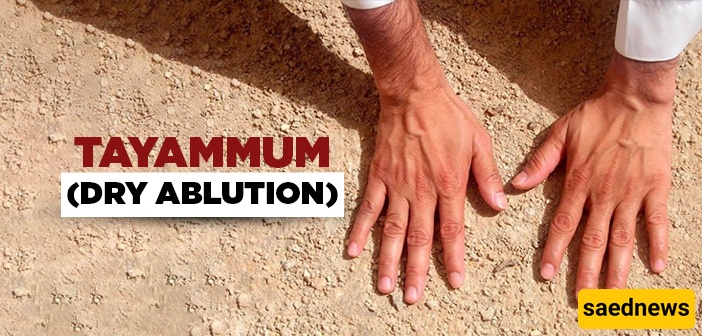
According to Saednews, Sometimes circumstances arise in which performing ghusl for major ritual impurity (janabah) is not possible—such as lack of water or when using water would cause harm. In such cases, tayammum as a substitute for ghusl is introduced as a religious ruling. But how is tayammum correctly performed? What are its conditions, and what should be observed for it to be valid? In this article, we will examine the steps of tayammum in a clear and practical way.
Ghusl becomes obligatory when semen is discharged from the body or when sexual intercourse occurs. Normally, a person must perform ghusl to attain ritual purity for acts of worship such as الصلاه (prayer). However, there are situations where performing ghusl is impossible or very difficult. In such cases, tayammum may replace ghusl.
In general, tayammum instead of ghusl is permissible in the following situations:
When water is not available and cannot be obtained.
When there is not enough time to perform ghusl and prayer would be missed.
When using water is harmful, or there is fear of illness or worsening a condition.
When obtaining or using water causes extreme difficulty beyond normal tolerance.
When using water would cause severe thirst or illness for oneself or dependents.
When the body or clothes are impure and using water for ghusl would leave no water to remove the impurity.
When the available water is not permissible to use.
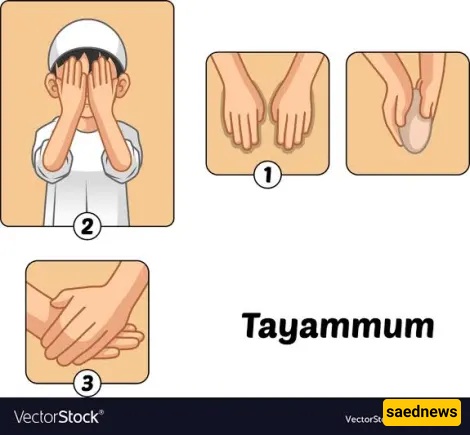
Tayammum instead of ghusl for prayer consists of four simple steps: intention, striking the hands on a valid surface, and wiping the forehead and hands. The order must be followed as described below:
At the beginning, one must intend in the heart to perform tayammum instead of ghusl for obedience to God. For example:
“I perform tayammum instead of ghusl of janabah for the sake of God.”
Place both palms simultaneously on something that tayammum is valid on—such as soil, sand, or stone.
Wipe both hands across the entire forehead, from the hairline to the eyebrows and upper nose area, including both sides of the forehead. As a precaution, the hands should also pass over the eyebrows.
Wipe the back of the right hand with the left palm, then the back of the left hand with the right palm.
It is recommended (mustahabb) to strike the hands on the earth once more before wiping the backs of the hands.
According to most religious authorities (except some scholars such as Ayatollah Sistani, Makarem Shirazi, and Nouri Hamedani), if a person performs tayammum instead of janabah ghusl, they do not need wudu or additional tayammum for prayer.
However, for tayammum replacing other types of ghusl, wudu is generally required unless it is also not possible, in which case tayammum for wudu is performed.
According to Sistani, Makarem Shirazi, and Nouri Hamedani, tayammum in place of any ghusl is sufficient for prayer, and no additional wudu or tayammum is required (except in specific cases such as intermediate istihada). However, performing wudu as a precaution is considered better.
Tayammum is valid on materials derived from the earth, such as soil and various types of stone. However, as a precaution, if soil or stone is available, it is better not to perform tayammum on materials such as baked gypsum, lime, bricks, pottery, or mineral stones like agate.
If a person is required to perform tayammum instead of ghusl or wudu but part of the area used for wiping or striking is injured and bandaged, they may still perform tayammum by wiping over the bandaged area.
If a person feels too embarrassed or ashamed to perform ghusl, they are not allowed to perform tayammum at the beginning of prayer time and pray immediately.
Instead, they must purify any impure parts of the body and wait until the end of the prayer time, when only enough time remains to perform tayammum and pray briefly. At that point, they may perform tayammum and pray.
However, deliberately delaying prayer in a way that removes the opportunity for ghusl is sinful. Even so, the prayer performed with tayammum remains valid, although it is recommended to make it up later as a precaution.
If a person performs tayammum instead of ghusl due to lack of water, one wudu is sufficient afterward.
Tayammum in place of ghusl removes the need for wudu or additional tayammum, though performing wudu is recommended as a precaution in non-janabah ghusl cases.
Tayammum instead of ghusl also suffices for wudu when the excuse remains.
Tayammum is valid even if the material (soil, gypsum, stone) is on walls and not necessarily on the ground.
If a person remains in a state of janabah for several days and performs tayammum, then later experiences minor ritual impurity (hadath asghar), they must perform tayammum again for each subsequent prayer until the excuse is removed, and also perform wudu if possible.