SAEDNEWS: Lacquer painting, or Zirlaki, emerged as an independent art form toward the end of the Safavid period and reached its artistic peak during the Afsharid, Zand, and Qajar periods.
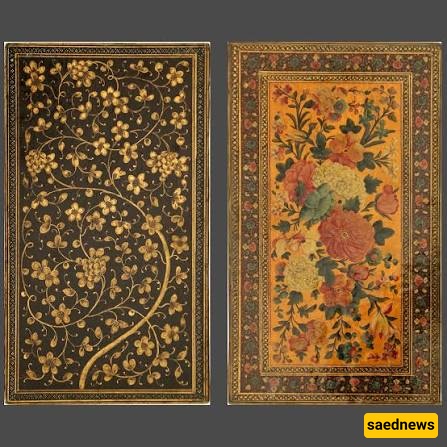
Accoridng to Saednews, Papier-mâché is essentially a French term meaning “compressed paper.” In art terminology, it generally refers to cardboard or paper-based objects whose surfaces are decorated with miniature paintings and coated with a special protective lacquer. The exact origins of this art form, which was formerly known as oil painting or lacquer painting, are not clearly established.
However, surviving works in Iranian and foreign museums, as well as in private collections, provide evidence that challenges the assumption that all Persian manuscripts before the Seljuk period had only plain or simple leather bindings without Islamic decoration. Reliable historical evidence indicates that lacquer painting became established in Iran during the Safavid period, developing alongside other traditional crafts and gradually evolving into a distinctive art form.
Because objects made using the papier-mâché technique were painted and then covered with a glossy protective coating, this art also became known as lacquer painting.
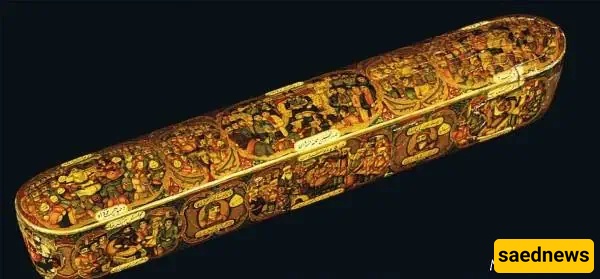
According to art encyclopedias, lacquer painting, sometimes referred to as under-lacquer painting, is a form of watercolor painting executed on paperboard objects such as pen cases, book covers, mirror frames, Qur’an stands, cosmetic boxes, playing cards, and trays, whose surfaces are subsequently covered with a protective lacquer layer.
With variations, this technique became common in several traditional arts of China, India, Iran, and other regions. In Iran, it became particularly popular from the late eleventh century AH, especially in the decoration of pen cases. Following the preferences of their customers, pen-case painters frequently depicted flowers and birds as well as European-inspired subjects, although examples based on traditional Iranian styles also survive.
The spaces between painted scenes were often decorated with floral patterns, calligraphic panels, or illumination. Notable artists associated with this tradition include Ali Ashraf and Aqa Najaf.
Lacquer painting essentially emerged from the tradition of Persian miniature painting and gave miniature artists a broader and more diverse field of artistic expression. Its growing popularity was closely connected with the decline of manuscript illumination and book arts in Iran. Unlike traditional manuscript painting, lacquer painting allowed artists to experiment with different viewpoints and compositions.
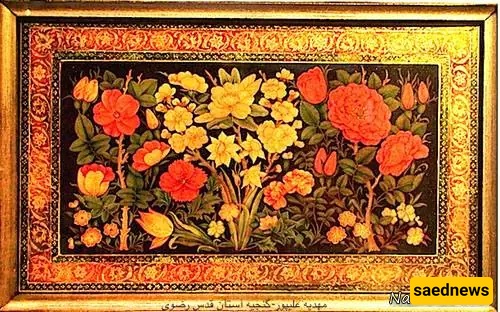
The development of lacquer painting was initially associated with leather bookbinding and decorative designs on leather and paper. Later, artists prepared surfaces using paper pulp and glue (papier-mâché) along with wooden molds. Once the surface was prepared for painting, it was coated with a thick protective layer made from a mixture of linseed oil, sandarac resin, and varnish. This gave the finished work an appearance similar to oil painting.
This technique was used to decorate a wide range of objects, including pen cases, book covers, mirror frames, Qur’an stands, jewelry boxes, carved and painted doors, wooden panels, decorative and military bows, and playing cards.
The earliest known example of pen-case painting dates to 1106 AH and bears the inscription “Ya Sahib al-Zaman.” It was painted by Muhammad Zaman and is preserved in the Hermitage Museum in St. Petersburg.
The decorative motifs used on pen cases generally fell into three main categories:
Flower-and-bird designs, painted on the upper surface or on both sides of the pen case and often incorporated into natural landscapes.
Floral and botanical patterns, accompanied by curling vines, scrollwork, and flowering branches.
Compositions combining arabesque motifs with figurative scenes, often executed in a European-inspired style. This third type became more widespread than the other two.
Although lacquer painting began to develop under Muhammad Zaman during the Safavid period and continued during the Afsharid and Zand periods through artists such as Ali Ashraf, Muhammad Hadi, and Muhammad Sadiq, it was during the Qajar period that the art reached a particularly luxurious and sophisticated form.
Its compositional elements became more systematic and harmonious, while male and female figures began to appear wearing contemporary Qajar clothing.
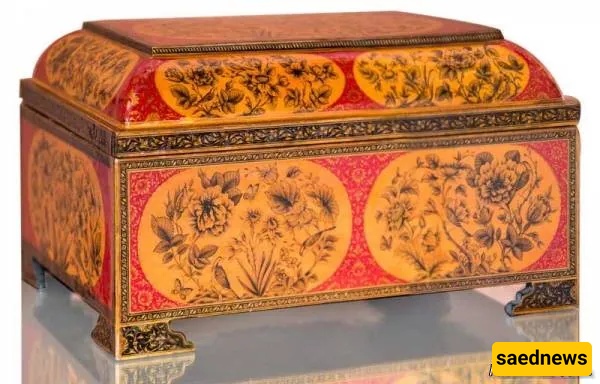
One of the finest surviving works from this period is a jewelry box signed by Mirza Baba and dated 1218 AH, in which the flower-and-bird motif became especially prominent.
During the Qajar period, the range of lacquer motifs became increasingly rich. Artists incorporated repeated floral designs, particularly roses, carnations, hyacinths, fruit blossoms, birds, butterflies, mixed bouquets, irises, and simple compositions featuring shield-shaped and medallion-like motifs.
Lacquer painting underwent significant quantitative and qualitative development during the Qajar era. In many respects, its growing popularity, together with enamel painting, was associated with the decline of traditional manuscript production and book decoration.
During the reign of Fath-Ali Shah, artists such as Mihr Ali, Mirza Baba, Sayyid Mirza, and Abdullah Khan increasingly shifted their artistic efforts away from manuscript illustration and toward lacquer painting, enamel work, and oil painting.
During this period, Tehran, Isfahan, and Shiraz became important centers for the production of lacquer and enamel works.
The subject matter expanded considerably. In addition to traditional floral and bird compositions, artists depicted court ceremonies, battles, mythological and historical episodes, hunting scenes, scenes of divine judgment, landscapes, and a wide variety of floral and bird motifs.
One of the finest book covers of the period was commissioned by Fath-Ali Shah for a copy of the Khamsa of Nizami associated with Shah Tahmasp. Sayyid Mirza and Muhammad Baqir executed the cover in 1245 AH.
Among the prominent artists of this period were Najaf Ali and his three sons—Muhammad Kazim, Ja'far, and Ahmad—as well as his brother Muhammad Ismail. They dominated much of the lacquer-painting tradition during the second half of the thirteenth century AH and received the patronage of Manuchehr Khan, the governor of Isfahan.
Another renowned Isfahan family was the Imami family. Nasrullah Imami and Reza Imami created notable lacquer works featuring floral and bird motifs on mirror frames, pen cases, and boxes.
At the same time, Aqa Bozorg Shirazi was active in Shiraz. He became particularly well known for lacquer portraits depicting prominent public figures and personalities.
During the reign of Nasir al-Din Shah, lacquer painting underwent another major transformation. New motifs and subjects appeared, including hazelnut blossoms, deer, parrots, rural scenes, informal bouquets, figures dressed according to the latest European fashions, clean-shaven men, and women wearing voluminous, pleated European-style skirts.
The increasing circulation of European images and foreign publications encouraged artists to borrow extensively from European visual sources. This eventually contributed to repeated and increasingly standardized compositions and decorative motifs.
During this period, the depiction of Imam Ali and his sons Hasan and Husayn in lacquer paintings reflected a renewed interest in religious iconography within Islamic art.
With the emergence of the modern era and the beginning of the Constitutional Revolution, lacquer painting gradually declined. Changes in artistic tastes, the increasing influence of modern European art, and the decline of traditional crafts contributed to its loss of prominence.
Although lacquer painting had developed into one of Iran’s distinctive decorative arts over several centuries, it eventually became largely obsolete and is now considered a largely discontinued traditional art form.