SAEDNEWS: In this article, based on the latest scientific evidence and studies, we address this frequently asked question.

According to Saednews, If you are looking for a healthy and nutritious snack, almonds are one of the best choices. However, many people face a mental contradiction: on one hand, almonds are known as a healthful food for wellness and fitness, while on the other hand, due to their high calorie and fat content, they are often seen as a fattening food. Can this small and nutrient-rich nut really lead to weight gain, or is this belief simply an old myth?
It all starts with the numbers on the nutrition label. Almonds are a calorie-dense food. This means that a small volume contains a significant amount of energy. A small handful of almonds (about 28 grams or roughly 23 almonds) contains around 165 calories, 14 grams of fat (mostly healthy unsaturated fats), 6 grams of protein, and 3 grams of fiber.
A superficial look at these numbers can easily create the belief that regular almond consumption significantly increases daily calorie intake and therefore leads to weight gain over time. However, modern nutrition science tells a much more complex and different story.
In recent years, extensive scientific research has been conducted to examine the relationship between almond consumption and changes in body weight, and the results may be surprising for many people.
The latest and most comprehensive scientific evidence shows that regular almond consumption is not associated with weight gain; in fact, it may even help with weight control and weight loss. A comprehensive systematic review in 2024 analyzing 37 randomized controlled trials found that including almonds in the diet was associated, on average, with a reduction of 0.45 kg in body weight, a 0.66 cm decrease in waist circumference, and a 0.66 kg reduction in body fat mass.
Another comprehensive review also supports these findings, showing that almonds are the only tree nut that leads to a small but meaningful reduction in body weight and fat mass compared to control diets. These results suggest that almonds’ effect on reducing abdominal fat and improving body composition is more important than just changes on the scale.
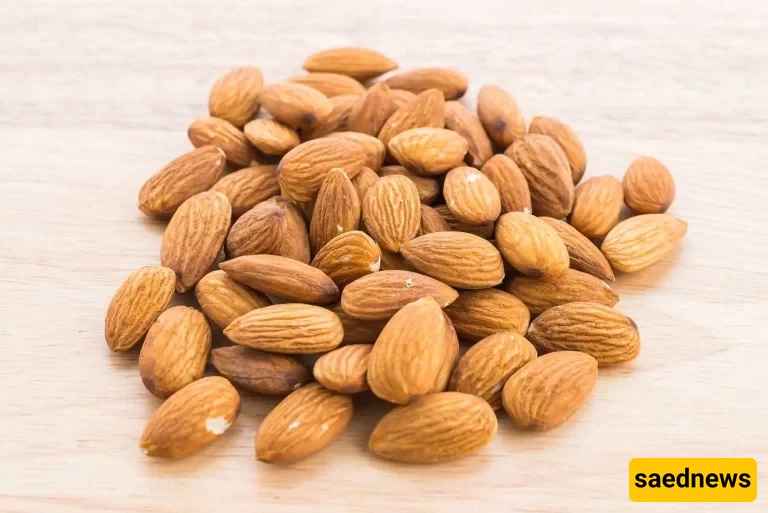
To understand this apparent contradiction—how a high-calorie food can help with weight control—we need to look at physiological mechanisms in the body:
Satiety effect: Almonds, thanks to their unique combination of protein, fiber, and healthy fats, are highly satiating. Eating almonds as a snack significantly reduces feelings of hunger. A recent meta-analysis showed that consuming 50 grams or more of almonds daily significantly reduces hunger. The natural result is a lower tendency to consume other high-calorie, low-nutrient snacks throughout the day.
Incomplete calorie absorption: Perhaps one of the most surprising findings is that the body does not absorb all the calories in almonds. The cellular structure and fiber content of almonds trap part of the fat during digestion, preventing full absorption, and allowing it to be excreted. This phenomenon, known as reduced metabolizable energy, means almonds effectively provide fewer usable calories than expected.
The positive effects of almonds are not limited to short-term outcomes. A one-year study on individuals who habitually consumed unhealthy snacks showed that replacing them with almonds had no negative effect on body weight or composition after 12 months. Interestingly, overall diet quality significantly improved in the almond-consuming group.
Additionally, large epidemiological studies confirm that higher nut consumption over the long term is associated with lower weight gain and a reduced risk of obesity. Specifically, replacing just 0.5 servings (about 14 grams) of almonds or other nuts with snacks such as chips, fries, or processed meats is a simple and effective strategy for preventing gradual weight gain over the years.
Putting all the scientific evidence together, the answer is clear: no, almonds are not inherently a fattening food. This old belief is completely inconsistent with modern scientific findings. In the context of a balanced diet, almonds not only do not lead to weight gain, but due to their high satiety, incomplete calorie absorption, and improvement of overall diet quality, they can be a valuable ally in weight control or weight loss.
The key to benefiting from almonds is portion size and how they are consumed. For positive effects on weight, a daily handful (about 28–50 grams) of raw, unsalted, and unroasted almonds is recommended. The best approach is to use almonds as a filling, nutritious snack that replaces processed and high-calorie foods. Mindful consumption and paying attention to each bite help prevent unconscious overeating.