SAEDNEWS: One type of refrigerator-freezer system is the difference between Defrost and No-Frost refrigerators. Today, we’ll take a closer look at these two cooling systems and explore how they differ. Join us on Delgarm as we compare them.

According to Saednews, Refrigerators are designed to preserve food and prevent spoilage by lowering the temperature inside the cabinet. This cooling process is achieved through a refrigerant that circulates continuously through a closed system.
The main components of a refrigerator’s cooling system include:
The metal tubing at the back of the refrigerator, known as the condenser or radiator
The evaporator, located in the cooling compartment or freezer
The compressor, or refrigerator motor
Other pipes and passages that connect the system
Together, these components form a complete circuit through which the refrigerant circulates. The compressor is responsible for moving the refrigerant through this circuit.
When the refrigerant reaches the evaporator, it absorbs heat from the materials and air inside the cooling compartment. As it absorbs heat, the refrigerant becomes warmer. The compressor then moves it under pressure toward the condenser coils at the back of the refrigerator. There, the refrigerant releases its heat into the surrounding air, cools down, and continues through the system.
This explains why refrigerator condensers and evaporators are designed as networks of tubes: the larger surface area allows heat to be transferred more efficiently.
It also explains why the cooling circuit must remain completely sealed. If any part of the system is punctured or develops a leak, the refrigerant can escape and the refrigerator will no longer cool properly.
In the past, when electricity was unavailable in many areas, ammonia was used in some refrigeration systems. Heat caused the ammonia to circulate through the system and produce a cooling effect.
Traditional absorption refrigerators could operate using kerosene or other fuels instead of electricity. The fuel supplied the heat needed to circulate the ammonia and make refrigeration possible. Some fuel-powered refrigerators are still used in remote areas.
Ammonia is now generally avoided in household refrigerators because it is highly toxic, can be dangerous under certain conditions, and can cause serious corrosion when combined with moisture.
Historically, Freon and other chlorofluorocarbon (CFC) refrigerants were widely used instead. However, many of these refrigerants were found to damage the ozone layer. As a result, the refrigeration industry has moved toward refrigerants with lower environmental impact.
The basic refrigeration cycle can be summarized as follows:
The compressor starts operating and compresses the refrigerant.
The high-pressure refrigerant moves through the system toward the condenser.
In the condenser coils, the refrigerant releases heat into the surrounding room.
The refrigerant then reaches the expansion section, where its pressure and temperature decrease.
It enters the evaporator, where it absorbs heat from inside the refrigerator.
The refrigerant becomes warmer and returns to the compressor.
This cycle continues until the refrigerator reaches the required temperature.
In other words, a refrigerator does not actually create cold. It removes heat from inside the cabinet and transfers that heat to the surrounding room.
When warm air passes over a cold surface, the air loses some of its moisture. Depending on the temperature of the surface, this moisture can appear as water droplets or freeze into ice.
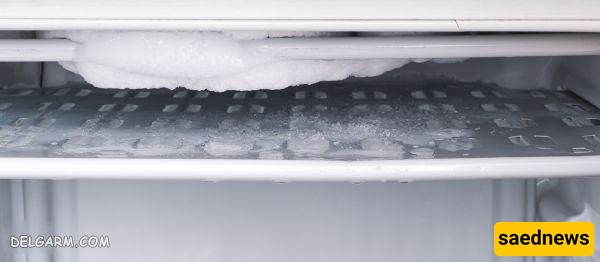
Every time the refrigerator door is opened, some warm, moisture-containing air enters the cabinet. Similarly, placing warm food inside the refrigerator introduces additional heat and moisture.
When this moist air comes into contact with the cold evaporator or cooling surfaces, some of the moisture condenses and freezes, forming frost or ice.
As frost builds up, it can interfere with heat transfer between the evaporator and the air inside the refrigerator. In fan-assisted systems, excessive frost can also restrict airflow. Both effects reduce cooling efficiency.
To solve this problem, modern refrigerators use automatic defrosting systems, including Defrost and No-Frost technologies.
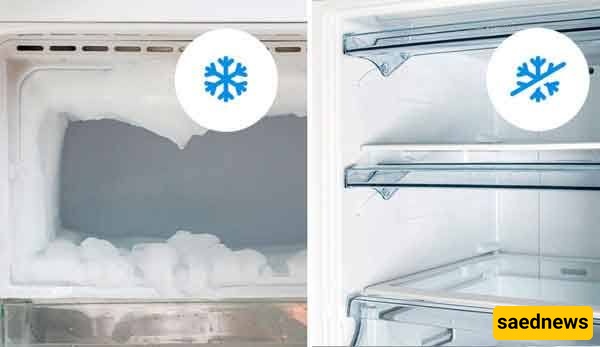
Defrost refers to the process of removing accumulated frost or ice from the evaporator or other cooling surfaces in a refrigeration system.
Because moisture cannot be completely prevented from entering a refrigerator, frost may eventually form. Defrosting is therefore necessary to maintain efficient operation.
The term No-Frost means that visible frost does not normally accumulate inside the refrigerator or freezer compartment.
However, this does not mean that frost never forms. In a No-Frost refrigerator, the evaporator coils are generally located behind a cover rather than being directly exposed inside the cabinet.
A fan circulates cooled air throughout the refrigerator. Moisture that freezes on the hidden evaporator is periodically removed through an automatic defrost cycle.
During this cycle, an electric heating element melts the accumulated frost. The resulting water flows through a drainage system into a container near the compressor, where the heat from the compressor helps evaporate it.
This process also helps prevent excessive frost from interfering with airflow and heat transfer.
Removing frost is important for two main reasons:
Frost acts as an insulating layer. When ice accumulates on the cooling tubes, it reduces heat transfer and makes cooling less effective.
Frost can restrict airflow. In refrigerators that use fans, ice buildup around the evaporator can reduce the amount of air circulating through the system, resulting in weaker cooling.
In conventional defrost refrigerators, frost removal may be handled in different ways.
Manual Defrost:
The user must periodically switch off and unplug the refrigerator, remove the food, and wait for the accumulated ice to melt. This can be inconvenient and may require food to remain outside the refrigerator for several hours.
Automatic Defrost:
Some refrigerators automatically enter a defrost cycle at regular intervals. The compressor temporarily stops and a heating element melts the frost. The water is collected and eventually evaporates near the compressor.
No-Frost refrigerators automatically remove frost, so users do not normally need to turn off the appliance for long periods to manually defrost it.
Because a fan circulates cold air throughout the cabinet, these refrigerators can also provide more uniform cooling. The cooling components are hidden behind internal covers, so visible frost does not normally accumulate inside the storage compartments.
Most modern side-by-side refrigerators and many newer refrigerator-freezer models use No-Frost technology.
The main difference is simple:
Defrost refrigerators: Frost can accumulate and may need to be removed manually or through a defrost cycle.
No-Frost refrigerators: Frost is automatically removed from the hidden evaporator, keeping the storage compartments largely free of visible ice.
Understanding how these systems work can help you choose between a conventional defrost refrigerator and a No-Frost model based on your budget, maintenance preferences, and cooling requirements.