SAEDNEWS: China’s secretive Shenlong space plane has released another unidentified object into low Earth orbit, adding to a growing mystery surrounding a vehicle that has deployed at least nine objects since 2022. Experts have confirmed the latest object came from Shenlong, but its purpose remains unknown.
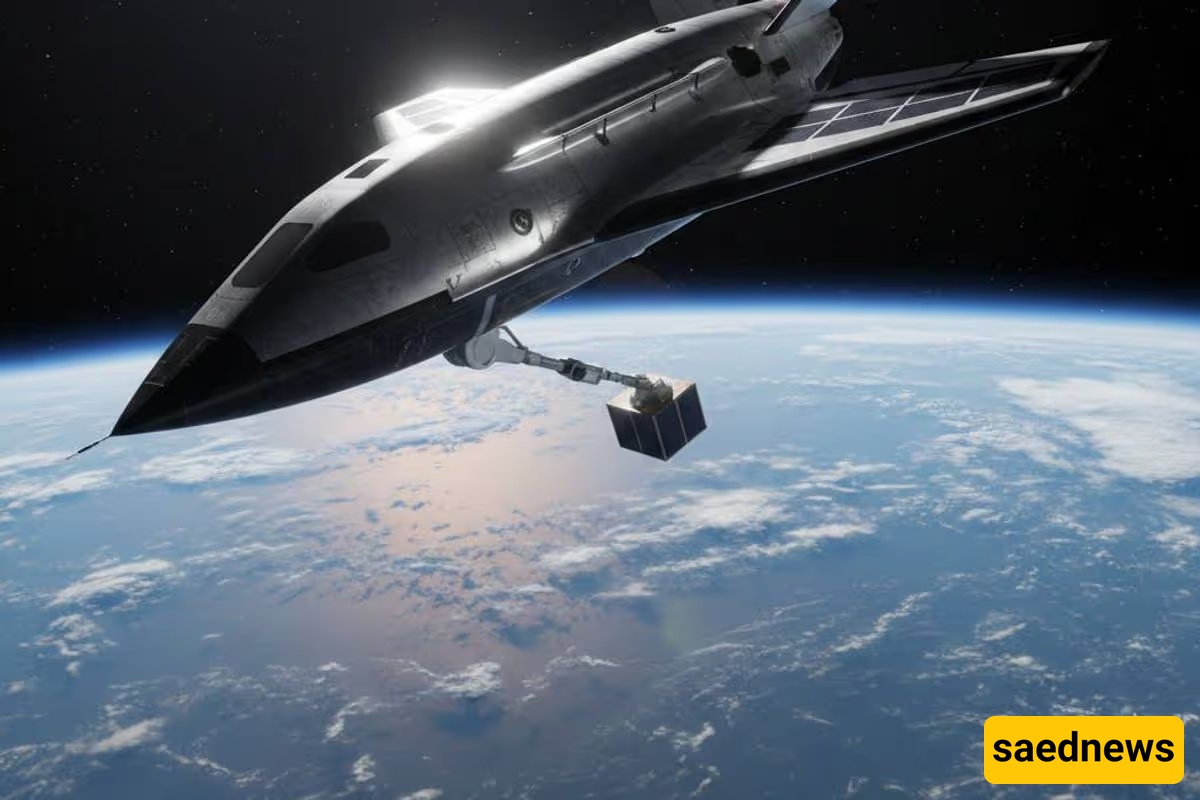
According to SaedNews: China’s highly secretive Shenlong space plane has once again placed an unidentified object into orbit, reigniting questions about what the reusable spacecraft is actually designed to do.
The latest development is particularly intriguing because Shenlong has now released at least nine objects during its missions around Earth since 2022. Despite repeated observations by space-tracking organizations and independent experts, there is still no publicly confirmed explanation of what these objects are intended to accomplish.
Shenlong, whose name means “Divine Dragon,” is a robotic, reusable space plane operated by China. It is launched vertically on a rocket, travels into low Earth orbit and eventually returns through the atmosphere before landing horizontally on a runway. Its basic operating concept has drawn comparisons with the retired U.S. Space Shuttle program.
But there is one major difference that keeps Shenlong surrounded by mystery: China has never released an official photograph of the spacecraft.
As a result, even basic details about its size, shape and design remain unclear. Chinese space authorities have also provided little meaningful public information about the vehicle’s objectives or the nature of its missions.
The spacecraft first reached space in September 2020 for a brief two-day mission. It later spent about eight months in low Earth orbit between August 2022 and May 2023. Its next mission lasted roughly nine months, from December 2023 to September 2024.
During those flights, Shenlong began demonstrating another unusual capability: deploying objects while in orbit.
Shortly after the launch of its second mission, it released its first known payload. During its third mission, it deployed seven more objects, including six that were released at roughly the same time.
Now, its fourth mission has added another chapter to the mystery.
The latest mission began on February 7, when Shenlong was launched aboard a Long March 2F rocket from China’s Jiuquan Satellite Launch Center in the Gobi Desert. For much of the mission, however, little public information emerged about what the spacecraft was doing.
That changed on June 22.
Leolabs, a private company specializing in tracking objects in low Earth orbit, announced on X that its network had detected an unidentified object near the Chinese space plane. The object was initially picked up by one of the company’s radars in New Zealand and did not correspond to anything already listed in its database.
Further observations from Leolabs’ wider radar network provided stronger evidence that the object was a separate orbital body. The company subsequently assessed with high confidence that it had been released by the Chinese space plane.
The following day, Jonathan McDowell, an astronomer and satellite-tracking specialist at Durham University in the United Kingdom and a former member of the Harvard-Smithsonian Center for Astrophysics, independently confirmed that the object originated from Shenlong. He also said the U.S. Space Force was tracking it.
McDowell suggested that the mysterious object could be a CubeSat—a small, cube-shaped satellite commonly deployed as a secondary payload. But that remains only a possibility. As with the earlier objects released by Shenlong, its actual purpose has not been established.
That uncertainty has fueled a range of speculation.
One possibility is that Shenlong is designed to conduct close approaches and orbital rendezvous with other spacecraft. Under that scenario, some of the objects it releases could serve as targets for practicing orbital maneuvers.
Other observers have speculated that the mysterious payloads could be covert reconnaissance satellites or potentially involve anti-satellite technology. However, there has so far been no reported case of Shenlong or one of its released objects destroying another spacecraft.
The spacecraft itself has accumulated an extraordinary amount of time in low Earth orbit—nearly 700 days in total across its missions.
Amateur observers have managed to capture a few blurry images of reflected light from the otherwise elusive vehicle. One of the most interesting images, recorded in August 2024, appeared to show a bright structure extending from the main body. Experts suggested it was probably a solar panel, a relatively unsurprising possibility given that most spacecraft obtain at least part of their power from sunlight.
Shenlong is not the only secretive space plane in operation.
The United States operates the Boeing X-37, another reusable space plane designed for long-duration orbital missions. The two operational vehicles of the X-37 program have collectively spent more than 4,200 days in low Earth orbit since 2010.
Yet there is an important distinction. U.S. officials have released considerably more information about the X-37’s design, mission parameters and research objectives than China has disclosed about Shenlong.
That information gap is what makes every new Shenlong deployment so compelling. Each unidentified object adds another piece to a puzzle that remains far from complete.
For now, the latest payload has been identified as an object originating from China’s secretive space plane, but its mission remains unclear. Whether it is a simple experimental satellite, an orbital target or something more sophisticated cannot be established from the available evidence.
And that unanswered question may be the most revealing part of the story. As Shenlong continues operating in orbit, observers are likely to keep watching—not only the space plane itself, but also whatever it chooses to release next.