SAEDNEWS: Russia’s Deputy Security Council Chairman sharply criticized the United States for its inconsistent and hypocritical approach to Iran’s nuclear program.
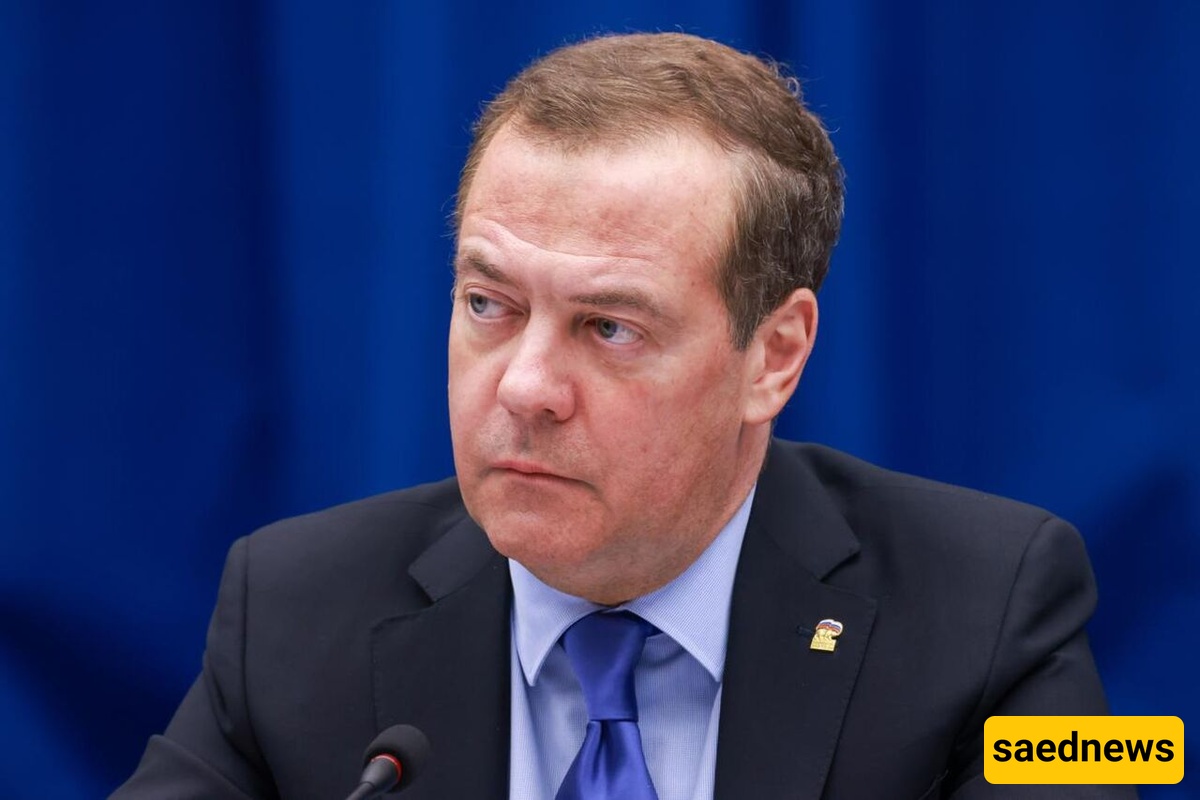
According to Saednews, In an article published in the Moscow Journal of International Law under the title “State Sovereignty and Nuclear Weapons: International Legal Aspects of Ensuring National Security,” Dmitry Medvedev argued that the principle of nuclear non-proliferation is often used as a political instrument, with little regard for the actual circumstances.
Medvedev criticized Washington’s military attack on Iran, saying it was justified under the pretext of protecting the global nuclear non-proliferation framework, despite Tehran’s declared commitment to its international obligations.
He noted that Iran had repeatedly demonstrated its willingness to cooperate through negotiations and inspections concerning its peaceful nuclear programme.
“By maintaining full transparency in negotiations and inspections related to peaceful nuclear activities, Tehran has shown through practical actions rather than words that it has no intention of acquiring nuclear weapons. Even despite direct threats of nuclear strikes and military aggression, including attacks on civilian nuclear facilities, Iran has not abandoned its status as a non-nuclear-weapon state under the Nuclear Non-Proliferation Treaty (NPT),” Medvedev stated.
The Russian official argued that Washington’s approach exposes the double standards underlying US nuclear non-proliferation policy. According to him, American restrictions are primarily determined by geopolitical interests, with pressure directed mainly at countries considered unfriendly by Washington.
In another section of the article, Medvedev discussed the legal framework of the NPT, describing the treaty's wording as sufficiently comprehensive in itself. However, he argued that its practical effectiveness is weakened because implementation depends heavily on the political attitudes of major powers.
“The universal character of the NPT is gradually being undermined, not because of deficiencies in the treaty itself, but because of the unequal manner in which its provisions are applied politically,” he wrote.
Medvedev further argued that the credibility of the non-proliferation system suffers when countries' rights to pursue nuclear activities are assessed according to their political relationships with major powers or military alliances.
“When the limits of permitted nuclear activities are effectively determined by whether a country is regarded as an adversary or an ally of a major power or military bloc, the non-proliferation framework loses part of its legal and political authority. Although the law remains formally equal for all states, its implementation becomes selective in practice,” he added.
Addressing the possibility of withdrawal from the NPT, Medvedev maintained that a country's departure from the treaty releases it from the obligations associated with membership.
“Once a state withdraws from the NPT, its international legal responsibility under the treaty for developing nuclear weapons comes to an end,” Medvedev concluded.