SAEDNEWS: Iran’s Foreign Ministry spokesman Esmail Baqaei said on Tuesday that Iran is the sole force standing against evil following the assassination of Ayatollah Khamenei by the US and Israeli regime, stating “our leader sacrificed himself to preserve Iran.”
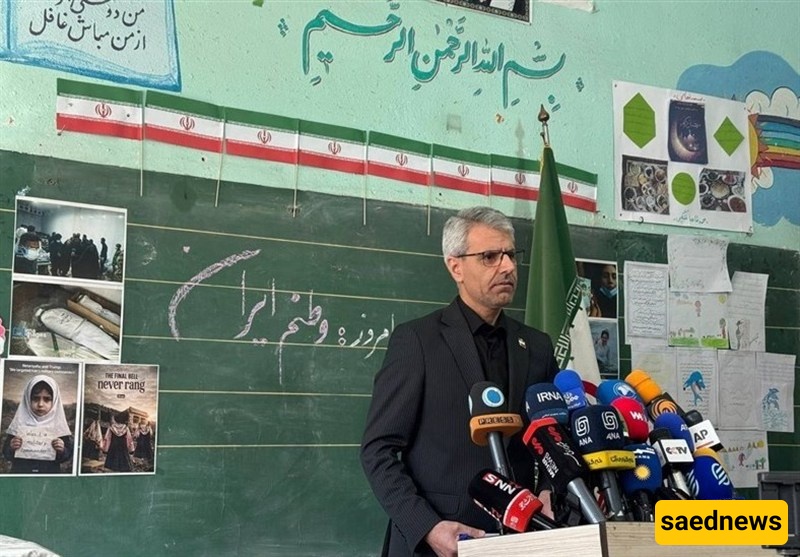
Baqaei made the remarks at a weekly press briefing held on March 3 at Shahid Mahallati School in Tehran, which had recently been hit in attacks by “the terrorist US regime and the Zionist.”
At the start of the presser, Baqaei offered condolences over the martyrdom of Leader of the Islamic Revolution Ayatollah Seyed Ali Khamenei, senior commanders and Iranian citizens, saying, “We are all in mourning…what matters to every single Iranian these days is defending the homeland.”
He said Iran has been confronted with aggression by “the most wicked individuals”, adding that the current events represent a clash between “good and evil.”
Baqaei blamed recent turmoil on two years of inaction by other nations in response to crimes committed by the Israeli regime in neighboring states.
“We said many times that if no action is taken by countries—countries that claim (to uphold certain principles)—this lawlessness will affect everyone,” he said, adding that indifference leads to complicity.
He also addressed civilian casualties, including children, saying they were to be buried today while emphasizing Iran’s resolve.
“Iran stands firm. The world must know what a standing Iran means,” he said.
Baqaei said Iran is “the sole remaining force against evil,” and described attacks on civilians and national infrastructure as tantamount to genocide.
On Diplomacy, War and Regional Security
Turning to diplomatic efforts preceding the war, Baqaei rejected claims about negotiations, saying they were based on falsehoods and should not be allowed to shape historical narratives.
He indicated that the United States and its allies had made contradictory statements about Iran’s threat, and questioned whether Iran had ever posed such a threat.
Baqaei said that although Iran pursued diplomacy, war was imposed by its enemies.
“We entered (the negotiations) with good faith…to show that Iran was not the side that was obstinate,” he said.
He condemned those attacking Iran for violating international law and undermining the United Nations Charter, asserting that such aggression threatens the international system.
Citing remarks by the US officials; he questioned Washington’s justification for military action.
“Marco Rubio says we decided to enter from Israel’s side. The US president says Iran was a threat. Was Iran a threat? Did Iran deploy troops? Did Iran send missiles to the White House? The contradictions must be seen,” he said.
He also referred to comments made by the US envoy Witkoff, saying, “A few days before the talks, Witkoff said we are puzzled why Iran does not surrender.”
“Which war did we start?” he asked. “We will stand against any aggression.”
Addressing past negotiations, Baqaei said Iran had engaged in diplomacy despite ongoing tensions.
He referenced the formation of the 2015 nuclear agreement, the US withdrawal from it, and subsequent efforts to revive talks, urging observers to assess which side had upheld commitments.
“We entered with good faith, while the images of our martyred children were before our eyes. We endured this suffering to show that Iran was not the side that was obstinate,” he said.
He stated that two rounds of talks had been held in Geneva and cited Omani mediator Busaidi as saying progress had been made.
“Before publishing that tweet, he spoke with the American side, and the wording was agreed upon with the US,” Baqaei said.
He added that a subsequent round of talks had been requested by the opposing side. Witkoff later outlined four demands—ending Iran’s nuclear program, missile program, regional support, and naval forces—which he said were not raised during negotiations.
“These are lies being constructed to justify their actions,” he said.
“This war is against civilization. The honorable Iranian civilization,” he added.
Baqaei said any prospect of resuming talks was secondary to national defense.
“At present, all of Iranians’ attention is focused on defense. We tested negotiations,” he said.
“We were attacked between two rounds of talks. This must remain in the corner of our minds.”
He condemned the United States and Israel for violating international law and undermining the United Nations Charter.
“Aggression against Iran marks the end of the United Nations system,” he said. “The principle of refraining from the use of force—the essence of the United Nations—was trampled.”
He also criticized European governments, saying, “All of Europe’s approaches are contradictory.”
Regional Security and False-Flag Operations
Responding to questions about regional security, Baqaei denied that Iran had conducted operations against neighboring countries and warned of possible destabilization efforts by the Israeli regime.
“The report that was published stating that Qatar and Saudi Arabia arrested Mossad agents while they were planting bombs should not be underestimated. I have repeatedly described this as a false-flag operation. The Zionist regime refrains from no wrongdoing! I ask our Arab friends to reflect carefully. The regime has no hesitation in expanding the scope of war and tarnishing Iran’s image,” he said.
He maintained that Iran’s actions target only the source of attacks against the country.
“This is part of the UN Charter, and we have the right to self-defense,” he said. “The security of every single country in the region matters to us.”
Baqaei said Iran’s focus remained on national defense, not negotiations.
“At present, all of Iranians’ attention is focused on defense,” he said, noting that Iranian forces responded even after the death of military leaders.
He rejected the notion that Iran’s actions target neighboring countries, instead indication that they are defensive actions.
“The security of every single country in the region matters to us,” he said.
Baqaei reiterated that those responsible for stopping the war are Iran’s enemies and urged the international community to act before it is too late.
“They must stop the war. We did not start it. Our choice was diplomacy,” he said.
“The international community must decide, before it is too late, to fulfill its duty.”