SAEDNEWs: Tawhid, in its true sense, means genuinely believing in God. It means that whether circumstances are good or difficult, I continue to believe in God and recognize Him as the true Owner and Master of everything.
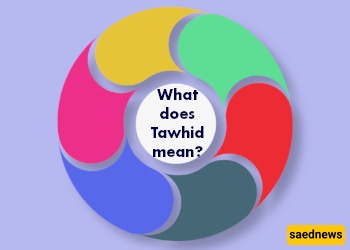
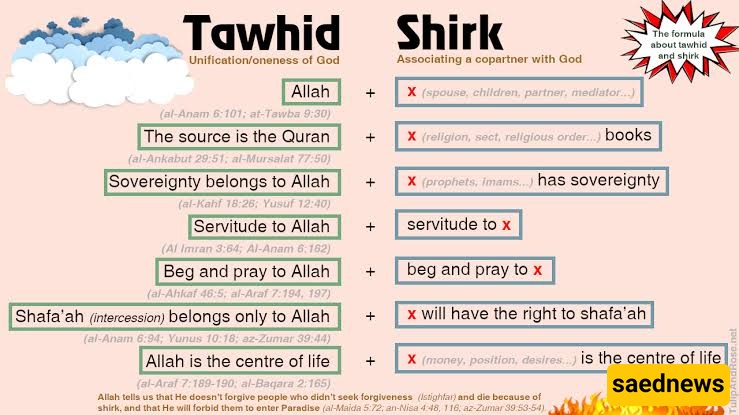
Accoridng to Saednews, Tawhid is the belief in the absolute oneness and uniqueness of God and the rejection of any partner or equal to Him. It is one of the most important concepts in Islamic belief and teachings. From the perspective of faith, Tawhid means believing that God is one; from the perspective of practice, it means dedicating worship exclusively to God.
As the central teaching of Islam and other monotheistic religions, Tawhid has had a profound influence on Islamic culture, thought, and religious sciences. Extensive discussions about it can be found in theology, Quranic interpretation, and Islamic traditions.
Tawhid is the fundamental principle of Islamic belief. It means recognizing God as unique, incomparable, and without any partner in the creation and governance of the universe.
The message of Prophet Muhammad at the beginning of his call to Islam emphasized belief in the oneness of God and the rejection of polytheism. Tawhid is also strongly emphasized in the Quran and the traditions of the Prophet and his family.
In its practical sense, true belief in Tawhid means maintaining faith in God under all circumstances—whether life is easy or difficult. It means recognizing God as the ultimate owner and authority and living with the understanding that changing circumstances should not lead a person away from the right path.
The word Tawhid comes from the Arabic root wahada, meaning to regard as one or to affirm as unique. Tawhid therefore refers to recognizing and affirming the oneness of God.
Two words commonly associated with God's oneness are Wahid and Ahad, both meaning “one” or “unique.” Some scholars have attempted to distinguish between them, but in Arabic dictionaries, Quranic verses, and Islamic traditions, both words generally indicate uniqueness and absolute oneness.
Tawhid can be understood through three closely related meanings:
God is incomparable and without equal.
God has no partner or associate.
God is not composed of parts and is absolutely simple and indivisible.
The second and third meanings are considered consequences of the first: because God is absolutely unique and incomparable, He can have neither a partner nor a composition resembling created beings.
The word Ilah, often translated as “God” or “deity,” has been explained in several ways, including:
The one who is worshipped.
The hidden or unseen reality.
The refuge and protector.
The being whose greatness amazes and overwhelms creation.
These meanings reflect different aspects of the divine nature and emphasize God's absolute perfection and uniqueness.
Surah Al-Ikhlas, often referred to as a concise description of God in Islamic teaching, focuses entirely on Tawhid.
“Say: He is Allah, the One.”
This means that God is absolutely unique and one.
“Allah, the Eternal Refuge.”
God is perfect and independent of all creation, while all creation depends upon Him.
“He neither begets nor is born.”
Unlike created beings, God does not come into existence through birth, nor does He produce offspring in the human or biological sense.
“And there is none comparable to Him.”
Nothing in existence is equal or comparable to God.
Together, these verses describe God as unique, independent, perfect, eternal, and unlike anything in creation.
While Wahid and Ahad describe God's attribute of being one, Tawhid refers primarily to the human act of recognizing and affirming that oneness.
In other words, Tawhid means that human beings acknowledge:
God is one, unique, and without equal.
The Quran expresses this principle by declaring that humanity's God is one God and that there is no deity besides Him, the Most Compassionate and Most Merciful.
Therefore, Tawhid is not merely an abstract theological concept. It is a conscious belief that shapes how a person understands God, worship, life, and the universe.
The uniqueness of God has important implications.
First, God has no partner. If there were another being equal to God, then God would no longer be absolutely unique.
Second, God is unlike created beings. Created things have limitations, dependencies, physical characteristics, and components. God, however, is not comparable to His creation.
Third, God's uniqueness means that human qualities and limitations should not simply be attributed to Him. Islamic traditions emphasize that God must not be understood as a being similar to His creatures.
One tradition describes Tawhid as distinguishing God from His creation. Another states that a person who compares God to created beings has not truly understood Him.
Islamic teachings describe Tawhid as the foundation of religion. It requires believers to recognize that the characteristics, limitations, and weaknesses found in human beings and other created things cannot be applied to God.
True Tawhid therefore involves:
Believing that God is one.
Recognizing that He has no equal or partner.
Understanding that He is unlike His creation.
Worshipping Him alone.
Remaining faithful to Him in both prosperity and hardship.
Ultimately, Tawhid is the foundation of Islamic faith. It teaches that God is absolutely one, unique, perfect, independent, and incomparable—and that all worship and ultimate devotion belong to Him alone.