SAEDNEWS: Discover when Hafez fortune-telling became popular and why the Persian poet earned the title “Tongue of the Unseen.”
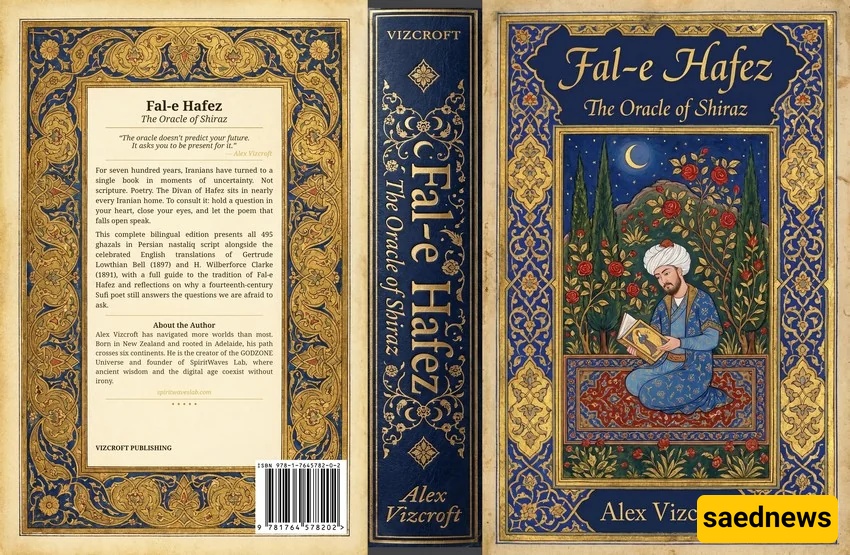
According to Saednews, Fal-e Hafez is one of Iran’s most cherished cultural traditions, combining poetry, hope, and the search for signs that may offer answers to life’s questions. Many Iranians and Persian speakers open the collected poems of Hafez with a specific intention, interpreting the poem they encounter in relation to their personal circumstances. Known as Fal-e Hafez, this custom blends literature, folk culture, and long-standing popular beliefs.
But what is the story behind Fal-e Hafez? When did this tradition begin, and who was the first person to seek an answer through Hafez’s poetry? This article explores the history of Fal-e Hafez, well-known accounts of its earliest practice, and its enduring place in Iranian culture.
There is no definitive, documented answer to this question. Historical sources do not identify a specific individual as the first person to consult Hafez’s poetry for guidance. However, several well-known stories describe the origins of this tradition. One of the most famous concerns the poet’s burial in Shiraz.
Hafez lived during the 14th century. Following his death, disagreements reportedly arose over where and how he should be buried. According to accounts repeated in some historical sources and writings about his life, a group of opponents objected to his burial, while his admirers defended his spiritual significance and literary achievements.
Legend has it that, to resolve the dispute, people decided to seek guidance by opening Hafez’s collection of poems at random.
The poem they encountered reportedly included these verses:
“Do not reproach me, drunk with love, for my dark record; Who knows what fate has written for each soul?”
The poem was also said to contain the following lines:
“Do not withhold your steps from Hafez’s funeral; Though drowned in sin, he is journeying toward paradise.”
These verses were interpreted as a favorable sign supporting the poet’s burial. According to the popular account, the disagreement was resolved in this way.
To understand the actual history of Fal-e Hafez, it is important to distinguish between the poet’s lifetime and the later spread of divination through his poetry. Hafez lived in the 14th century, but the practice of seeking guidance through his verses developed gradually after his death.
One of the earliest sources reportedly mentioning this practice is Diyar Bakriyya, written approximately 75 years after Hafez’s death. While describing Jahan Shah Mirza’s military campaign to Shiraz, the author refers to an instance of consulting Hafez’s poetry for an omen.
This account suggests that Fal-e Hafez has a history spanning several centuries and was already known among the public well after the poet’s death.
The following three historical stories, preserved in various accounts, illustrate how deeply this practice became embedded in Iranian cultural memory.
According to a popular story, after entering Shiraz, Shah Ismail I was encouraged by one of his companions to consult Hafez’s poetry regarding the fate of the poet’s tomb.
The story claims that a religiously conservative individual wanted to persuade the shah to destroy the tomb. One of the shah’s close associates, however, suggested that they first open Hafez’s collection and interpret the poem they found.
Shah Ismail accepted the suggestion. Upon opening the book, they reportedly encountered the following verse:
“At dawn, Gemini placed its belt before me, Declaring: I am the king’s servant, and I swear it.”
In the traditional account, the verse was interpreted as a sign that persuaded the shah not to destroy Hafez’s tomb.
Although the details of this story cannot be considered historically established without supporting documentary evidence, such accounts illustrate how Hafez’s poetry came to occupy a special place in Iranian beliefs and customs, extending far beyond its literary significance.

Another historical tale concerns Ahmad Shah Durrani, the Afghan ruler.
According to this account, when Ahmad Shah was preparing for military campaigns in Iraq, Azerbaijan, and Fars, a group of people from Khorasan encouraged him to consult Hafez’s poetry. By opening the collection, he hoped to discover a sign concerning the outcome of his campaign.
The poem he reportedly encountered contained this famous couplet:
“You have conquered Iraq and Fars through Hafez’s beautiful verse; Come now, for Baghdad’s turn has arrived, and the time for Tabriz is at hand.”
The poem’s meaning was associated with Ahmad Shah’s military ambitions, and his commanders interpreted it as an encouraging sign of potential victory.
According to the continuation of the story, they remained optimistic about the campaign, resumed their movements, and headed toward Herat.
Another story links the tradition to Nader Shah Afshar.
According to this account, while pursuing Afghan forces, Nader Shah entered Shiraz and visited Hafez’s tomb. Seeking insight into the outcome of the ongoing conflict, he consulted the poet’s collection.
The same couplet referring to Iraq, Fars, Baghdad, and Tabriz was reportedly revealed to him. Given the circumstances of the time, the poem was interpreted as a favorable sign encouraging further military conquests.
As with the other stories, this account should be understood as a traditional narrative rather than an independently verified historical event.
One of Hafez’s most famous titles is Lesan al-Ghayb, commonly translated as “The Tongue of the Unseen.”
In popular Iranian culture, this title is associated not only with the famous story surrounding his burial but also with the belief that his poetry can offer answers to hidden questions or provide signs concerning the future.
The popularity of this title is best understood within the context of Hafez’s literary and spiritual influence and the cultural beliefs surrounding his work.
His poems are rich in metaphor, allusion, mystical imagery, and layered meanings. This ambiguity allows readers to interpret the same verses in different ways, often connecting them to their own experiences, hopes, and concerns.
Yes. The practice of seeking omens and guidance through written texts predates Fal-e Hafez by many centuries.
Throughout history, people have turned to different forms of divination to seek answers to difficult questions and ease their uncertainty about the future. Consulting books for guidance has appeared in numerous cultures and is not unique to Iran.
Divination in other cultures: In antiquity and the Middle Ages, literary works such as Homer’s Iliad and Virgil’s Aeneid were sometimes used for divination. In one common method, a person would close their eyes, select a passage at random, and interpret it in relation to a particular question or intention.
Consulting the works of Persian poets: Iranian culture also has a long tradition of seeking guidance through poetry. Before Fal-e Hafez achieved its widespread popularity, the works of poets such as Ferdowsi, Kamal al-Din Isfahani, Saadi, and Rumi could also serve as sources of personal reflection and interpretation.
Fal-e Hafez remains a beloved Iranian tradition, practiced during family gatherings, celebrations, and special occasions such as Yalda Night, the winter solstice celebration.
For many people, opening Hafez’s Divan is more than an attempt to predict the future. It is an opportunity to reflect on personal concerns, find comfort in poetry, and connect with centuries of Persian literary heritage.
Although the historical origins of the practice cannot be traced to one definitively identified person or moment, the surviving accounts suggest that consulting Hafez’s poetry became established several centuries ago.
Ultimately, the enduring appeal of Fal-e Hafez lies in the remarkable ability of his poetry to speak to different generations, offering readers a space for hope, contemplation, and personal meaning.