SAEDNEWS: Red Fort (or Lal Qila) is the largest tourist attraction in Delhi, the capital of India. “Lal” means “red” in Hindi.
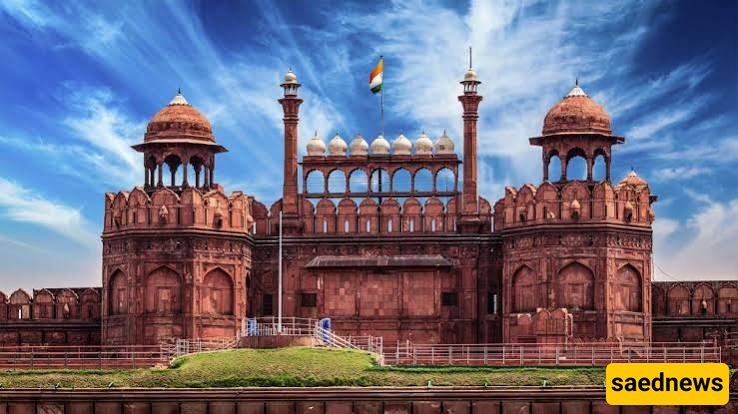
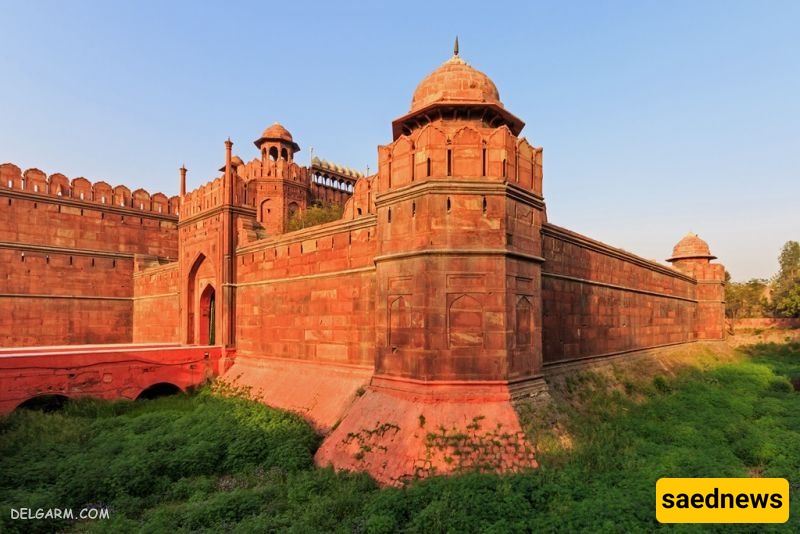
According to Saednews, The Red Fort, also known as Lal Qila, is one of the largest tourist attractions in Delhi, the capital of India. In Hindi, “Lal” means red, and the fort was given this name because of the extensive use of red sandstone in its construction.
The Red Fort was commissioned by Shah Jahan, the fifth Mughal emperor, when he moved his capital from Agra to Delhi. Construction of the fort took nine years. Located beside the Yamuna River, the Red Fort was built in the shape of an irregular octagon surrounded by massive red sandstone defensive walls.
The Red Fort complex consists of numerous impressive structures, including the Lahore Gate, named after the city of Lahore in present-day Pakistan, and the Moti Masjid, or Pearl Mosque, which was built from white marble. Islamic architectural influences can be seen throughout the complex. Persian inscriptions can also be found in various parts of the fort, although unfortunately, many of these inscriptions have been damaged or destroyed.
Every year on August 15, India’s Independence Day, the Prime Minister of India raises the national flag above the Red Fort and delivers a speech from the historic site.
The Red Fort covers an area of approximately 254 hectares, while its defensive walls extend for about 2.4 kilometers. The walls are approximately 18 meters high on the side facing the river and 33 meters high on the side facing the city. These walls played an important role in protecting the complex. In 2007, the Red Fort was inscribed on the UNESCO World Heritage List as a remarkable example of architecture reflecting Hindu, Persian, Islamic, and Timurid traditions. It also holds an important place in the political, social, and historical life of Delhi.
The Red Fort of Delhi should not be confused with another famous Red Fort located in Agra, near Delhi.
The Lahore Gate is the main entrance to the Red Fort. It takes its name from the historic city of Lahore, now located in Pakistan.
The Delhi Gate is another entrance to the Red Fort that historically provided access toward Old Delhi.
The Naqqar Khana, also known as the Naubat Khana, is located above the Lahore Gate and opposite Chatta Chowk. Musicians played drums and other instruments here five times a day, as well as when the emperor, princes, or members of the royal family entered the fort.
The building is more than 30 meters long and approximately 20 meters wide. With the exception of members of the royal family, visitors were required to dismount from their horses here before entering the main area of the fort.
Hayat Baksh Bagh, meaning “Life-Bestowing Garden,” was a beautiful garden within the Red Fort. It was once divided by two attractive water channels and numerous fountains. Today, unfortunately, the channels have dried up, leaving mainly vegetation in the area.
The Khas Mahal was the emperor’s private residence. It consisted of sleeping chambers, prayer areas, a veranda, and the Musamman Burj.
The Musamman Burj is a tower associated with the Khas Mahal and facing outside the fort. The emperor traditionally appeared here early each morning before the public.
The Elephant Gate was another entrance to the Red Fort. Two magnificent black elephant statues once stood in front of it. They were later destroyed in 1856 and, following restoration, are now displayed in the Mumtaz Mahal Museum.
Chatta Chowk, or the covered bazaar, was a marketplace located between the main entrance and the inner part of the Red Fort. Today, it is a popular area where vendors sell souvenirs to visitors.
Nahr-i-Behisht, meaning “Stream of Paradise,” was part of the emperor’s private residential area. The emperor could sit on its veranda and look toward the Yamuna River. Water channels branching from the Yamuna once flowed through the palace complex.
The Diwan-i-Am, or Hall of Public Audience, is a large independent courtyard paved with white marble. The emperor would appear on a raised platform along the eastern wall and meet members of the public.
The Qursi, or imperial throne, stands opposite the inner wall of the Diwan-i-Am. It is a large and impressive platform measuring more than two meters by one meter and approximately three meters high from the floor of the audience hall.
The throne was made of marble and decorated with delicate carvings and precious stones. Its jewels were removed in 1857. From this elevated position, the emperor listened to the requests and discussions of ministers and visitors.
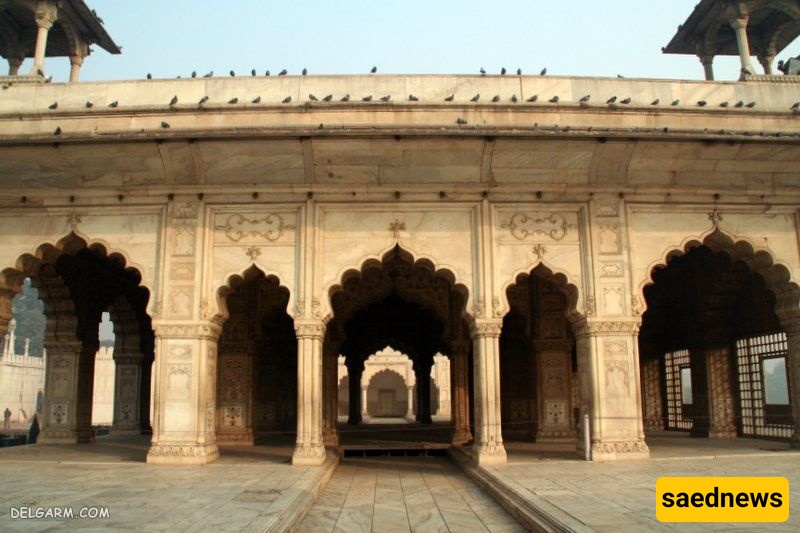
Lal Pardah, meaning “Red Curtain,” is a gateway on the left side of the Diwan-i-Am. A red curtain once hung there, and only the emperor and his close associates were permitted to pass beyond it. Having access through this curtain was considered a significant privilege.
The Diwan-i-Khas, or Hall of Private Audience, was where the emperor held private meetings and government sessions. The structure was built entirely from white marble. Its marble columns feature beautiful floral decorations highlighted with gold, while the original wooden ceiling was once covered with gilded silver.
The Scale of Justice is a delicate, jewel-decorated representation of the moon, stars, and scales carved into the marble between the Tasbih Khana and the royal sleeping quarters. The emperor commissioned this design to symbolize his commitment to balance, equality, and justice.
Sawan and Bhadon are two water pavilions named after months associated with the monsoon season. Water reservoirs behind the walls supplied these symmetrical structures, from which water once flowed through the surrounding channels.
Zafar Mahal is a red sandstone structure located between the Sawan and Bhadon pavilions, in the middle of a water tank. It was built by Bahadur Shah Zafar, the last Mughal emperor. A wooden bridge once stood to its east, although no trace of it remains today.
The Hammam was the royal bathhouse of the Red Fort. It is a separate structure featuring various internal channels and pools designed to provide both hot and cold water.
The Zenana, or women’s quarters, occupies the southernmost section of the Red Fort and served as the residence of the emperor’s female family members.
It includes the Mumtaz Mahal, which is now a museum, and the larger and beautifully decorated Rang Mahal, meaning “Palace of Colors.” The Rang Mahal served as the residence of the emperor’s principal wife. It features golden decorations, a painted ceiling, and a marble pool supplied with water from the Nahr-i-Behisht.
The Daawat Khana is the smallest section of the Red Fort and is located at its northern end. It was originally used as a residence for a prince and was later converted into a tea house by the British.
The Moti Masjid, or Pearl Mosque, is constructed from white marble. It was built in 1659 by Aurangzeb, the successor of Shah Jahan, as a private mosque and was later incorporated into the Red Fort complex.
The Red Fort contains two museums. One displays objects, textiles, books, and historical and artistic manuscripts, many of which are associated with the Mughal period in India and Iran. The other focuses primarily on historical weapons dating from the Mughal era through the period of British occupation.