SAEDNEWS: For many people, viewing ancient artifacts can indicate the historical depth and antiquity of a land. Iran, as one of the rich countries with a long and turbulent history, possesses a wide range of historical and archaeological monuments such as Taq Bostan.
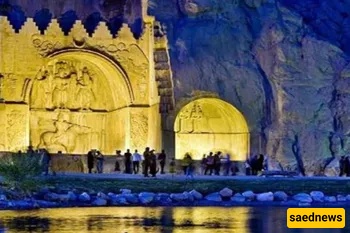
According to Saednews, Taq-e Bostan is a historical monument carved into the mountains of Kermanshah during the Sasanian era. This remarkable site offers visitors a vivid glimpse into history at a single glance, making it a major attraction for travelers heading to Kermanshah or those discovering it for the first time.
If you plan to visit this region, it is essential to learn about this historical masterpiece and the reasons behind its creation.
Every historical monument has its own story, created in a specific era by the order of a king or ruler in a particular part of Iran. Taq-e Bostan—known in Kurdish as “Taq wa San,” derived from “Taq” (arch), “wa” (of), and “San” (stone), meaning “stone arch” or “arch of stone”—was built during the Sasanian Empire in Iran.
This ancient stone artwork was created in the 3rd century CE. Initially, the Sasanian kings considered areas around Persepolis for carving such reliefs, but eventually chose the lush and strategic Silk Road route near Kermanshah to demonstrate royal power and prestige.
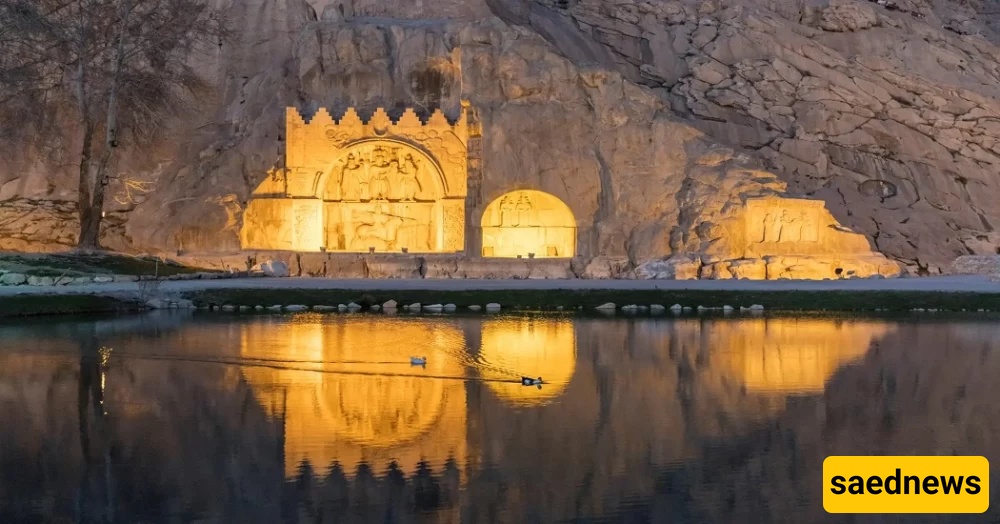
The finely carved stone reliefs at Taq-e Bostan reflect its high artistic and historical value. Scenes such as the coronation of Ardashir II, deer hunting, wild boar hunting, and armored horseback riders can all be observed in detail. There are also additional carvings, including equestrian figures and inscriptions attributed to different historical periods.
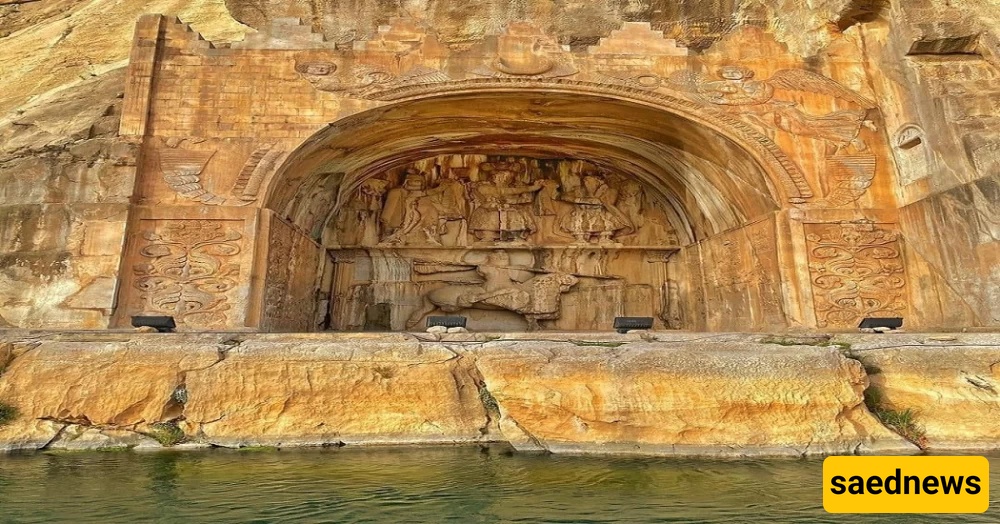
The depiction of Khosrow riding Shabdiz, accompanied by female musicians, is particularly detailed. The clothing shown in the reliefs features intricate patterns, golden threads, geometric diamond designs, and richly decorated garments.
In the boar hunting scene, the king’s attire is decorated with mythical motifs such as the Simurgh. The royal robes, thrones, attendants, and elephant riders are also carved with floral and bird patterns, emphasizing the grandeur of the Sasanian court.
This historical complex consists of two main arches: a large and a small one.
In the smaller arch, carvings of kings such as Shapur II and Shapur III can be seen. Inscriptions written in Pahlavi script also narrate historical events of that era.
In the larger arch, the coronation of Khosrow Parviz is depicted. Additional carvings include winged angels, hunting scenes of boars, birds and fish in marshlands, elephants, horses, boats, and the symbolic Tree of Life.
Like many Iranian historical monuments, Taq-e Bostan has experienced ups and downs throughout history.
Some damage is human-made. During the Qajar period, officials carved their own inscriptions beneath the arch. One example is the image of Mohammad Ali Dowlatshah, son of Fath-Ali Shah Qajar. Historians generally do not attribute artistic or historical value to these later additions.
Environmental factors such as weather changes and ground movement have also caused damage, including cracks and algae growth, affecting some of the original carvings. These issues have made restoration a priority for archaeologists.
After visiting Taq-e Bostan, you can explore the surrounding area and also visit the Stone Museum nearby. The museum displays finely carved stone artifacts such as a bust attributed to Khosrow Parviz, representations of Ahura Mazda, and other Sasanian and post-Sasanian stone carvings.
There are several ways to travel to Kermanshah. Air travel is one of the fastest options, and flights can take you there quickly and easily.
From the city center, you need to travel about 9 kilometers northwest to reach the site. Airport taxis and city taxis are available to take you directly there.
The site is open daily from 9:00 AM to 8:30 PM, except on certain religious holidays such as the 9th and 10th of Muharram, the 28th of Safar, the 21st of Ramadan, the 25th of Shawwal, and the 14th of Khordad (June 4), when it is closed.
Entrance fees can be confirmed on-site.
By staying in Kermanshah, you can also visit several nearby attractions:
Imamzadeh Ebrahim is only a short distance away
Bam-e Kermanshah (Kermanshah Roof) is about 1.5 km away
Kuhestan Park is 3.9 km away
Zagros Paleolithic Museum is 10.2 km away
Anthropology Museum is 13.9 km away
Tekyeh Moaven al-Molk is 14.6 km away
With proper planning, you can visit multiple attractions and enjoy a memorable journey in Kermanshah.