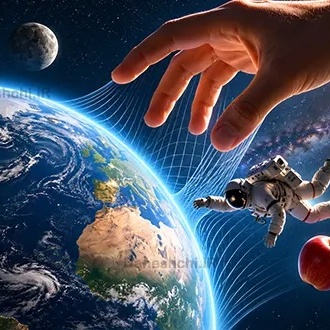
SAEDNEWS: Gravity not only keeps us on the surface of our planet but also influences every aspect of life, from bone development to weather patterns and planetary motion. This article explores this fundamental force in depth and examines its applications in science and technology.
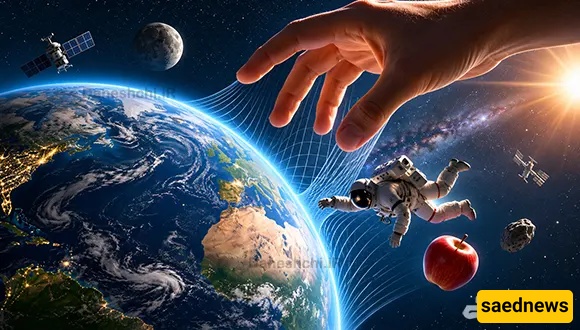
According to Saednews, Gravity is one of the fundamental forces of nature, profoundly influencing our daily lives. It keeps us anchored to Earth and plays a crucial role in the movement of planets, the rotation of stars, and even the structure of galaxies.
Gravity is the force of attraction between objects with mass. Its strength depends on the masses of the objects and the distance between them. Although gravity has been studied since the time of Isaac Newton, our understanding of it has evolved significantly with scientific advances, particularly through Albert Einstein’s theory of general relativity.
According to general relativity, gravity is not simply a force pulling objects together. It can also be understood as the curvature of spacetime caused by mass and energy.
Earth's mass produces gravitational attraction, keeping humans, trees, water, and other objects on its surface. Without gravity, everyday life as we know it would not be possible.
Newton's law of universal gravitation is expressed by the following equation:
\[ F = \frac{Gm1m2}{r^2} \]
Where:
\(F\) is the gravitational force.
\(G\) is the universal gravitational constant.
\(m1\) and \(m2\) are the masses of the two objects.
\(r\) is the distance between their centers of mass.
This equation shows that more massive objects exert a stronger gravitational attraction, while the force decreases as the distance between them increases.

Gravity has many effects on the human body. It determines our weight and allows us to walk and move around on Earth's surface. It also influences biological processes. For example, gravity affects the development and maintenance of bones and muscles, particularly as the body adapts to different gravitational environments.
Gravity plays an essential role in Earth's water cycle. It pulls rainwater toward the ground, helps water flow into rivers and lakes, and influences the movement of water through the environment.
Without gravity, water would not remain bound to Earth's surface in the way it does today, making life as we know it impossible.
Earth's gravity helps keep the Moon in orbit around our planet. The gravitational interactions between Earth, the Moon, and the Sun also contribute to ocean tides.
Gravity governs the movement of planets throughout the solar system, maintaining their orbital paths and influencing the overall structure of planetary systems.
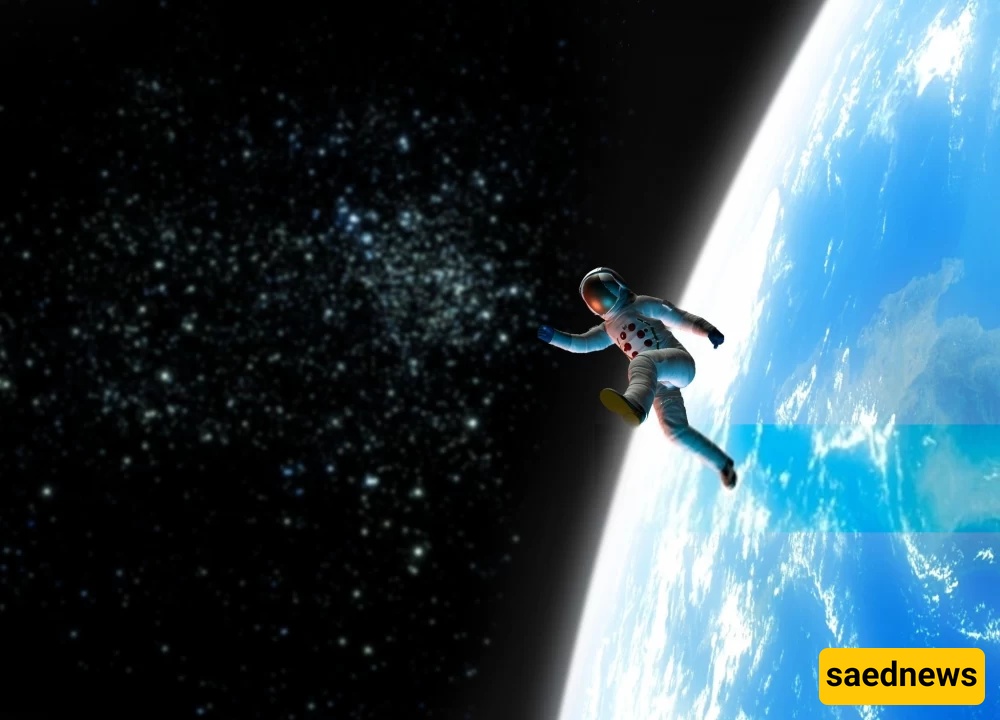
Gravity is a major consideration in space exploration. To escape Earth's gravitational pull without further propulsion, an object must reach Earth's escape velocity, approximately 11.2 kilometers per second near the surface, ignoring atmospheric resistance and other complications.
Achieving the necessary speed and trajectory allows spacecraft to travel into orbit and, with additional propulsion and carefully planned maneuvers, reach the Moon and other planets.
Gravity is essential to research in physics and astronomy. By observing the movements of planets, stars, and galaxies, scientists can investigate gravitational interactions and learn more about the structure and evolution of the universe.
These studies help answer fundamental questions about how the universe works and how celestial objects form and evolve.
An understanding of gravity has contributed to the development of transportation systems, aviation, and space technology. Engineers must account for gravitational forces when designing aircraft, spacecraft, satellites, and other systems that operate under Earth's gravitational influence.
This knowledge helps improve the safety, efficiency, and reliability of modern transportation.
Scientists can study the effects of gravity under different conditions using specialized experiments and simulations. In laboratories and space research facilities, researchers investigate how materials and biological systems behave in microgravity and other gravitational environments.
These studies contribute to advances in materials science, medicine, and space technology.
Gravity is a fundamental feature of nature that makes life on Earth possible and governs the interactions between objects throughout the universe. From its influence on the human body and Earth's water cycle to the movement of planets and the challenges of space travel, gravity shapes many aspects of our existence.
A deeper understanding of gravity allows scientists to explore fundamental questions about the universe and develop new technologies. Continued research into this remarkable phenomenon remains essential to expanding our knowledge of the natural world.
Earth's gravity does not have a visible shape. It is commonly illustrated using gravitational field lines that point toward Earth's center, representing the direction in which gravity pulls objects. Near Earth's surface, these lines are approximately parallel because the gravitational field changes relatively little over short distances. Around Earth as a whole, however, the field points inward from all directions toward its center.