SAEDNEWS: The spokesman of Iran’s Atomic Energy Organization (AEOI) says that military attacks, acts of sabotage, and assassinations cannot destroy Iran’s nuclear knowledge or industry.
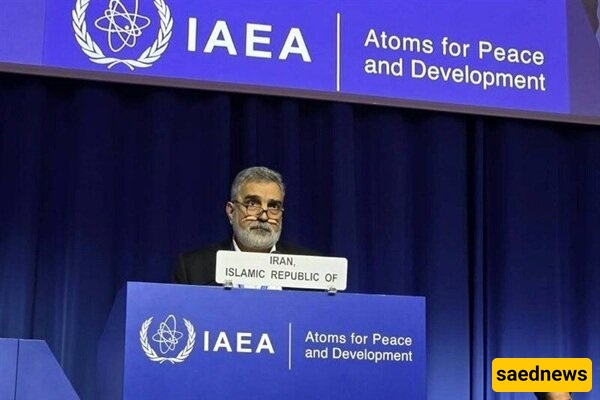
According to Saednews, In an address to the International Atomic Energy Agency (IAEA) General Conference in Vienna on Tuesday, AEOI spokesman Behrouz Kamalvandi said that placing nuclear facilities in secure and suitable locations should not be interpreted as an attempt to conceal them.
Kamalvandi said Iran had consistently faced threats of war and security risks, making it natural for the country to protect vital facilities from potential military attacks.
He noted that although Iran’s sensitive nuclear facilities are located underground, they have remained subject to IAEA monitoring and inspections.
Kamalvandi also stressed that military attacks, sabotage, and assassinations cannot eliminate Iran’s nuclear expertise or industry.
According to Press TV, his remarks followed two rounds of US-Israeli military action against Iran, which reportedly included attacks on safeguarded Iranian nuclear facilities.
He said Iran had developed its nuclear capabilities through decades of experience dealing with unreliable international partners and external pressure.
Kamalvandi said Iran’s nuclear science and technology had an 80-year history, while the Atomic Energy Organization of Iran (AEOI) had existed for 52 years. He added that Iran was among the early members of the Treaty on the Non-Proliferation of Nuclear Weapons (NPT) and had consistently maintained that its nuclear activities were peaceful.
He recalled that Iran had faced pressure and sanctions over its nuclear program for more than 25 years while continuing negotiations and honoring its international commitments, including those under the Joint Comprehensive Plan of Action (JCPOA).
According to Kamalvandi, the United States was the only JCPOA participant to withdraw from the agreement. Iran nevertheless continued implementing its commitments unilaterally for approximately 18 months following the US withdrawal.
He said 15 consecutive reports issued by the IAEA director general at the time had confirmed Iran’s implementation of its JCPOA commitments. Despite this, he said, Iran was subjected to additional unilateral sanctions, including measures described by their proponents as “crippling.”
Kamalvandi said negotiations resumed in 2022 following a change in the US administration, with a return to the JCPOA appearing within reach before Washington declined to finalize an agreement. Talks later resumed under the current US administration, but Israel launched military action against Iran in June 2025 while the parties were preparing to review technical details at the IAEA.
Regarding the IAEA, Kamalvandi questioned whether the agency’s repeated inspections of Iranian nuclear facilities had ever established that Iran had diverted nuclear material.
He also accused the IAEA director general of politicized conduct and applying double standards, arguing that recent statements and reports had provided grounds for Iran’s adversaries to justify military action.
Kamalvandi urged the IAEA to condemn attacks on Iran’s nuclear facilities and engage with Tehran. He also called on the agency to fulfill its responsibilities under its statutory mandate and treat Iran in the same manner as other member states.
He reiterated that Iran’s nuclear program was peaceful and transparent, while its sensitive facilities had been placed in secure locations, including underground sites, because of the country’s continued exposure to military and security threats. Such protective measures, he said, should not be regarded as concealment.
Kamalvandi added that Iran’s decision to develop indigenous nuclear capabilities was rooted in its experience with European countries that, according to him, had failed to fully honor nuclear-related contractual commitments both before and after the Islamic Revolution.