SAEDNEWS: China’s Chang’e-6 samples reveal a surprising geological difference between the Moon’s near and far sides, offering new insights into its history and evolution.
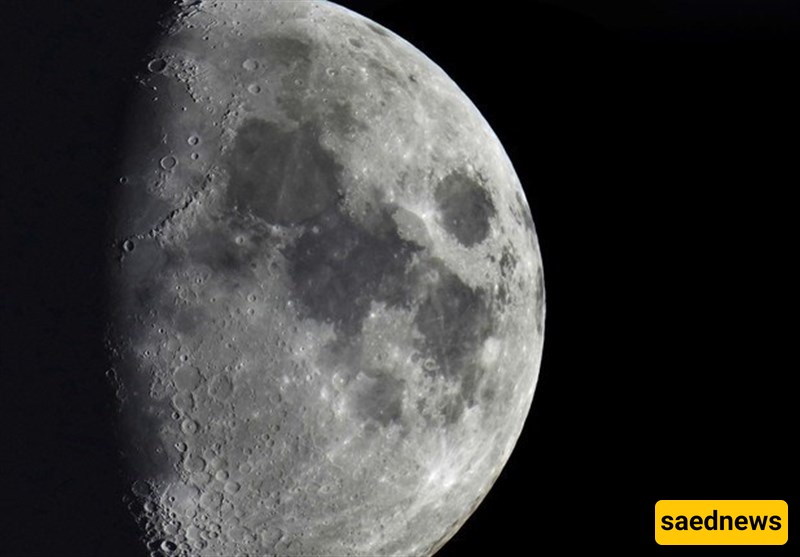
According to Saednews, A new scientific study suggests that Earth's magnetic field has influenced how the solar wind interacts with the Moon, leaving lasting differences between its near side and far side. By analyzing lunar soil returned by China's Chang'e 6 mission, researchers found that the two hemispheres have experienced solar wind exposure in different ways over billions of years.
The Sun continuously releases a stream of charged particles known as the solar wind. Since the Moon has no thick atmosphere or global magnetic field, these particles strike its surface directly.
Over billions of years, the Moon's dusty surface, known as the regolith, has preserved these particles. Scientists study trapped noble gases such as helium, neon, argon, krypton, and xenon because they rarely react with other elements, making them reliable indicators of past solar wind activity.
Until now, researchers could only examine samples collected from the Moon's near side. That changed when China's Chang'e 6 mission returned 1.935 grams of soil from the South Pole–Aitken Basin on the lunar far side, allowing the first direct comparison between the two hemispheres.
Researchers from the Institute of Geology and Geophysics of the Chinese Academy of Sciences, together with collaborators, analyzed the noble gases trapped inside the Chang'e 6 samples.
One of the most significant findings involved neon isotopes. The far-side samples contained a lower ratio of neon-20 to neon-22 than previously studied near-side samples. This closely matched theoretical predictions for material exposed to stronger solar wind fractionation, indicating that the far side experienced a more energetic solar wind environment.
The team also examined krypton and xenon trapped in the lunar soil.
Heating experiments revealed that solar wind xenon in the Chang'e 6 samples was mainly released at high temperatures, indicating that the particles had penetrated deeper into the lunar surface. In contrast, samples from the Chang'e 5 mission on the near side released xenon at both low and high temperatures.
This difference suggests that solar wind particles reached greater depths on the Moon's far side, implying they arrived with higher speeds and greater energy.
The researchers attribute these differences to Earth's magnetosphere.
As the Moon orbits Earth, it periodically passes through the magnetosheath, a region surrounding Earth's magnetic field where the solar wind slows significantly—from about 400 kilometers per second to roughly 200 kilometers per second.
This slowdown primarily affects the Moon's near side, which faces Earth. Because slower particles carry less energy, they do not penetrate as deeply into the lunar surface.
The far side, however, always faces away from Earth and remains exposed to the full speed of the undisturbed solar wind. As a result, faster particles are able to travel deeper into the lunar soil.
The researchers estimate that about one-quarter of the solar wind exposure recorded at the Chang'e 5 landing site came from this slower flow, while the Chang'e 6 landing site showed no evidence of experiencing the same protective effect.
The study provides the first direct physical evidence that Earth's magnetic field influences the speed of solar wind particles reaching different parts of the Moon.
Scientists also suggest that noble gases preserved in lunar soil could serve as long-term records of interactions between the solar wind and Earth's magnetosphere. Combined with studies of ancient magnetic fields on Earth, these gases may help researchers reconstruct how Earth's magnetic environment has evolved over geological time.
The findings reveal that the relationship between the Sun, Earth, and Moon is more complex than previously believed. They also show that the Moon has preserved a unique record of these ancient interactions, offering scientists a valuable new tool for exploring the long-term history of Earth's magnetic shield.